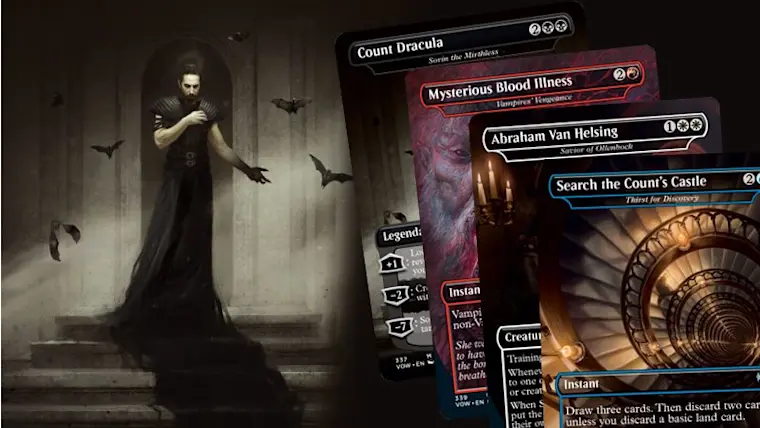
If we ignore Dominaria, which contains a large number of disparate inspirations and has never been especially focused on the horror genre, Magic has only three settings that feature Vampires in a tribal capacity: Zendikar, Innistrad, and Ixalan. (Another one is technically Ulgrotha, the adoptive plane of
The Zendikari Vampires are savage warriors or shamanic mystics who roam the land with their exposed skin covered in war paint and sprouting horns. They're one of Magic's most original creations, sporting the kind of disturbing yet eye-catching aesthetic we can see in the art of cards like


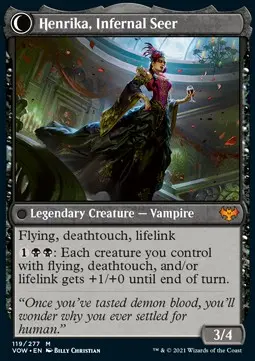
That's where Innistrad comes to the rescue, as a setting that routinely enacts the more traditional vision of the vampire as a wealthy, decadent aristocrat who lives in a luxurious castle and drinks blood from an ornate gold chalice. So when the opportunity presented itself to make a new series of box toppers with a "skin treatment" inspired by Dracula, Innistrad was the natural place for it. After all, its vampires already look like they exist in the late nineteenth-century Europe of Bram Stoker's novel.
Where the Godzilla cards felt more jarring with their depiction of fighter jets and skyscrapers, the cards from the Dracula series elicit less of a cringe. Maybe the stark contrast was part of the point back when Ikoria: Lair of Behemoths first introduced these Universes Beyond-like crossovers. (They aren't actually part of Universes Beyond, since these cards are mere reprints with alternate art and a flavor name superimposed onto the original name.)
But for those of us who prefer softer promo art that doesn't take them out of the experience, the Dracula cards might be more their speed. Also, their artwork is just absolutely gorgeous. Plus, in this case, it's not even cross-promotion, since the references are taken entirely from the 1897 book, which is in the public domain, and not from any of the many adaptations and reinventions it engendered in all kinds of media over its 124 years of cultural relevance.
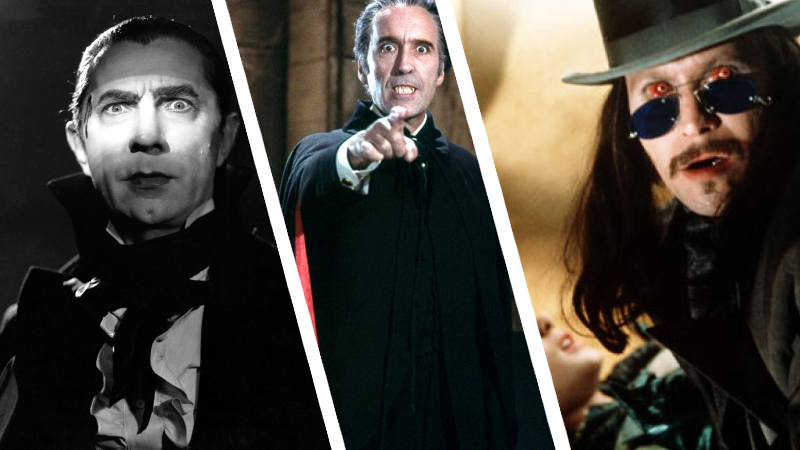
Let's review all eighteen Dracula cards—seventeen box toppers acquired by purchasing a booster box or Collector Boosters, plus the Buy-a-Box promo, which is the Castle Dracula reskin of
Count Dracula
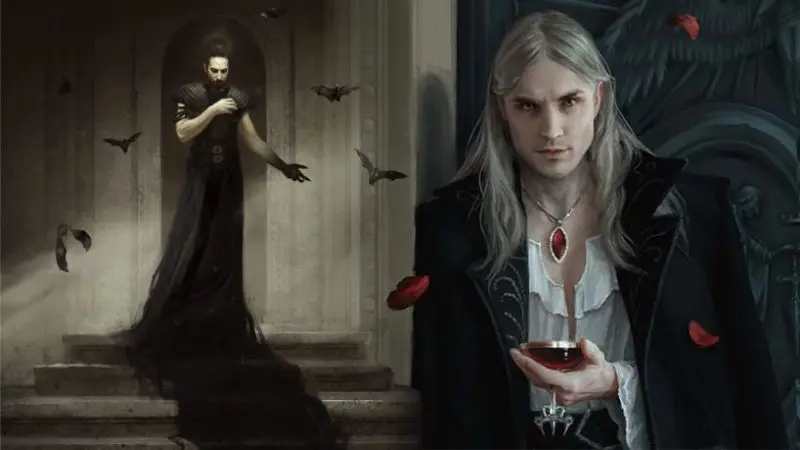
This is the first of four cards in the series that portray the novel's titular character. Dracula is commonly thought to be inspired by the historical figure of Vlad III of Wallachia, a bloodthirsty fifteenth-century prince who was known in his time as Vlad Țepeș ("Vlad the Impaler") or Vlad Drăculea ("Vlad, Son of the Dragon," a title inherit from his father Vlad II). Bram Stoker's character shares most of his back story with the real Vlad, but he's reimagined as an immortal vampire who lives in a decrepit old castle in Transylvania, before moving to England following the events of the story.
Everything about Dracula has become so iconic that it's hard not to immediately think of him when the very concept of a vampire is evoked. Yet, at the time of the book's publication, Dracula embodied a radical disconnect from the vampires of Eastern European folklore, usually described as hideous monsters. In contrast, Dracula was handsome, refined, charismatic, a figure of magnetic allure and sex appeal that would change forever the way vampires were going to be conceived in pop culture from that point on. The card's artwork recaptures this sinister charm, while hinting at an ancestry farther east.


As the primary Vampire in the game, Sorin Markov gets to dress up as Dracula, namely in his latest
Dracula, Blood Immortal
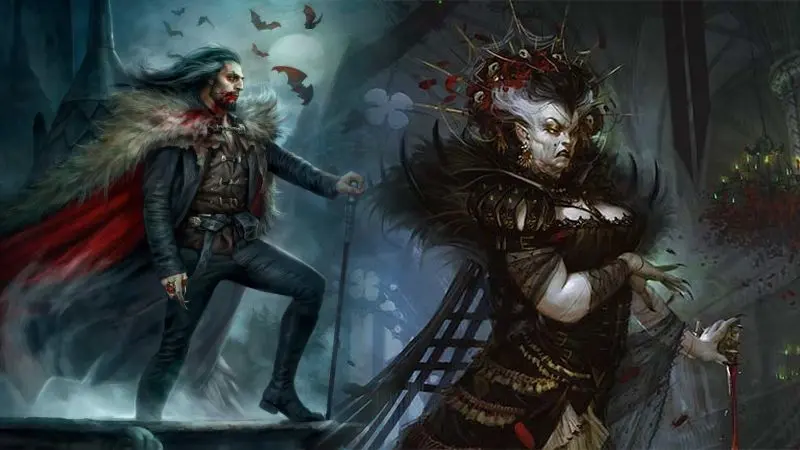
This outdoor Dracula is haunting the Carpathian Mountains where his castle is located, so we're still in the first part of the novel. The fur-lined cape and leather clothes suggest his ancient nobleness (Dracula claims to be a direct descendent of Attila the Hun) as well as his past role as a "voivode"—a warlord who spent most of his days fighting the Turks in the middle of gory battlefields, far from the comfort of palatial halls. Like in the previous card, bats are established as Dracula's signature animal companions, even if the novel sees him turn into a large black wolf as well.


Dracula, Lord of Blood // Dracula, Lord of Bats


We see here Dracula inside his castle, an arresting if decaying architecture. The long flowing cape is the more traditional centerpiece of the character's wardrobe. The epithet reminds us of Dracula's main preoccupation (and apparently his own Blood tokens take the form of red candles rather than petals) while the back face has him as the Lord of the Bats, reinforcing his bond with the little flying mammals.
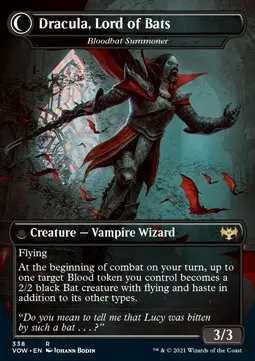
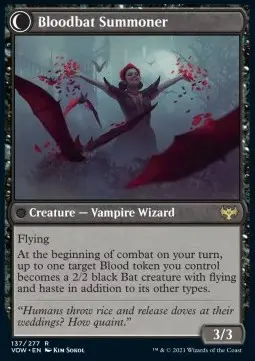
The flavor text is what an incredulous Dr. Seward asks Van Helsing, as reported in the former's diary in chapter fourteen of the novel.
Dracula the Voyager // Casket of Native Earth


The first portion of the novel culminates in Dracula boarding a Russian ship headed to Whitby, a coastal town in Northern England. He carries with him several boxes of earth from his castle's soil, which is key to his survival and rest. Another crucial factor is the presence of the ship's crew and the blood running through their veins. By the time the Demeter reaches her destination, Dracula is alone onboard.
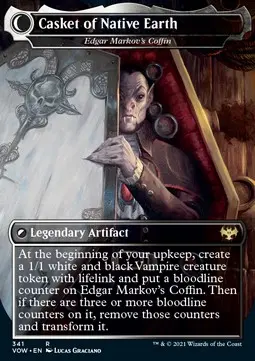
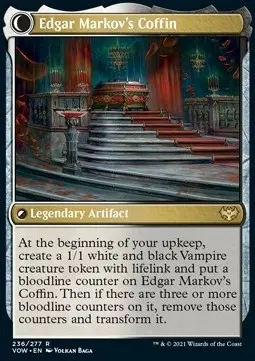
Edgar Markov is the closest Innistrad has to a direct Dracula reference. (Baron Sengir is the more obvious homage, but he's from Ulgrotha.) After all, he's the oldest of his kind, not to mention responsible for the creation of vampirism itself. His
The flavor text is from chapter seven, part of the Demeter's log.
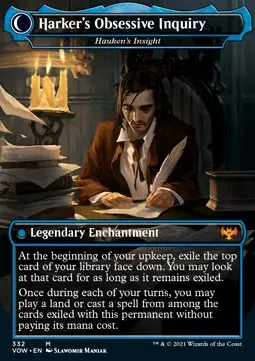
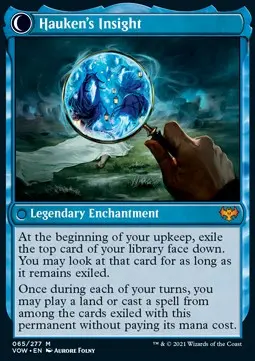
Jonathan Harker // Harker's Obsessive Inquiry


Arguably the male protagonist of Bram Stoker's book (of which the titular character is, of course, the antagonist). He's an inexperienced English solicitor who is sent by his employer to meet Dracula in his castle, in order to assist with the acquisition of various properties the Count is planning to purchase throughout England. The trip doesn't go too well for young Jonathan, who's almost turned into a vampire by Dracula's unruly "brides." When he finally manages to get back to England, he becomes one of the main members of the gang of improvised vampire hunters who join Abraham Van Helsing on his quest to destroy Dracula.
Mina Harker
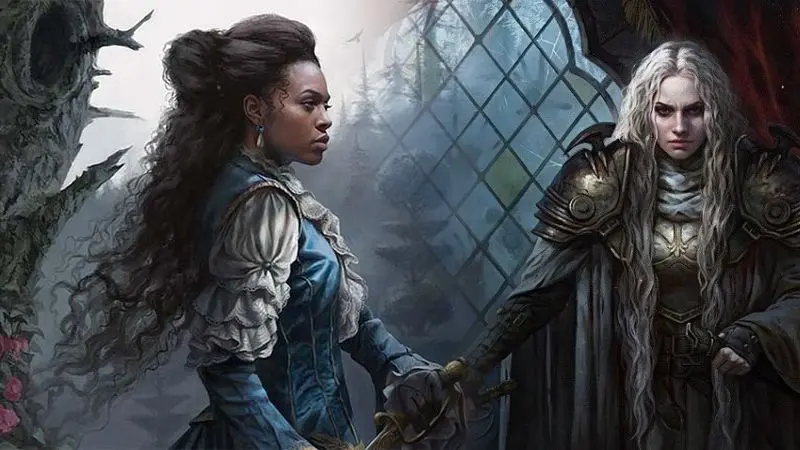
Born Mina Murray, she's the female protagonist of the story—Jonathan's fiancée and, later, wife. She's a young schoolteacher, but the fierce demeanor portrayed on the card's art by Magali Villeneuve is not unfounded, as she travels alone to Budapest to retrieve an ill Jonathan after his Transylvanian misadventure. They marry there before returning to England and enrolling into Van Helsing's vampire-hunting club, in which Mina takes active part until the very end. At some point, Dracula turns his attention on Mina, bites her, and feeds her his own blood, with the intention of making another creature of the night out of her. This leaves Mina with the ability to connect telepathically with the vampire, which the hunters use to track Dracula's movements.


The flavor text is from an extract of Mina's journal that appears near the end of the book, in chapter 26. She's reporting what Van Helsing said in preparation of their final strike against Dracula.
Lucy Westenra // Lucy, Arisen Vampire


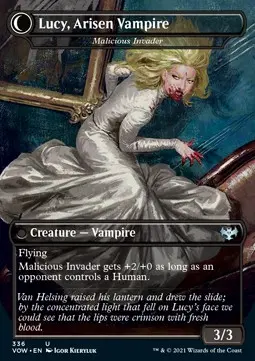
Lucy is Mina's best friend and the first English victim of Dracula. She's a spunky nineteen-year-old socialite from a wealthy family. All three men who would go on to become secondary members of the Van Helsing gang—Dr. John Seward, Lord Arthur Holmwood, and Quincey Morris—ask her hand in marriage during the same day. She accepts Arthur's proposal. But not long after that, Dracula gets to her in wolf form, and Lucy quickly gets sick and dies, only to return to un-life as a vampire who preys on children. Her three suitors, under Van Helsing's guidance, ultimately have to suffer the heartbreak of being forced to stake and behead their beloved.
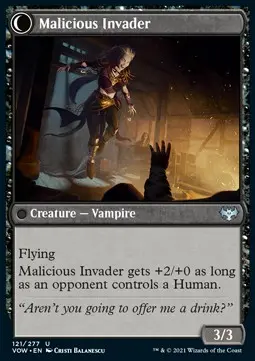
Lucy wasn't much of an
The flavor text on the front is an extract of Mina's journal from chapter eight, referencing the first warning signs of Lucy's fate. The back is from Dr. Seward's diary in chapter sixteen.
Abraham Van Helsing
The most archetypical vampire hunter in literature, Van Helsing is a Dutch professor with a vast knowledge of science, medicine, history, and the occult. Soured by the death of his son and the descent into insanity of his wife, he's called to consult on Lucy's mysterious illness by Dr. Seward, to whom he's a friend and mentor. Van Helsing immediately recognizes that the problem troubling his protégé and his friends is vampiric in nature and leads all the other characters in a crusade against Dracula, chasing him back to Transylvania.


While
Renfield, Delusional Minion
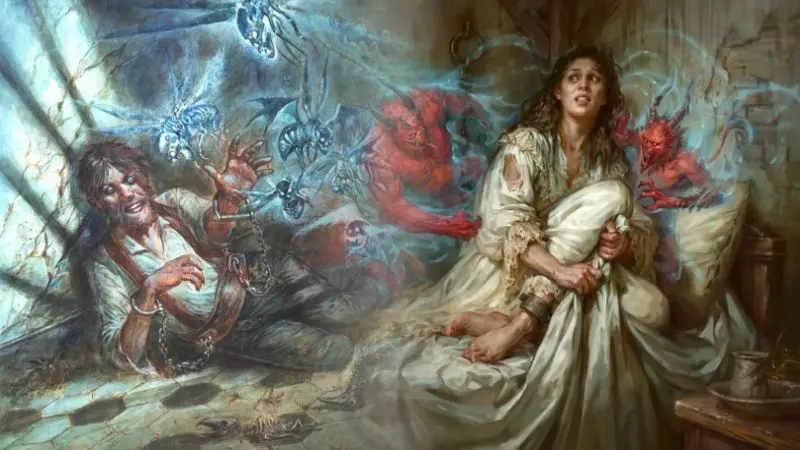
One of the most memorable presences in the book and in many of its adaptations, R.M. Renfield is a mental patient at the asylum where Dr. Seward works. His diagnosis is "zoophagous maniac," as he's prone to eat flies, spiders, and birds, in the delusion of gaining their life force by ingestion. Seward notes Renfield's age as 59 and his temperament as "sanguine" and "morbidly excitable" with "periods of gloom." (Modern psychology has used Renfield as a case study for a mental disorder that got the name of "Renfield Syndrome.")
After falling under the influence of Dracula, Renfield becomes his main henchman, thus allowing the vampire free access to the hospital, which is used as the gang's sanctuary and base of operations. Renfield strongly desires to be turned into a vampire, but instead ends up casually murdered by Dracula for a perceived betrayal. His role in the novel is extremely important, as it allows Stoker to underline the psychological hold of the vampire on his victims and to describe the nature of vampirism in scientific terms.


It's unlikely
The flavor text is, predictably, a transcription of Renfield's delirious ramblings made by Dr. Seward in his diary. It appears in chapter eleven.
Dr. John Seward
Along with English Lord Arthur Holmwood and American frontiersman Quincey Morris, Dr. Seward is part of the trio of Lucy's suitors who form the backbone of the Van Helsing gang. Out of the three, he's the only one to get a card, possibly because he's the one who links the most to other threads: He's Van Helsing's former pupil, Renfield's psychiatrist, as well as the administrator of the insane asylum that functions as headquarters for the group, located in close proximity to Dracula's main English lair of Carfax Abbey.


The flavor text is taken from a letter of Lucy to Mina in chapter five.
Sisters of the Undead
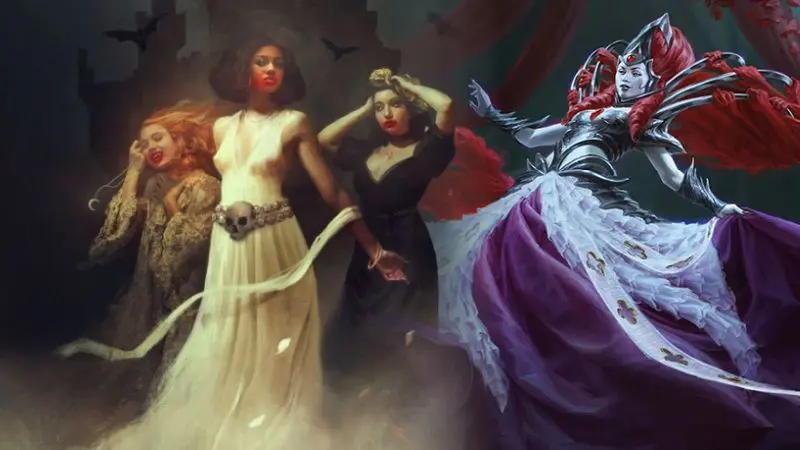
These are the three overly sexual female vampires who assault Jonathan in Dracula's castle, then are killed by Van Helsing in the last part of the novel. They're usually referred to as the Brides of Dracula. It's odd that Wizards didn't choose to go with that expression, considering it's what the reskinned Magic card's already using.


In fact,
The Three Weird Sisters // Fiends of Darkest Night


The Brides again, not called Brides again. Although, the expression "weird sisters" is actually utilized by Jonathan in his diary in chapter four, from which the flavor text on the back face also comes. The title "Fiends of Darkest Night" is not from the book.
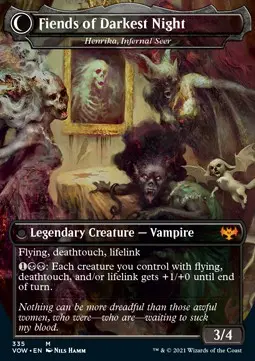
All in all, the Brides are among the most colorful and unsettling characters in the novel.
Castle Dracula
Dracula's home, described by Stoker as located near "Borgo Pass" (whose proper name is Tihuța Pass) in the Bârgău Mountains in the Eastern Carpathian region. Since 1989, there's a hotel called "Castel Dracula" on the pass.


In the context of Crimson Vow,
Harker's Journal


In all likeness, this reskin directly derives from the set already including a card called
Van Helsing's Holy Ward
In the book, Van Helsing employs a series of protective measures against vampires, most of which have become highly iconic, like garlic and crucifixes. One that's less represented in later adaptations but very crucial in the story is the crushed holy wafer sprinkled in a circle. None of these seem to be what the artwork on this card went for, which looks more like sealing wax of some sort.


Regardless of the actual form of the tools,
Mysterious Blood Illness
This is what Lucy contracts after having been bitten by Dracula.


The instant mass damage aspect of
The flavor text describing Lucy's dire state is from Dr. Seward's diary in chapter ten.
Search the Count's Castle
This is what Jonathan does when Dracula has left the castle for England at the beginning of the novel, abandoning him at the mercy of the Brides. For some reason, the art is also sort of reminiscent of Alfred Hitchcock's Vertigo (which Drew Tucker already paid ample homage to when illustrating


The flavor text is taken from chapter three, and it's obviously quoting Jonathan's journal.
Quincey Harker
This is the quirkiest inclusion in the entire series. Quincey is Jonathan and Mina's son, named after Quincey Morris, the only character in the Van Helsing gang who died during the story's events (but, to be fair, also the one who got to stake Dracula through the heart). The only mention of Quincey Harker in Stoker's novel comes from a note by Jonathan on the very last page. It has the function of a sort of epilogue dated seven years later, in which Jonathan reveals he and Mina had a son who they called Quincey.


Fast forward to 2009, when Bram Stoker's great-grandnephew Dacre Stoker, along with screenwriter Ian Holt, published an official sequel to the original novel, titled Dracula the Un-dead. In this follow-up, set 25 years after the events of the first book and centered around Quincey, the young Harker ultimately finds out the revived Dracula is his real father and then witnesses a brutal duel between him and Elizabeth Báthory. It is a very weird book.
So maybe it's correct to depict Quincey as a
At least the card's flavor text is not from Dacre Stoker's controversial "masterpiece." Those are actually some of the very last lines of Bram Stoker's seminal novel. What better way to end this examination? Aside from going to scatter a few holy wafer crumbles around the windows. You never know.
Opinions expressed in this article are those of the author and not necessarily Cardmarket.