
The Card Itself
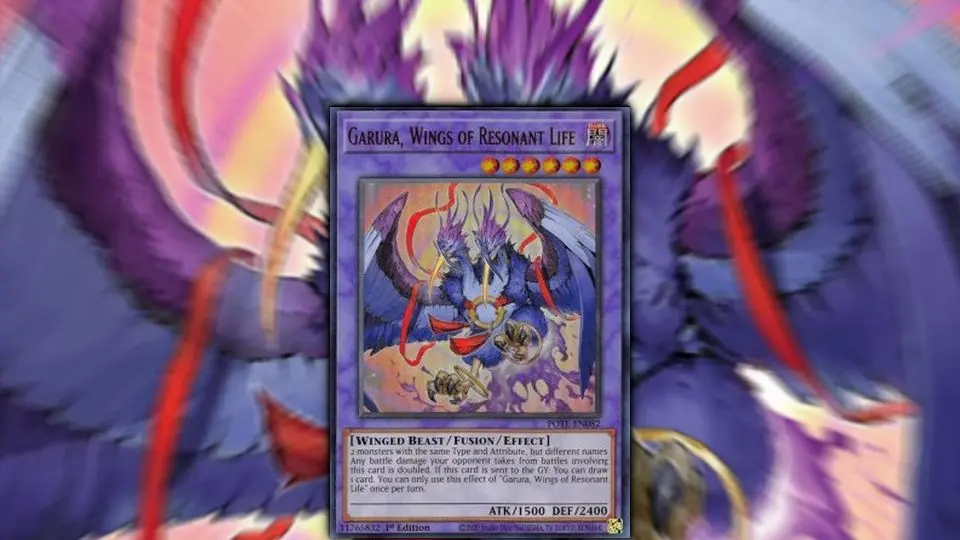
On its surface, Garura is an entirely unremarkable card. It is not attached to any particular archetype, has no way of being fusion summoned more efficiently than a generic card like
Who Needs to Summon Monsters?
While Garura itself is, admittedly, not amazing on the field, it has some interesting synergies with existing cards. Thanks to its ability to draw a card when sent to the graveyard, simply getting it there can be an appealing option. Let's look at another exciting card from Power of the Elements that synergizes well with Garura,

Ultimate Slayer is one of the most hyped cards in Power of the Elements, and it's not hard to see why. It removes a monster from the field without sending it to the graveyard, cannot be responded to by monster effects, and sends a card from the extra deck to the graveyard to boot. Even if you have to structure your extra deck in a way that facilitates it, the card remains extremely strong. Garura is one of many fusion monsters that acts as a powerful card to send from the extra deck for the effect of Ultimate Slayer. Its card-drawing effect will trigger, meaning Ultimate Slayer will effectively cycle itself once it resolves. This makes Garura an option over other fusion monsters like
While not an individual card, there is an entire archetype that appreciates the draw one effect in a similar way to Ultimate Slayer: the Dogmatikas.

The Dogmatika archetype has seen play since its release in Rise of the Duelist as an engine in a variety of decks, such as Invoked, Shaddoll, Eldlich, and even a multitude of rogue strategies like Spellbook. The cards share a common theme of sending cards from the extra deck to the graveyard, and as a result, Garura is a natural consideration in decks already using the Dogmatika engine. Cards like
Actually Summoning the Bird
While simply getting Garura in the graveyard is an option, actually summoning Garura, despite its mediocre field presence, represents even more powerful synergies. Let's start with a bang and discuss perhaps the most appealing use case for it,

Super Polymerization is an extremely powerful spell, allowing a player to fusion summon using monsters from both sides of the field. This is already strong, but combined with its status as a quick-play and unable to be responded to, you have a card that has seen on and off meta usage for the entirety of its legal lifespan. When not in the main deck of archetypes like HERO and Shaddoll, which can utilize it with their wide range of attribute-focused fusions, it often sees use in the side deck as a way to break boards while fielding a monster without letting your opponent respond. A host of generic fusion monsters exist to summon with it, such as
Garura, similarly, is an incredible monster to make using Super Polymerization. With its materials being any two monsters with the same type and attribute, most archetypes will fold in some way to a Super Polymerization, as monsters within archetypes will often share these traits. Going second, it can effectively break boards against some of the best decks of the format.
As an example, against Spright, if they use
Perhaps even more notable is that Garura makes Super Polymerization appealing as a generic option in the main deck, rather than just the side deck. Because Super Polymerization is a quick-play spell, you can set it on your first turn and use it as disruption against a wide variety of archetypes that will summon the materials necessary for the summon of Garura. For example, you can fuse away
Tearlament

Tearlament is expected to be one of the best decks of the upcoming format, alongside Spright. When sent to the graveyard, almost all the main deck Tearlament monsters can fusion summon a fusion monster, as long as they use themselves as material. Note, however, that they don't have to summon a Tearlament monster. This means Garura becomes a possible card to summon off the Tearlament monsters' effects, and a notable one at that. While Garura is never something you want to leave on the field, its level, generic materials, and built-in cycling make it an appealing option when laddering through Tearlaments.
Any two Tearlament monsters other than
Fluffal

Fluffal is another popular fusion deck among the playerbase, and has even seen niche success, such as a Top 4 finish at a Texas regionals earlier this year. While Fluffal isn't nearly as relevant as Tearlament will be, it is an example of other fusion decks being able to make use of Garura as a laddering point for fusion climbing. Fluffal will often have extra copies of Polymerization and fusion material to spare, and using any two Fluffals or any two Frightfurs will yield a Garura, which can be used to climb into powerful link monster such as
Conclusion
Garura has a lot going for it: powerful synergies when being sent from the extra deck to the graveyard, generic materials that make it appealing to summon and ladder with, and a cycling effect that ties all of this together. Hopefully, all of this has convinced you of a seemingly unassuming card's possible use, and to watch out for Garura, Wing of Resonant Life, when Power of the Element releases.
Opinions expressed in this article are those of the author, not of Cardmarket.