
Hello, my dear Cardmarket readers, I missed you! But I simply had to take a break from Magic for a few months. However, I am back now, and I bring presents: lots of charts, figures, tools, and of course a whole bunch of decklists—all the way from Modern Horizons 2 to today. Even if you've spent the last five months living under a rock in a cave on the far side of the moon, this article should bring you up to speed on all things Modern.
Part I – MH2 Redefining the Format
Last time we took a look at the metagame one month before the release of Modern Horizons 2. After Strixhaven had made its impact on the format,
Then the preview season truly started, followed by the most impactful release of the year. And then for a few weeks people tried to break the format, figure out the new

The Post-MH2 Modern Metagame
Is it true that Wizards could release a Modern Horizons set without breaking the format? To find out, let us start with the most represented archetypes in the published data of Preliminaries and Challenges (and Showcases, PTQs …) during that one month before the next release.

Izzet Prowess
We notice that people tried to keep on playing the previous best deck of the format, Izzet Prowess, to see whether the new brews would be able to keep up with it. The lists evolved a little though. As in prior articles, the example lists we showcase are the most recent ones with the highest number of points during that period.
| Izzet Prowess by The_nayr, 4th at Modern Showcase Challenge on July 4 | ||
|---|---|---|
| Main Deck | Sideboard | |
|
|
|
We notice that two thirds of the lists adopted
Now, you might be wondering how to get the proportion of decks that run a card?
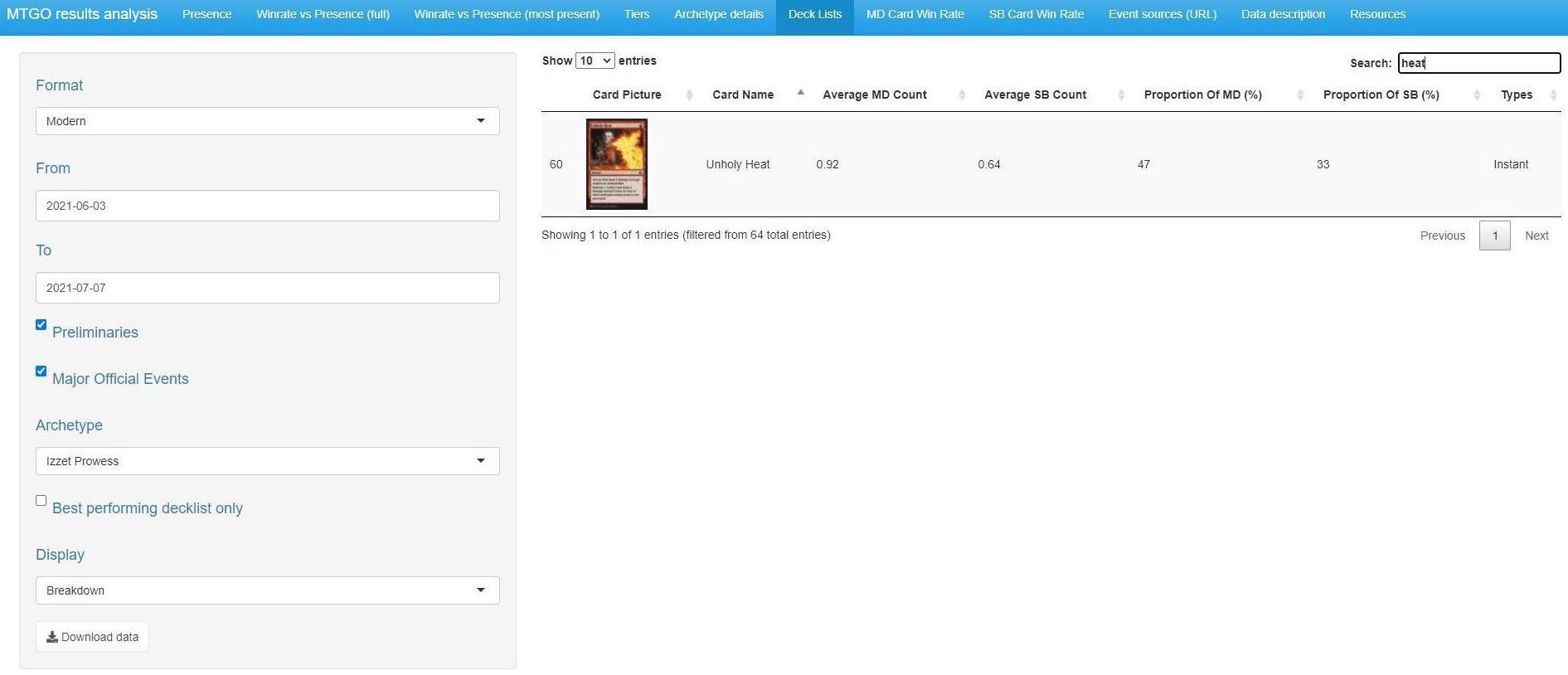
Indeed, I recently published a website where you can get a lot of the data by yourself, with tons of filters and features, that is still under development:
There's more to come about it in a future article.
Amulet Titan
The other archetypes at the top of the format also are known faces that received new toys. Amulet Titan—#nobadmatchup—acquires
You can also note that
| Amulet Titan by kanister, 2nd at Modern Challenge on June 19 | ||
|---|---|---|
| Main Deck | Sideboard | |
|
|
|
This list is unusual as it runs 61 cards in the main and fourteen in the side. The reasoning was that
Deck guide: For a recent sideboard guide for the deck, you can take a look at PuntThenWhine's on Twitter.
Hammer Time
Another deck that tremendously appreciated the addition of
| Hammer Time by CrusherBotBG, 1st at Modern Challenge on July 4 | ||
|---|---|---|
| Main Deck | Sideboard | |
|
|
|
Deck guide: For the best guide on the deck (on Patreon), make sure to ask Laplasjan. Note that the deck now splashes black mostly for
Asmo Urza
Besides, again thanks to
You can see below an example of a Dimir list, but we could find Food shells in almost all combinations of colors.
| Dimir Asmo Urza by sneakymisato, 1st at Modern Challenge on June 27 | ||
|---|---|---|
| Main Deck | Sideboard | |
|
|
|
Other variants also appeared, without blue and for instance
Izzet Murktide
However,


So, what does a Ragavan-plus-Darcy (also known as DRC) deck look like? Mostly a low curve midrange pile. Let us introduce Izzet Murktide. Since you play red and a delirium package for Channeler, you might as well add
Having pretty much access to all the best anti-Amulet cards in the format allowed the deck to thrive and kick Amulet from its temporary throne as you can see in the next part.
Here, you may note that
| Izzet Murktide by MZBlazer, 1st place at Modern Challenge on July 4 | ||
|---|---|---|
| Main Deck | Sideboard | |
|
|
|
Rakdos Midrange
How about keeping the red part of the deck, but replacing counterspells with discard spells? That's the idea behind this Rakdos Midrange deck, which somewhat existed before, just like people would try to make
| Rakdos Midrange by Golgarburr, 9th at Modern Showcase Challenge on July 4 | ||
|---|---|---|
| Main Deck | Sideboard | |
|
|
|
Stoneblade
Just like Izzet Prowess ran
This is also an archetype where we could witness the evoke Elementals making a splash early, such as
| Jeskai Stoneblade by Thunderstriker7, 1st at Modern Challenge on June 13 | ||
|---|---|---|
| Main Deck | Sideboard | |
|
|
|
Deck guide: Do you want to play it? Kyle Boggemes has a guide to share.
Blue Living End
If you had a close look at the decklists so far, you might be wondering why one would run a narrow card such as


We often mentioned Living End in previous articles, without going in depth on it, as other graveyard combo decks such as Oops All Spells and Dredge had more results. That time is over. The structure of the archetype changed a bit with the new set while the game plan of cycling creatures before reanimating them through a cascade spell finding
Among other new toys,
| Blue Living End by Glacier7, 3rd at Modern Showcase Challenge on July 3 | ||
|---|---|---|
| Main Deck | Sideboard | |
|
|
|
Deck guide: Do you want to master it? Ask Sodek (on Patreon), one of the best combo players in Modern.
Footfalls
While Living End is an all-in combo deck, the Modern format now includes another cascade deck. Outside of the cascade package it's filled with interactive cards, which makes it to be classified as a midrange deck. Besides, this time the card you cascade into does not require much setup to work:
| WURG Footfalls by Darthkid, 2nd at Modern Showcase Challenge on July 4 | ||
|---|---|---|
| Main Deck | Sideboard | |
|
|
|
The white splash adds
| Temur Footfalls by teruteru8140, 15th at Modern Showcase Challenge on July 4 | ||
|---|---|---|
| Main Deck | Sideboard | |
|
|
|
Deck guide: For more details about the history of the Footfalls archetype and a full primer, you can check out the teachings of Chris Giglio, a proficient Modern grinder on Magic Online.
Yawgmoth
Maybe you are more into creature combo decks? Or enjoy emblematic characters of Magic's storyline? I have just the right deck for you. Use
| Yawgmoth by claudioh, 2nd at Modern Challenge on June 21 | ||
|---|---|---|
| Main Deck | Sideboard | |
|
|
|
Deck guide: Are you looking for an intricate deck that your opponent might have trouble to play against correctly? You knocked at the right door, and a compilation of resources on the deck is available.
Humans
Last, people still ran Humans after MH2, toying with several new tribe members, such as
| Five-Color Humans by ichi-roku, 2nd at Modern Challenge on June 6 | ||
|---|---|---|
| Main Deck | Sideboard | |
|
|
|
Later, the deck evolved to Jeskai and picked up
Deck guide: If you still want to make it work, you could start with this Reddit guide by Fluorspar.
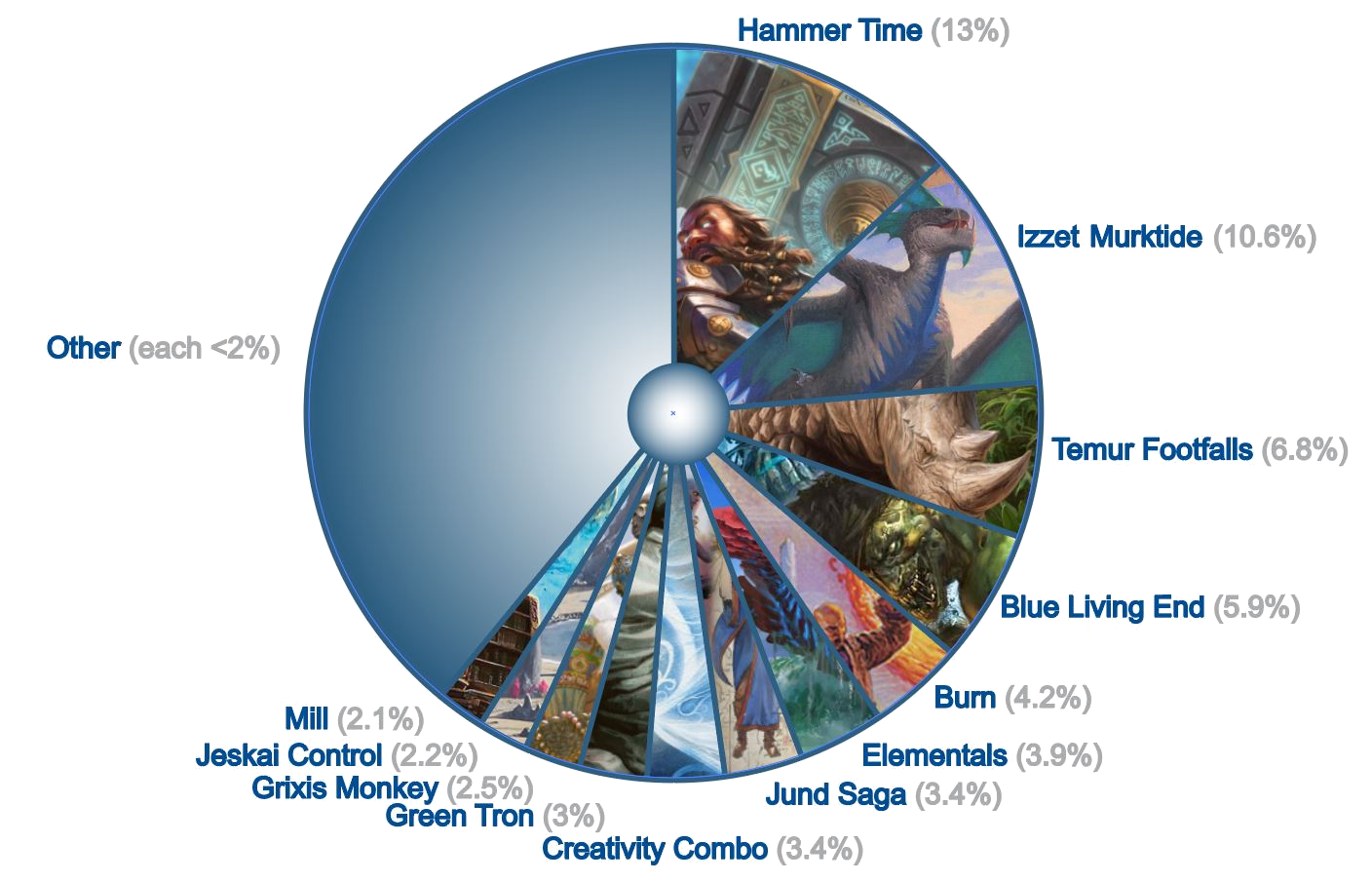
Of course, many more archetypes appeared in the results, especially when people were trying to figure out what was going to be stronger than the rest. That is why the "Other" part of the pie almost represents 50% of the chart. You could also argue that Stoneblade should be split into smaller archetypes based on the color combination just like Footfalls was in the example. The point was merely to showcase the new archetypes that emerged while people were brewing up new contenders in this metagame (which already belongs to the past) and to mention the impactful cards of the set.
Besides, by splitting the Stoneblade decks, we would not have had a single deck based in white and blue represented in the chart, and the case of this archetype since MH2 is very interesting as you shall see later. Indeed, you might have noticed that none of the usual fair decks like White-blue Control or Black-Green/Jund Midrange made it onto the chart. Other old linear decks such as Tron and Burn did not do any better. In the next chapters, we learn more about what happened to them.
Part II – From AFR to MID
Barely one month after Modern Horizons 2, Adventures in the Forgotten Realms joined the card pool. To be honest, that set did not have much of an impact. Only a few cards made it to decks with good enough results to be published. The most played card ended up


The Post-AFR Modern Metagame
If we take a larger picture of the metagame for the two months between Adventures in the Forgotten Realms and Midnight Hunt, we get the following:

If you read the first part of this article and my previous ones, you should be familiar with most archetypes by now. Note how Amulet Titan, Izzet Prowess, Rakdos Midrange, Asmo Urza, Yawgmoth, Stoneblade, and Humans faded. Instead, a few decks rose to greater prominence.
Burn
Good old Burn has an interesting matchup against pretty much all of the best decks of that format, for instance with
| Boros Burn by frakom, 3rd place at Modern Challenge on September 5 | ||
|---|---|---|
| Main Deck | Sideboard | |
|
|
|
Deck guide: Should you need a guide for Burn, you can read Frakom's (on Patreon)—the player behind the result above (and many more with Burn).
Elementals
Not as old as Burn, Elementals got a complete facelift with MH2, as all the evoke cards are of course Elementals. Combined with
To make sure you do not lose to blue decks, you can run the full set of
| Elementals by derk714, 1st place at Modern Showcase Challenge | ||
|---|---|---|
| Main Deck | Sideboard | |
|
|
|
Deck guide: Kanister provides quality insight about the deck in this article.
Jund Saga
Jund Saga is the latest final evolution of the Super Saiyan Jund Midrange.
| Jund Saga by Bullwinkkle6705, 1st at Modern Challenge on August 22 | ||
|---|---|---|
| Main Deck | Sideboard | |
|
|
|
Deck guide: Is your Jund soul still burning strong? Bullwinkle, the winner of that event, shared his insight on Twitter.
Creativity
Do your remember the
| Four-Color Creativity by calmdownbronco, 2nd at Modern Challenge on August 1 | ||
|---|---|---|
| Main Deck | Sideboard | |
|
|
|
Deck guide: Do you want to learn more about the Velomachus version? MrRaeb wrote a few words on the topic. For the Emrakul version, I would suggest a video by Zan Syed, SCG player of the year.
Green Tron
How about Green Tron? Well, even though it reappeared, we cannot say it really got much love in MH2. Rather the opposite. At least there was
| Green Tron by Yumas2, 2nd at Modern Challenge on August 2 | ||
|---|---|---|
| Main Deck | Sideboard | |
|
|
|
Grixis Monkey
Onto another new deck: Grixis Monkey. A control deck mostly developed by TSPJendrek, it harnesses the power of the
| Grixis Monkey by TSPJendrek, 4th at Modern Super Qualifier on July 26 | ||
|---|---|---|
| Main Deck | Sideboard | |
|
|
|
Deck guide: If you want to learn from this great builder and player, you can have a look at his guide on Patreon.
Jeskai Control
In the meantime, white-blue players dropped
| Jeskai Control by bobthedog (Gabriel Nassif), 1st at Modern Challenge on July 19 | ||
|---|---|---|
| Main Deck | Sideboard | |
|
|
|
Note that this list is recognized to be quite untuned by the designer himself, who created it on stream to attack the specific meta he was expecting. And indeed, it worked pretty well.
Mill
Last, as mentioned earlier, Mill got a great upgrade in
| White-Blue Mill by Wisnia, 1st at Modern Challenge on September 12 | ||
|---|---|---|
| Main Deck | Sideboard | |
|
|
|
Have you noticed that the list above is white-blue, instead of the usual blue-black? While the latter combination remained more popular, this variant is the one that had the best score. If you want to learn about it from its creator, he wrote a piece about it on Patreon.
Comparing the Two Months of the AFR Metagame
However, tallying up the metagame over those two months doesn't show the whole picture. In fact, the meta changed widely from one month to the other. Here is a table comparing the two.
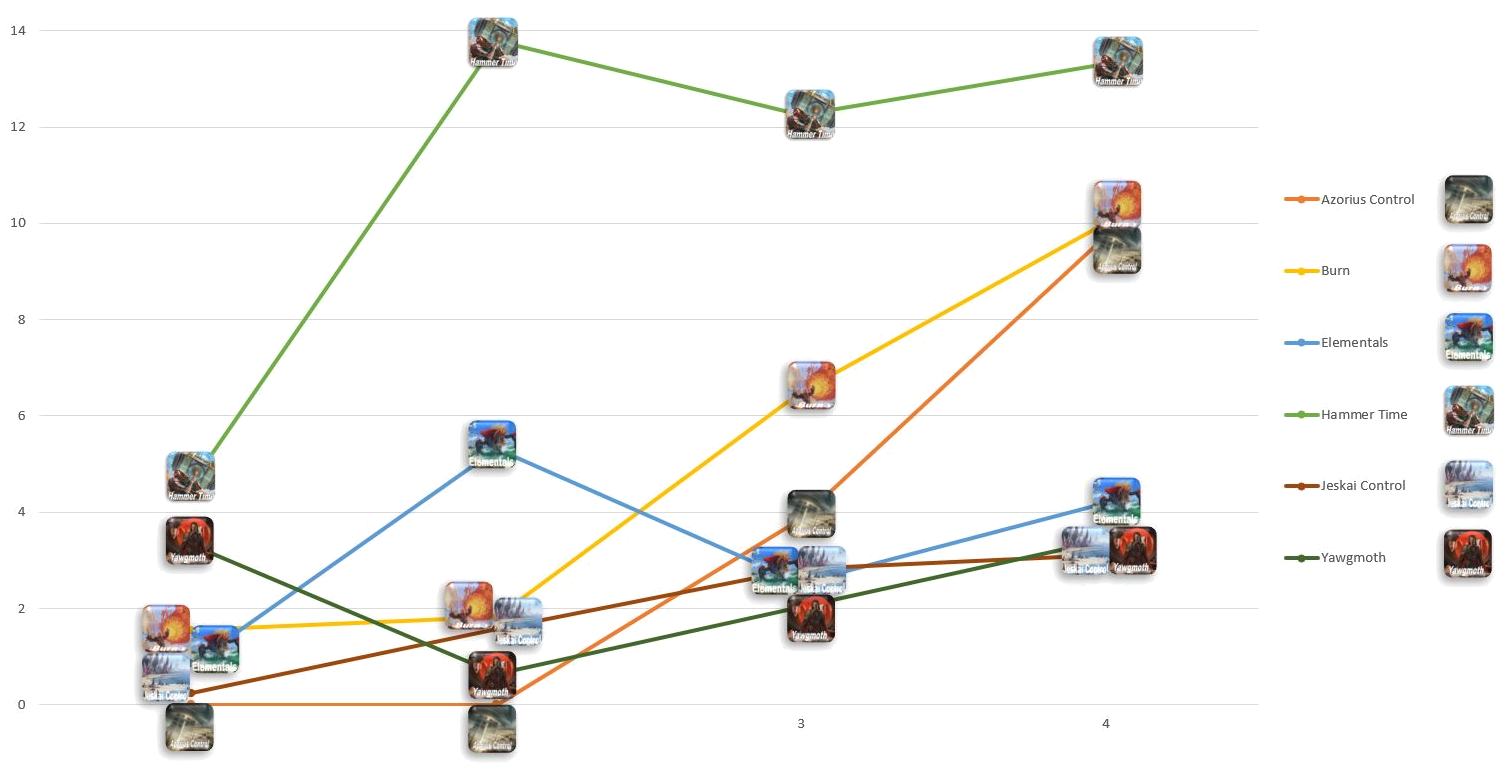
As you can see, about half of the archetypes over 2% of presence changed from one month to the other. Decks that did not appear on the overall pie chart for the full two months are:
-
- Jund and Rakdos Midrange
- Taking Turns, which is the alternative build of Creativity mentioned earlier
- Yawgmoth, which hit a slump during the first post-AFR month
- Azorius Control, which is covered in more depth later
Also note that Azorius Control and Jund Saga were not represented at all during the first month and climbed the ranks on the second. Maybe a graph to showcase this in the next part would be useful?
Part III – MID Going Forward
So far we have covered three months and two sets of changes in Modern. Time to take on the last month and tackle the final set. First, let us see which cards from Midnight Hunt saw play in competitive lists. In main decks, the most represented is
Reanimator
Wait, Reanimator? In Modern? Yes, with
| Reanimator by barczek, 7th at Modern Challenge on October 3 | ||
|---|---|---|
| Main Deck | Sideboard | |
|
|
|
Phoenix
To be fair, another deck harnessing the power of
| Jeskai Phoenix by AspiringSpike, 6th at Modern Challenge on September 19 | ||
|---|---|---|
| Main Deck | Sideboard | |
|
|
|
Azorius Control
Now, how about the MID cards that entered some sideboards? Yes, they exist as well! Two of them see the most play at the moment. On the one hand,
Alright, alright, we mentioned the deck enough, finally, it is time for Azorius Control!
| Azorius Control by Nammersquats, 1st at Modern Premier on October 16 | ||
|---|---|---|
| Main Deck | Sideboard | |
|
|
|
There is a lot to unpack here. The most important change is the inclusion of
Your planeswalkers can also help deal with most permanents temporarily,


Why would you run
Deck guide: Would you like to learn more about the deck? Team TaC's Patreon might have something for you then.
The Post-MID Modern Metagame
And with that, we finally should know all the decks we need to be aware of to take a look at the post-MID Modern metagame.
Hammer Time remains on top. Meanwhile, the older archetypes that are Burn and Azorius climbed all the way up to the second and third position, continuing the ascension that they already started in the middle of the AFR metagame. On the other hand, Jund Saga is relatively stable again compared to the previous month's sharp rise. It is also interesting to note that the "Other (each <2%)" portion keeps shrinking. Is this a sign of the metagame getting solved? Are people tired of brewing after months of changes? Are the MH2 cards really stronger than what the rest of the format can offer?
We might need to wait another month to see if this trend continues. What is certain is that at least some people are still brewing, while some other decks try to abuse the weak spots of this creature-focused metagame.
Four-Color Yorion
Oh, wait, did you notice it? There is still one deck on this pie chart that we did not talk about yet!
| WURG Blink by stainerson, 3rd at Modern Premier on October 18 | ||
|---|---|---|
| Main Deck | Sideboard | |
|
|
|
Let me introduce the ultimate grinding machine (for now—another might be on the way with cascade spells …). It's a nightmare fusion between Elementals and Four-Color Control that came out this month. Some versions even add
Presence Evolution Since MH2
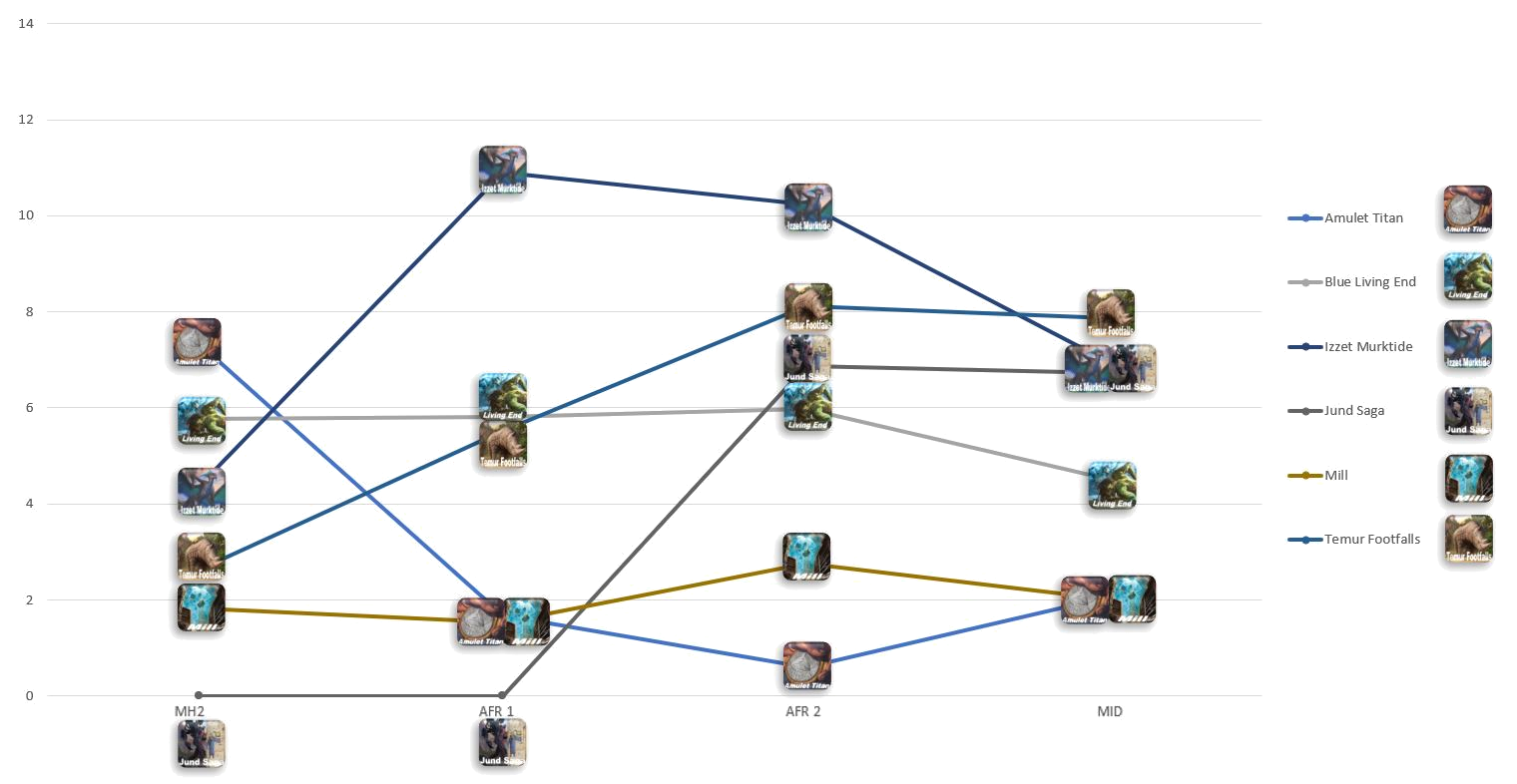
Below you find a summary of the changes in our data set, starting with MH2, for what are now the most represented decks in the format that will make it to our final tier list (outside of WURG Blink that just appeared in tournaments). The results are divided into four periods of about one month each, mainly based on the releases of each set:
- MH2: from June 3 to July 6
- AFR 1: from July 7 to August 11
- AFR 2: from August 12 to September 16
- MID: from September 17 to October 18
The data is cut into two charts, in order to make it easier to read. In the first chart, you see decks that have mostly been one the rise since MID. The second shows archetypes that mostly stagnated or regressed after MID.
Post-MID Modern Win Rates
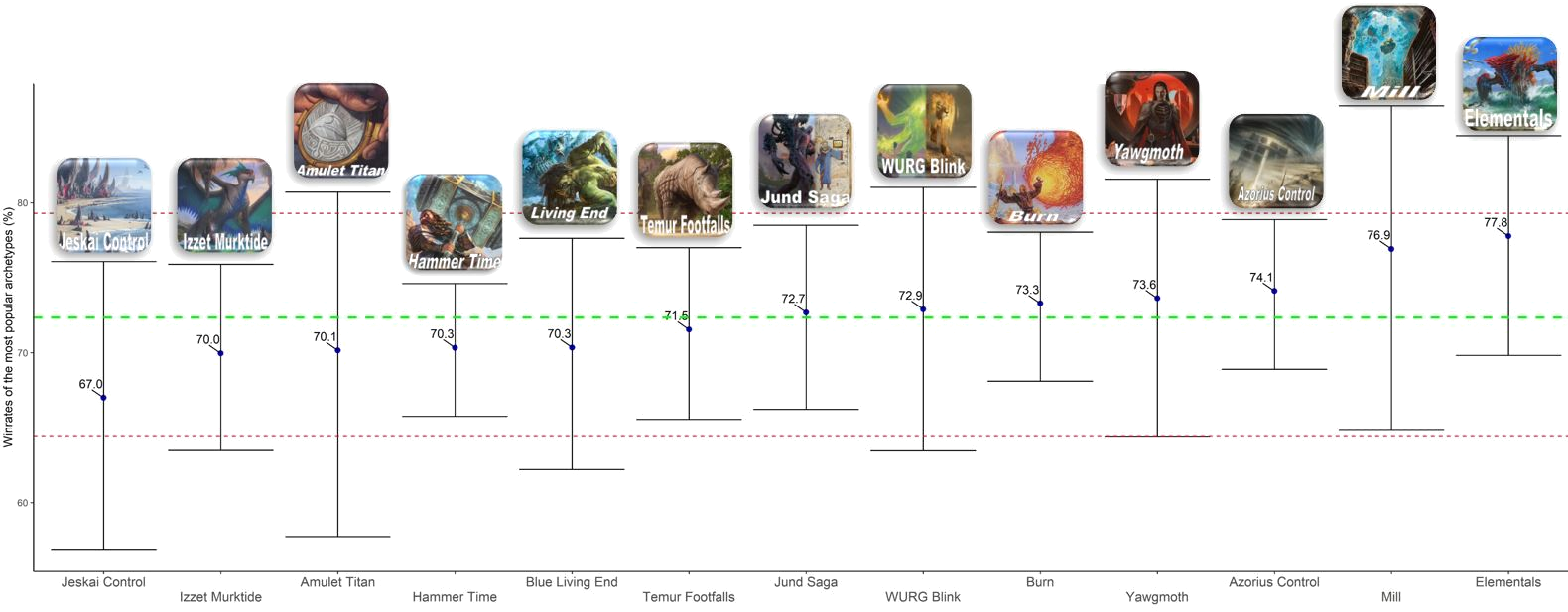
Now that we are aware of the presence of the most played decks, let us start working on our usual tier list. To do so, we need, as usual, the win rates.
Win Rate Evolution Since MH2
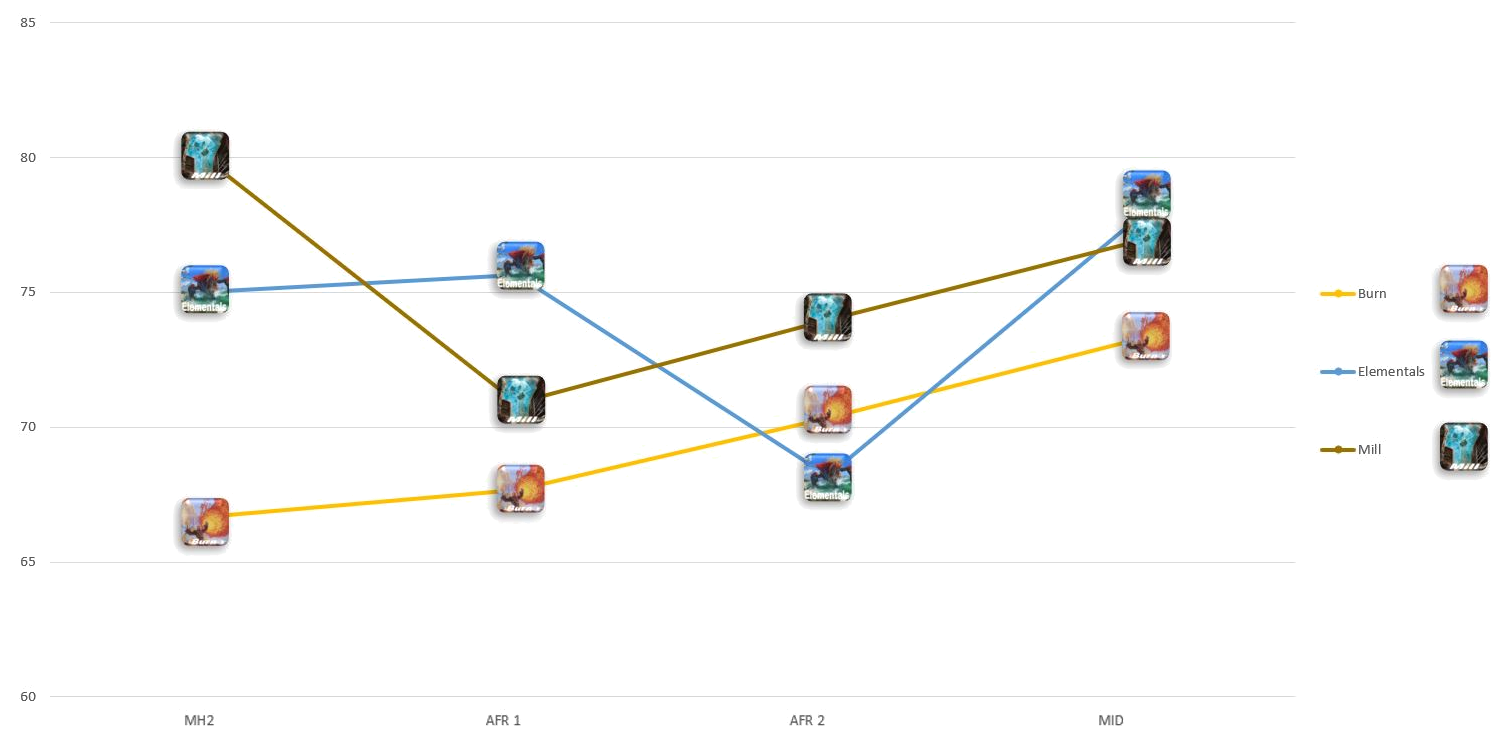
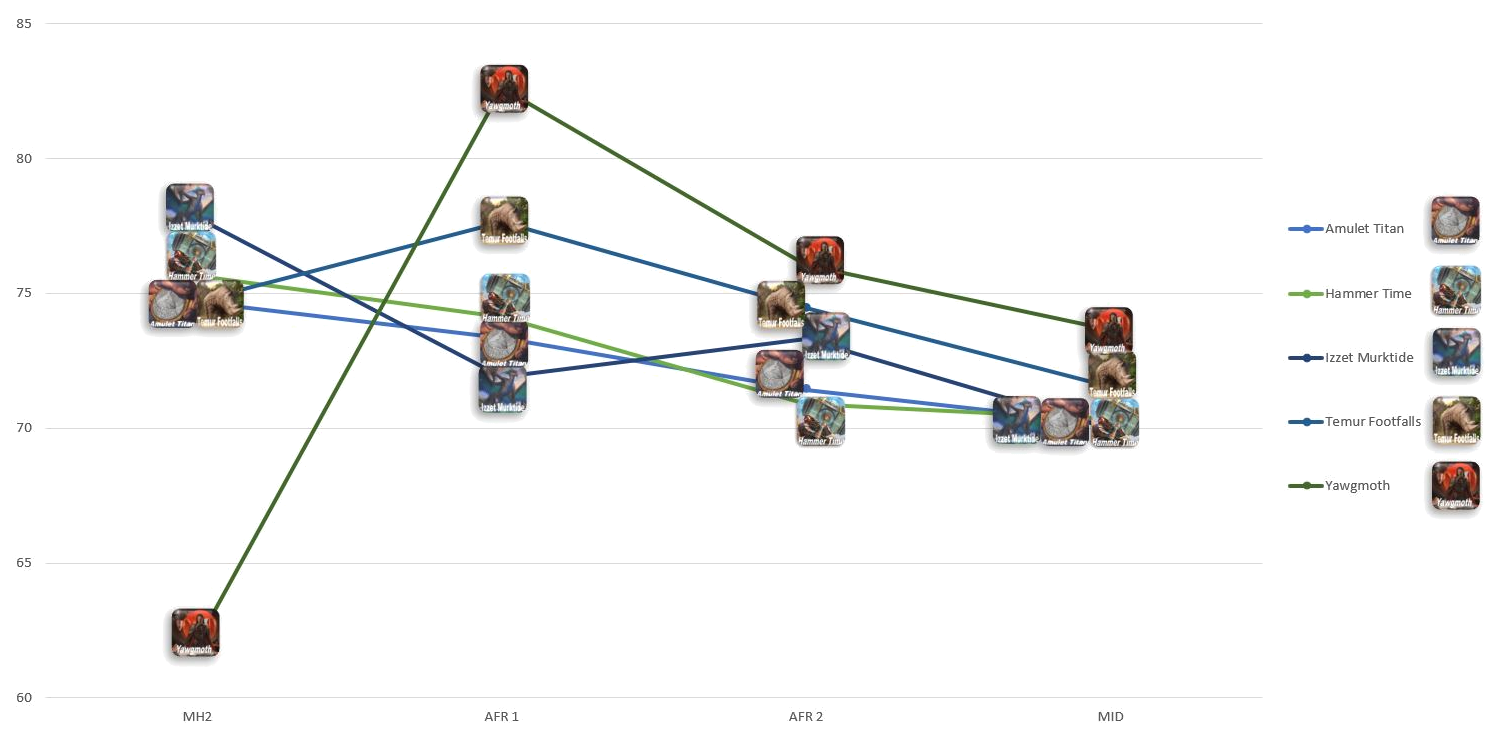
If you are curious about the way the win rate of those decks evolved over time, just like their presence did, you should find the following graphs relevant. Again, the data is split in four periods, same as above, and I also tried to put together archetypes with similar win rate behaviors in order to make it easier to read. First, we got the archetypes whose win rate mostly increased over time, especially after the release of MID. Next are the archetypes whose win rate mostly decreased over the past months. Last are the archetypes whose win rate decreased more or less significantly after MID but were rising or stable before it.
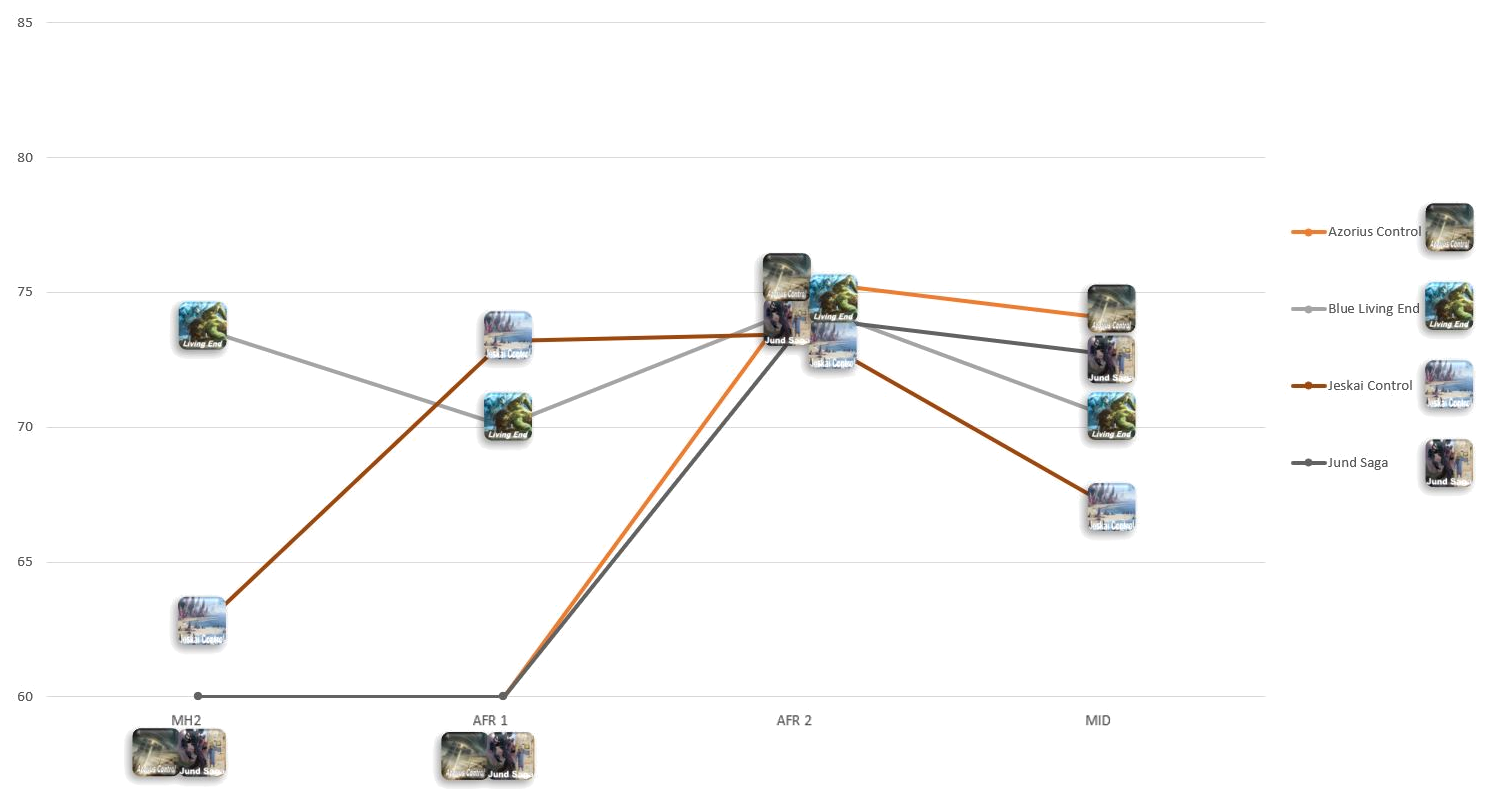
The way of splitting the archetypes may be debatable, but the main goal was to get graphs with fewer archetypes to make them easier to read anyway. We can mostly gather that, since MID, most of the top-tier decks saw their win rate decreasing. Among them, Azorius Control and Jund Saga only faced a small loss, which is to be expected after their fast ascension to the top of the format while people started adapting to them. Similarly, Hammer Time and Amulet's win rate barely drop in that period, but it is more of a stabilization after weeks of decrease since MH2.
On the other hand, Elementals' win rate has mostly been increasing since MH2, only dropping severely once in the second half of the AFR meta. But the dramatic increase after MID more than made up for it, going even over its previous high. Mill has also been ascending quietly since MH2, not accounting for the drop after the release of AFR, which we can easily explain with the very small presence of Mill at the time, leading to a more volatile win rate. Last among those improving decks, Burn, now the second most represented deck in the results, has simply been improving both in terms of win rate and presence since MH2. People seemed to have stopped respecting it until MID, while the Burn lists themselves were tuned to fight the new threats in the metagame.
I also find the case of Living End quite interesting, as both its presence and win rate remained relatively stable since MH2. I must say that I am not sure of the way to interpret this. Here is my funny theory: The deck is secretly overpowered and people try to get results with it, but not too many not to see it banned. The more reasonable theory would simply state that the deck is strong and tried to fight the hate, but people simply respected it more and more over time at the same time as it was trying to overcome the answers.
Displaying Win Rate and Presence Together
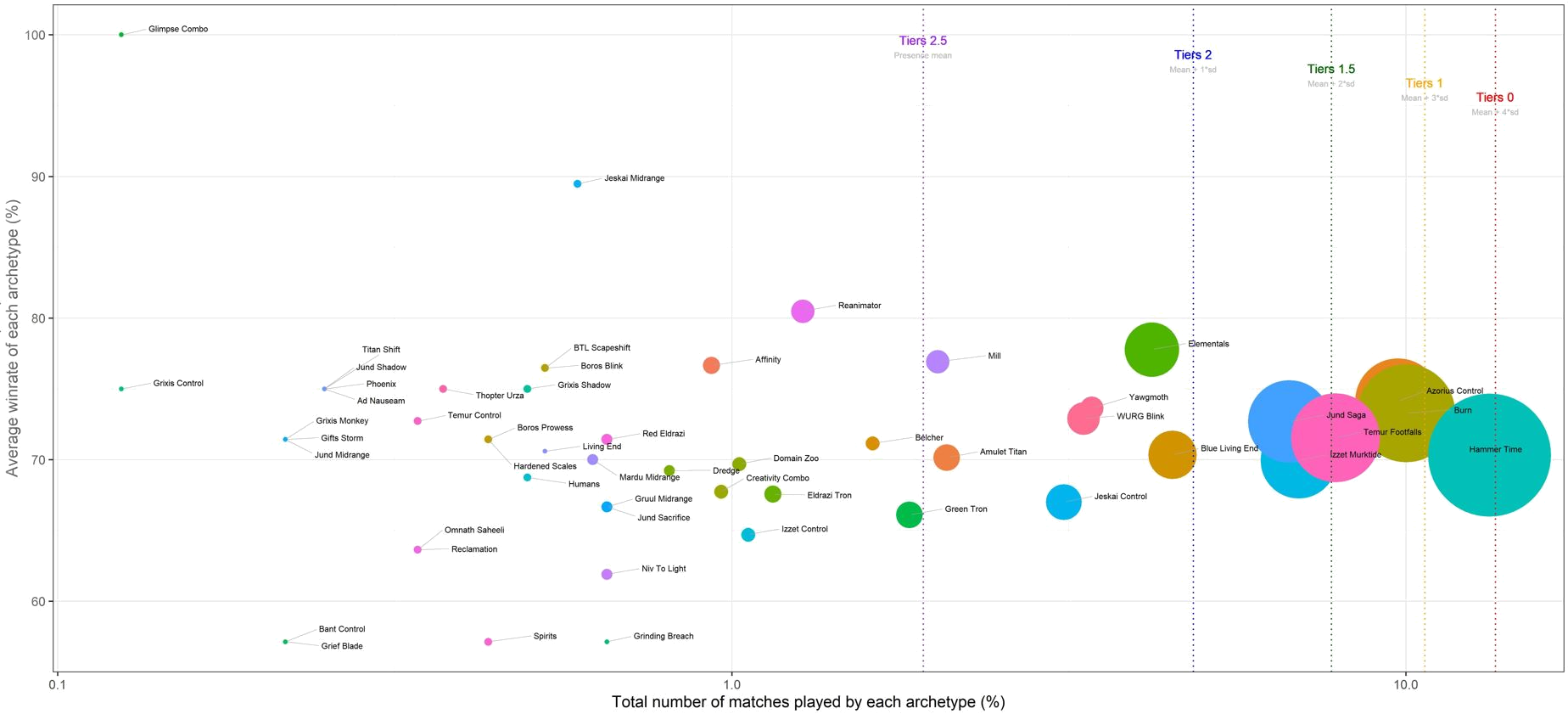
Now we can combine one factor with the other, as we did in the past. We get the following for the entirety of the archetypes:
What are the decks with a particularly high win rate you notice here? We already introduced Reanimator earlier, which is one of the closest decks to join the tier list by breaking above the average presence. Aside from that, there's …
Glimpse Combo
Glimpse Combo is another cascade deck based on the recent
| Glimpse Combo by Talisker, 4-0 at Modern Preliminary on October 1 | ||
|---|---|---|
| Main Deck | Sideboard | |
|
|
|
Jeskai Midrange
The other deck with a high win rate in this table is automatically labeled as a Jeskai Midrange deck, but you could call it a Jeskai Stoneblade deck if you wish. Though, to be fair, it is more of a red-white deck that splashes blue for
| Jeskai Midrange by Talisker, 1st at Modern Challenge on October 17 | ||
|---|---|---|
| Main Deck | Sideboard | |
|
|
|
From Data to Tier List
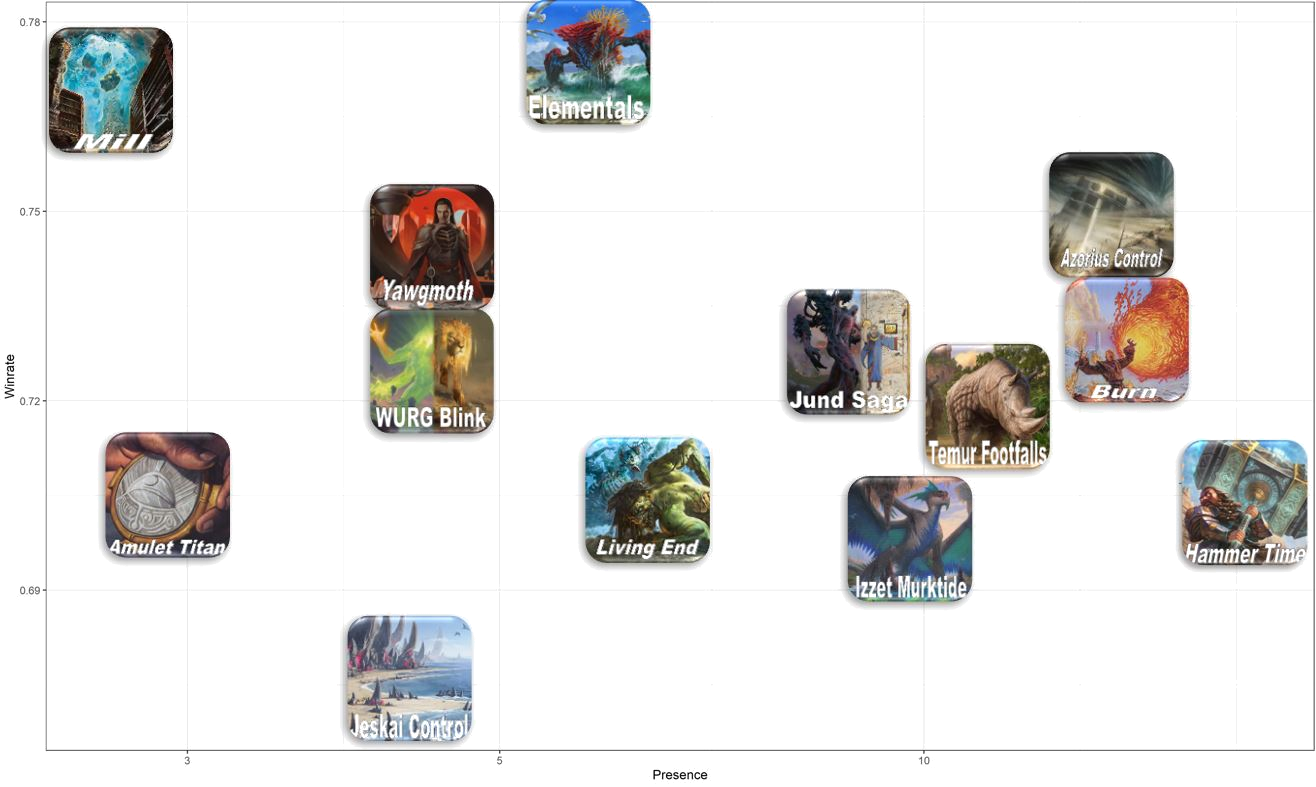
The tier list is close! Now, let us display only the deck with a presence over the average presence (which happens to be around 2%, so we see the same archetypes as the ones depicted in the pie chart).
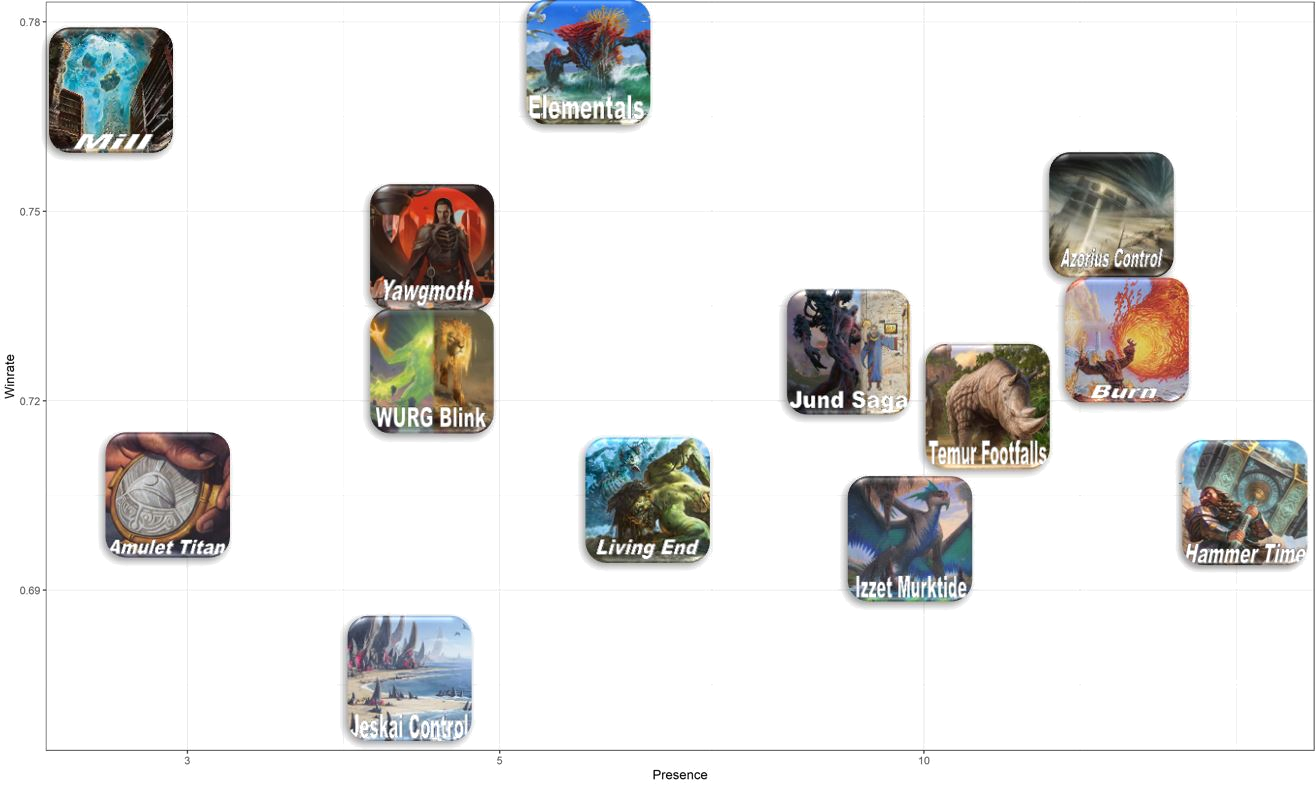
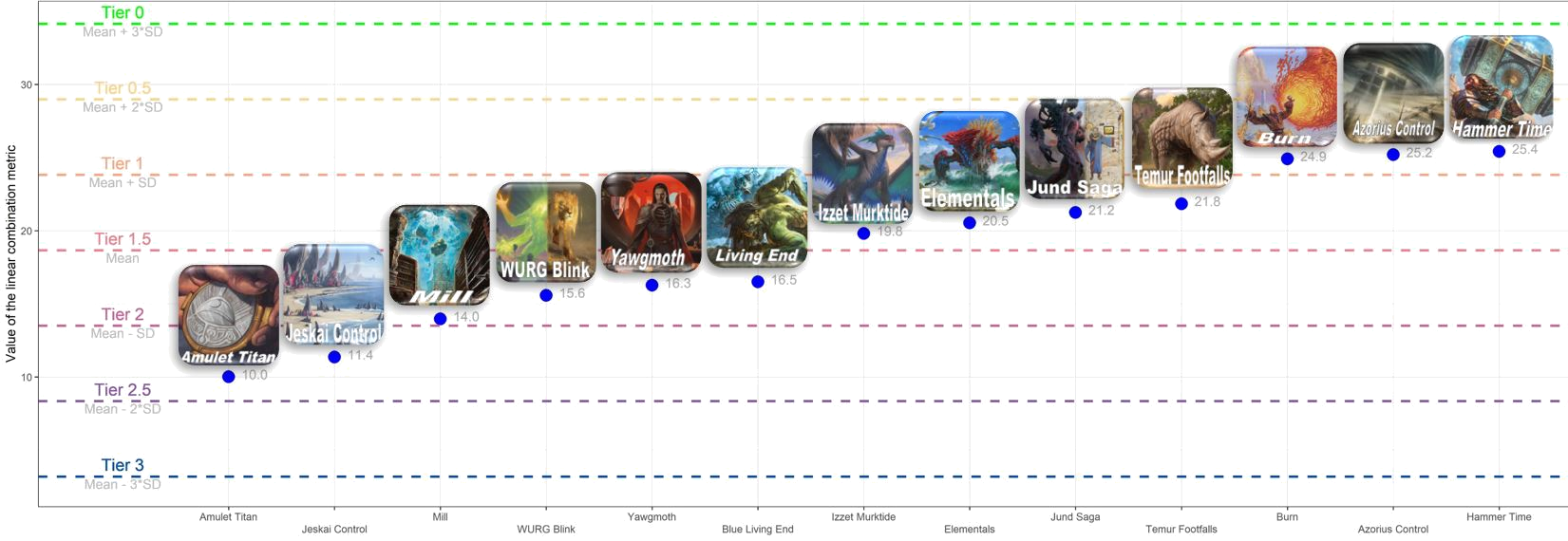
Next, with the formula presented in a previous article, we normalize and sum the metrics that are the presence and the win rate, and we set the limit for tier 1.5 as the average of the results of this aggregation. For the other tiers, we determine them by adding or removing standard deviations on that value.
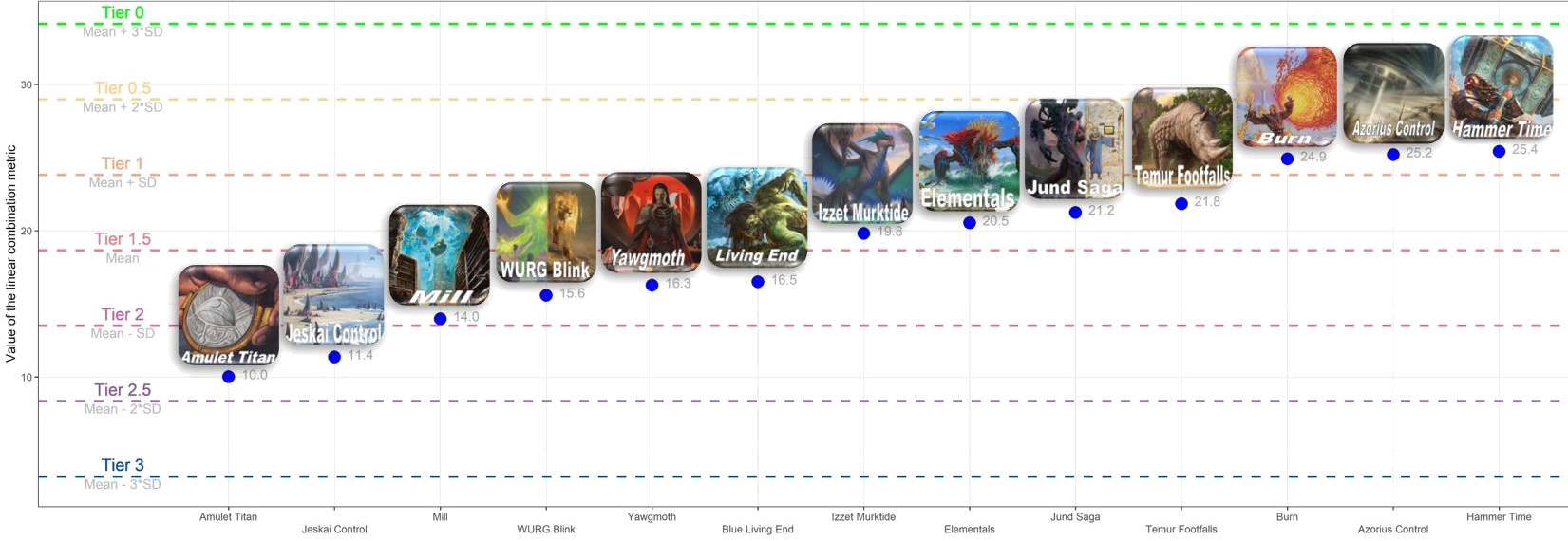
And … Yes, we made it, here is the tier list for the first month of the Modern MID metagame! (Insert Final Fantasy victory theme song.)
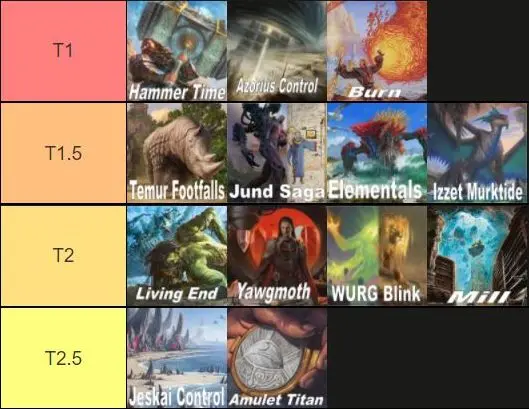
Closing the Game Article
There was a lot to cover since MH2, as the format radically evolved, even though a few of the historical archetypes of the format are still here and even doing really well. While the impact of the next sets, AFR and MID, was relatively minor, the metagame still underwent multiple changes over the last four months as people are still trying to figure out the entirety of the possibilities MH2 offers. At least we now have a relatively clear picture of what is going on, and the metagame is becoming more focused, as we can see with the "Other" category dwindling over time. This reinforces control decks now that they know what to target and by doing so allows them to cover a large portion of the format.
I hoped you enjoyed the article in spite of its length, maybe simply checking the titles and the pictures. Thankfully, even if you did just that, you should have found it helpful to understand how the metagame evolved and where it is standing at the moment.
Feel free to ask in the comments or on Twitter for additional information if needed, such as more details on the application mentioned early in the article, how I collected the guides for each deck (or others), or data about other decks. (Who knows, maybe you are interested in Affinity with
I'd also be glad to hear your opinion on the structure of the article and the graphics. See you back for the next metagame update!
Opinions expressed in this article are those of the author and not necessarily Cardmarket.