
It is here! The long awaited banned & restricted announcement. There was so much hype for it after the deployment of the Pauper Format Panel and the bans in Pauper last Thursday. Tons of talks took place everywhere (Reddit, Discord, Facebook, Twitter, Twitch, YouTube, WhatsApp, forums, and I must forget a few platforms) in the run-up. Most content creators gravitated toward
While still speculating on different possible changes if any were to happen, a lot of people also called the "no change" in Modern. And that is indeed what we got. The latest announcement did not affect Modern. Nevertheless we received some feedback from Aaron Forsythe, Vice President of Design at Wizards of the Coast, saying that the format looked fine according to "data and sentiment."
Lurrus warps the format more than any other card, no doubt. (That will always be true of something.) At this time we decided it wasn't detrimental to the format. Opinions surely vary here.
— Aaron Forsythe (@mtgaaron) January 26, 2022
He also made some comments on cards to unban that people bring up regularly, specifically
Anyway, even without any action taken in Modern, I still need to thank them because it afforded me the perfect topic for this introduction, no matter the outcome! Now let us move on and see how Modern archetypes fared in the published tournament results from Magic Online over the last four weeks. Here are the events we are covering today:
Modern Challenge 2022-01-01
Modern Challenge 2022-01-02
Modern Challenge 2022-01-08
Modern Challenge 2022-01-09
Modern Challenge 2022-01-15
Modern Challenge 2022-01-16
Modern Super Qualifier 2022-01-16
Modern Showcase Challenge 2022-01-22
Modern Challenge 2022-01-23
Modern Preliminary 2021-12-27
Modern Preliminary 2021-12-28
Modern Preliminary 2021-12-29
Modern Preliminary 2021-12-30
Modern Preliminary 2021-12-31
Modern Preliminary 2022-01-03
Modern Preliminary 2022-01-04
Modern Preliminary 2022-01-05
Modern Preliminary 2022-01-06
Modern Preliminary 2022-01-07
Modern Preliminary 2022-01-10
Modern Preliminary 2022-01-11
Modern Preliminary 2022-01-12
Modern Preliminary 2022-01-13
Modern Preliminary 2022-01-14
Modern Preliminary 2022-01-17
Modern Preliminary 2022-01-18
Modern Preliminary 2022-01-19
Modern Preliminary 2022-01-20
Modern Preliminary 2022-01-21
Here are some quick statistics:
Number of decks in the data: 438
Number of different players in the data: 306
Number of different cards in the data: 759
Number of exact archetypes in the data: 69
Number of rounds played in the data (with Top 8s): 2,998
Average number of Swiss rounds in the data: 6.56
Minimum number of Swiss rounds in the data: 4
Maximum number of Swiss rounds in the data: 9
Number of events in the data: 29
Archetype Presence
We should be used to the process by now. As always, we start with a look at the most represented archetypes among the top finishes—Challenge/Showcase/Premier/PTQ Top 32s plus Preliminary 3-1 and 4-0 results.
They are weighted by the number of matches to make appearances in larger events more meaningful, which is relevant to try to determine the best decks later. This means, a deck that reached the finals of a nine-round event, adding three matches in the playoffs, has a weight of 9+3=12, whereas a Preliminary list comes in at a weight of 4. Interestingly, the ranking remains pretty much the same when you only take the number of appearances without weighing them.

Since last month, Izzet Murktide collapsed, now showing less than half of its previous results share. It still sits at a comfortable fourth place though, whereas Grixis Shadow multiplied its share by 1.5, moving up to first place. WURG Blink also saw reasonable growth, up to third place . In between, Hammer Time remains extremely stable. Mill is happy with those changes, the Shadow matchup much easier than Murktide, and gets back over the 2%. Less
On the other hand, Azorius Control has a way harder Grixis Shadow matchup than it ever had (historically preying on it) and might need to rethink its structure or wait for a meta change to come back. It also was stronger against Murktide than the current iteration of Shadow. The following table summarizes all of these changes for all of the decks that were above 2% in presence.

Among those decks, I think I need to mention that the difference between WURG Control and WURG Blink keeps getting harder to identify automatically. Indeed, in recent events, kanister and a few other players developed a version cutting the "bad cards," taking both Top 2 spots at the same event and placing another one in the Top 32. Looks like replacing
| WURG Control by kanister, 1st at Modern Challenge, January 24 | ||
|---|---|---|
| Main Deck | Sideboard | |
|
|
|
However, many people raise strong arguments against the use of pie charts in representing such data. Even though they are widely used in that context in Magic, bar charts are instead recommended. Besides, while I set a bar at 2% of presence for readability on the pie chart (and to be fair I should even just stop after ten or twelve decks anyway), the tier list is based on decks that are above the average presence. And this time, the average presence is much lower than 2%, sitting at 1.45%. So that is why I present to you another graph for the presence in the results today:
With that, three more decks appear: Creativity Combo, Dredge, and Gruul Midrange. I don't remember the last time we showcased a Gruul list (also known as Ponza), so here it is!
| Gruul Midrange by Boucha, 19th at Modern Challenge, January 16 | ||
|---|---|---|
| Main Deck | Sideboard | |
|
|
|
It is also worth showing a Creativity list again. The latest versions changed win conditions, going from
| Creativity Combo by SpiderSpace, 2nd at Modern Showcase Challenge, January 23 | ||
|---|---|---|
| Main Deck | Sideboard | |
|
|
|
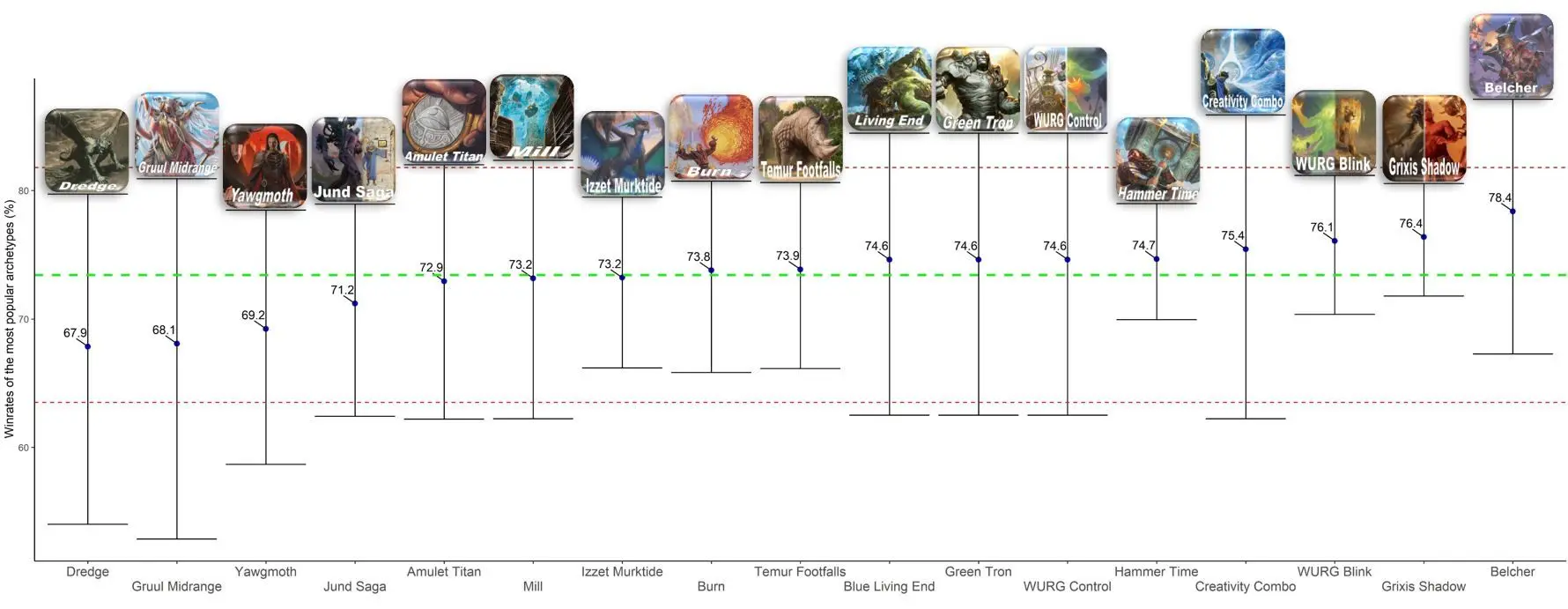
Archetype Win Rates
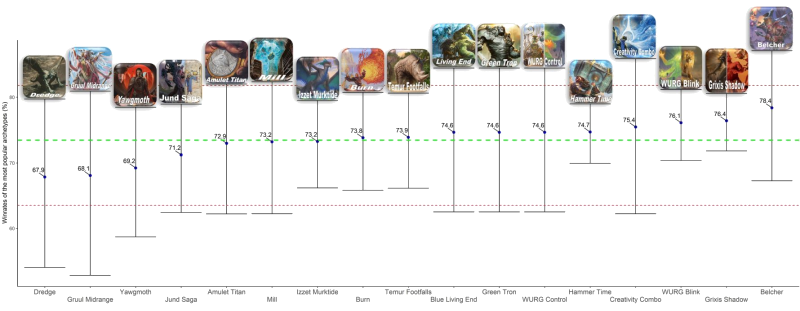
Do you think that so many win rates this much above 50% is abnormal? Don't worry, it was all planned. Or at least, it is to be expected. After all, as mentioned earlier, we only have data on the best-performing decks in Challenges/Preliminaries. So rather than the actual win rate, it is rather a metric of whether the deck tends to win tournaments or is at the lower end of the Top 32.
Belcher still looks very well positioned, and the most played decks also seem to have high win rates. Among the outsiders, Creativity also looks quite interesting, though its lower presence (meaning less matches) means that its win rate is even less reliable than the others, as you can see with the large interval. Besides, it might just have surprised people with the different build.
Displaying Win Rate and Presence Together
So now we have the data for both the presence and win rate. Let's visualize it.
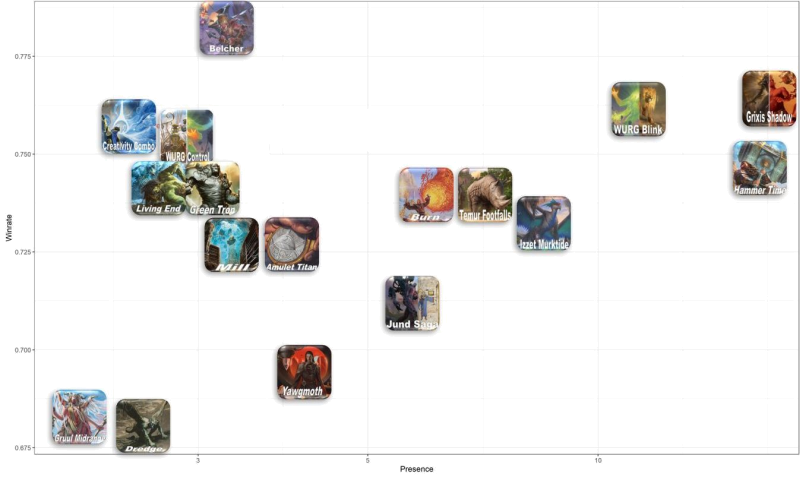
It is interesting to note that there seems to be a stronger correlation between the win rate and presence than we saw previously. The big exception is Belcher, which is famous for being underplayed. (It is not a playstyle a lot of people enjoy, and it also has to be underplayed, in a way, because, when it is played a lot, it receives more hate and immediately becomes much worse.) We should also be glad to note that more decks appear on the graph than previously, which suggests that last month's trend of increased concentration on a smaller number of decks was just a temporary thing.
Once again, do not worry. I know that you like to see what happens outside of the top tiers too, so here is the complete picture (with tiers based on presence only, the only metric most other tier lists would use):
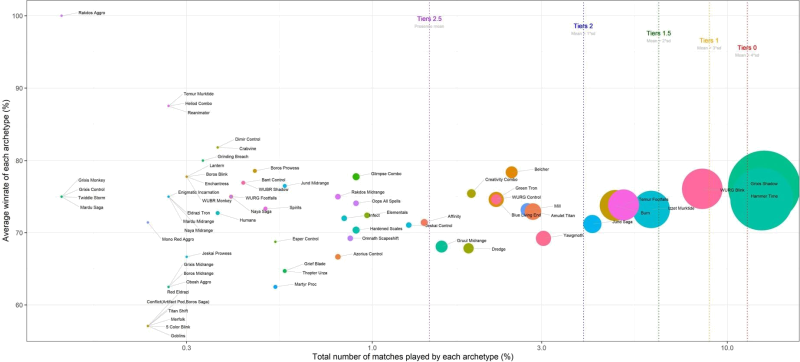
Are you wondering what that lonely dot in the top left side corner is? You can guess that it comes from a Preliminary given its minimal presence. Here is the corresponding list (which actually looks closer to a midrange than an aggro deck now that I check it manually, so this could need an update):
| Rakdos by JMM, 4-0 at Modern Preliminary, January 7 | ||
|---|---|---|
| Main Deck | Sideboard | |
|
|
|
From Data to Tier List
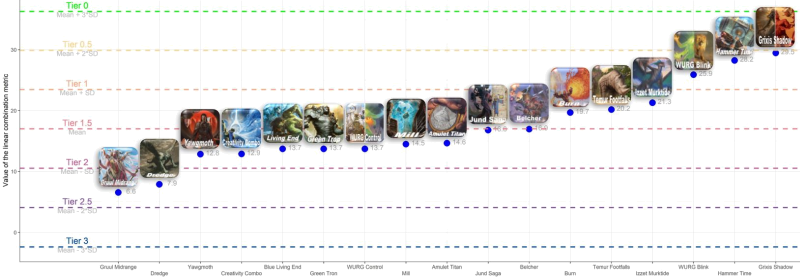
Now that we have the data on both metrics for the most represented decks (above the average presence), we can use the same normalization formula as before on both of them. Summing up then gives us a value we can use to rank the decks.
Note that I recently changed the formula for the points a little. Here are the old and the new formula:


Basically, as someone mentioned months ago in the comments (yeah, it took me a while to get to it)—the values don't go up to 1 when you divide as you do in the first formula, because you already reduced the values on the numerator by subtracting the minimum value, so the maximum of those values divided by the maximum of the initial values is not 1. Overall, it doesn't change much, but it might re-equilibrate a little the impact of both variables in the presence, as the mark for the maximum value of presence will be the same as for the maximum value of the win rate.
The tier list is then generated by setting the average of those values as the threshold for tier 1.5, and then adding or subtracting standard deviations to change tiers.
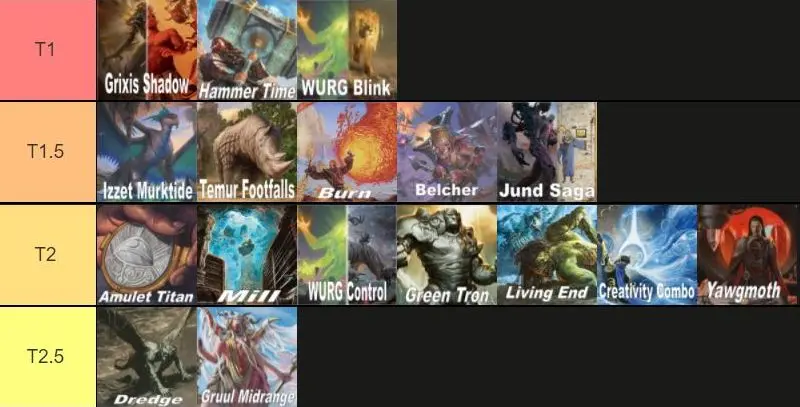
If you want to toy with the template, you can find it here on Tiermaker.
Conclusion
This is it for the month! If you want some more data, you can also check out the win rates of decks with or without companions as well as some of the most powerful MH2 cards on Twitter. I had prepared these in anticipation of the banning announcement.
See you in about a month for the next metagame update! (Or maybe earlier for another type of article? Who knows …?)
Opinions expressed in this article are those of the author and not necessarily Cardmarket.