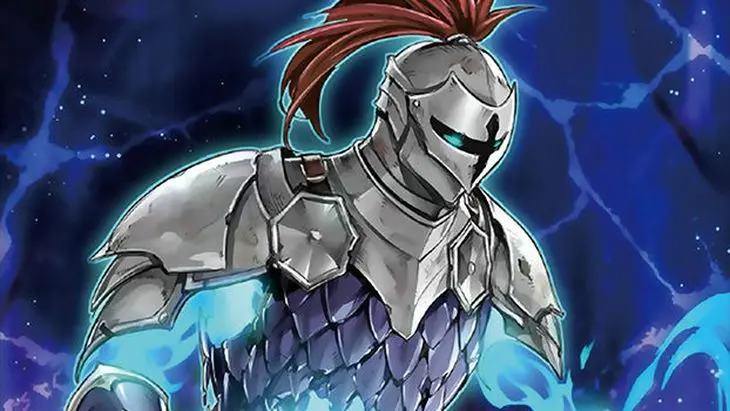
Phantom Knights decks come in a variety of shapes and forms. The way to play Phantom Knights is totally up to the duelist who is piloting the deck. This article describes the different takes on the strategy and what implications each version has for gameplay as well as deck design.
Each version of the Phantom Knights has its pros and cons. Which one you want to pick will come down the opposition you expect to face as much as your playstyle. Before we get to the different versions, I want to mention that every single one of them utilizes the Burning Abyss engine in the main deck, including , , , and/or .
1. Pure
This is my favorite version of the deck. This deck utilizes the phantom knights cards to their full potential by ending on a board of via . The Dragon is a powerhouse of a card, its monster effect negation insanely powerful. In a format that is ruled by monster effects, nine times out of ten, you will win the game with a card like this on your board. The weakness of this deck is spell cards, , , or can flat out end your board. However, not all is lost since you will still have a card like set, which can still interrupt your opponent's plays to get you another turn.
2. Dragun
If we are talking about playing it safe, this is the deck for you. Some duelist refer to the pure version as a "win more" strategy. With the dragun package you can still end on , , and a , giving you one omni-negate and four potential monster negates—three from Apollousa and one from the Blade. The upside of this deck is that it utilizes what is arguably the strongest card ever printed in Yu-Gi-Oh!, Red-Eyes Dark Dragoon. However, if you run the dragun package, you also have to include , , and . All three are cards that are considered "bricks" if you open them. More duelists are piloting this version of the deck.
3. Destiny
With the release of Burst of Destiny came another powerhouse of a card in . The versatility of this card is incredible. The difference between the destiny hero package and the dragun package is that you essentially have no bricks. You get another interruption on your opponent's turn while playing cards like , , and . In a strategy like Phantom Knights, whose strongest point is consistency, the destiny hero package doesn't just add to that; it also adds another recurring interruption your opponent has to deal with.
4. Destiny 2.0
At my locals in Albania, one of the duelists I was playing against, Gjyzel Gjyzel, put a rather interesting spin on the destiny hero package. Instead of going for , he used the effect of to send , with and as materials, to summon . This might be considered a budget version of the package. You can use either Celestial for its draw two effect or as an extender. The only mandatory destiny hero that needs to be included is Dynatag in order to use its effect to make Dystopia live during your opponent's turn. As a fellow duelist, I really enjoy rogue spins on popular strategies, and this type of package might be an excellent alternative to players who cannot afford a card like Destroyer Phoenix Enforcer but still want their deck to be versatile.
+Artifacts …?
On top of the versions listed above, some players have been experimenting with the artifact engine, using cards like and . However, I would not consider this a separate version of the deck as much as incorporating a small engine. After all, the playstyle does not change that much with the inclusion of this engine.
Conclusion
I have mentioned in my other articles that Phantom Knights is one of my favorite decks this format. With the reprint of in the 2021 Tin of Ancient Battles, the strategy is not only fun to play but should also be affordable for most people. The versions mentioned in this article are the best options to play, and depending on your budget, you can definitely still compete with Phantom Knights in major events.
Opinions expressed in this article are those of the author and not necessarily Cardmarket.