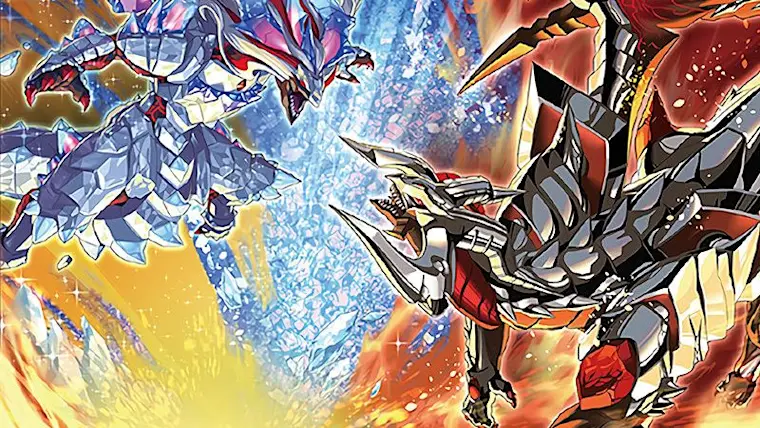
Structure Deck: Albaz Strike has dropped, and immediately the Despia/Branded deck started racking up finishes in the top of cut of various tournaments. It is all thanks to one engine that is splashable into many decks. Today we talk about this engine and its potential effect on deck building in the future.
Following up the same concept of previous fusion engines, the branded engine offers easy access to big fusion monsters using materials from your deck. Sounds familiar, right? We have three engines that basically do the same thing, , , , and . Curiously enough, all of these fusion spells are evolutions of another spell card that debuted in August 2006. was the first card to apply the concept of fusion summoning from deck. At the time, it was an insanely powerful mechanic, and therefore the card came with restrictions (that were increased over time with erratas), which gave the opponent ample time to respond to it before its effect took place.
The Star of the Show
is the card that makes everything possible. It can only be used once per turn (thankfully) and its only restriction is that it locks you out of any extra deck monster that is not a fusion monster. Looking at the restrictions of Red-Eyes Fusion and Fusion Destiny, we can safely say that restrictions are slowly being lifted. Who knows, in the future the norm might actually be fusion summoning from the deck, or we might get a generic spell card (not Future Fusion) that can fusion summon any monster by using the materials from deck. One can only dare to hope, but I admit it sounds like a bad idea already.
Branded Fusion specifically needs as material for whichever monster is being summoned. The summoned monster has to list Fallen of Albaz as a material, which means that it is not generic enough. However, the monsters themselves can end up helping you go into other generic fusion monsters. You simply need to choose your other material wisely. Also, Branded Fusion can use materials either from the deck, hand or field. This assures that it is always live even if the materials are no longer in your deck. Think of it as a consistency boost in a way.
The Protagonist
Fallen of Albaz has been through quite a journey before ending up in this structure deck. While it is technically considered a brick since it is a card you must play two to three copies of for your engine to function, its effect is actually that of a mini . Upon summon, by discarding one card, you can fusion summon using Albaz and a monster from your opponent's side of the field without using any fusion spells. It is a decent non-targeting, non-destruction spot removal, but probably very situational. Being a level four and having 1,800 attack is also quite decent.
The Supporting Cast
For the main deck, that is really all you need, unless you are playing a more focused Despia/Branded strategy. In that case, you have to search for . can also search Aluber, which gets you to Branded Fusion. Another new addition is . While it requires a little more of a setup by having a fusion monster that lists Albaz as a material already in the graveyard, it can special summon itself to search Branded Fusion while returning another card from hand to the bottom of the deck.
The Extras
The main thing you want to do with your fusion monsters, tutored to the field through Branded Fusion, is to let them help you summon more fusion monsters that might be impossible to summon under normal circumstances. Let's start with the first example. You use Branded Fusion to send Albaz and to the graveyard to summon . Albion gives you the ability to fusion summon one more time by banishing materials from the hand, field, or graveyard. I have to stress that Albion lets you fusion summon any fusion monster, not just monsters that list Albaz as a material. By banishing Albaz and Hex-Sealed Fusion, you can summon a on the field. Granted, Dragoon will lose its destruction effect that comes with burning your opponent's lifepoints, but it still retains its ability to negate. Being able to summon Dragoon without using the restrictive Red-Eyes fusion or having more bricks in your deck is quite impressive honestly.
Back to Albion itself. It has a decent 2,500 attack and a secondary effect that lets you either add to hand or set a branded spell or trap directly from deck during the end phase of a turn, at which point it is sent to the graveyard, meaning it can set up another Branded Fusion for you to use later.
As a counterpart to Albion, we have . Lubellion requires a dark monster as material, as opposed to Albion, which needs a light monster. Its effect is somewhat similar to Albion. Upon summon, by discarding a card, you can fusion summon a level eight or lower fusion monster by returning the materials to the deck from the field, graveyard, or even face-up in the banished zone. Let's say you used a Shaddoll monster as material to summon Lubellion. You can shuffle back that same monster along with Albaz (which is a dark monster) to fusion summon the walking floodgate, . Lubellion then cannot attack for the rest of this turn, so it is not a bad thing that it has 3,000 defense.
We also should not forget about , which is the boss monster of the strategy. Using either Albion or Lubellion, you can summon this card to your field. As a quick effect, once per turn (two turns technically as you cannot use this effect in consecutive turns), you can send one monster that mentions Albaz as material from the extra deck to non-target banish a monster from the field. If you sent Albion, its effect will activate to give you a branded spell for later. Also, if Mirrorjade leaves the field because of an opponent's card, it turns into a during the end phase.
The Places Where the Show Is Playing
So basically, apart from the Despia strategy, any deck that relies on fusion summoning is an ideal partner in crime for this engine. Take Cyber Dragons for instance. Branded Fusion by itself can give you enough damage on board going second through and . As mentioned previously, Shaddoll is also a contender. Dogmatika variants are also interesting since you can send through Mirrorjade.
The only thing is that is not a good fit for this deck. If Anaconda is used to summon either Albion or Lubellion, there will be no further plays and both dragons do nothing by themselves. Hence, other decks might prefer to fit the engine instead, but decks that primarily rely on fusion summoning would and should take advantage of this new engine.
The Price of Admission
This is one of the most anticipated engines of the year and makes the Despia deck a meta contender. However, it remains to be seen the splashability of this engine into other decks and whether a future banlist that gets rid of Anaconda might make it even more appealing. Only time will tell.
Let me know in the comment section below which other decks this engine could fit into, and what your plans are for this engine!
Opinions expressed in this article are those of the author, not of Cardmarket.