
It was June 11 and like much of Europe I had my eyes glued to a screen eager to get the first results. Who would win and who would lose? An exciting month lay ahead. Admittedly, unlike almost everyone else, I had my eyes more on Cardmarket.com in an open browser tab than on any of the football games on TV.
Indeed, the beginning of the UEFA European Football Championship coincided with the Modern Horizons 2 prerelease, and both entertainment properties were to have their ups and downs. Well, mostly ups, as it turned out. Being part of a Danish-Italian household living in Spain, there were enough teams to root for. But even more surprising than three teams somewhat relevant to us making it all the way to the semifinals was the rise of something else. Something that was supposed to fall. Because Wizards had finally decided to drive the price of enemycolored fetch lands—

No More Fetch Tease Throws
This time we were not talking reprinting fetch lands as expeditions or box toppers, or teasing us with a trickle of mythics in some limited print-run set. It wasn't even a case of draining our wallets into the voracious vacuum known as the Secret Lair. Announced nearly a year or so ahead, the whole world was aware that the five enemy fetches were coming as rares in Modern Horizons 2. And the world rejoiced.
Fetches for all! Affordable fetches for all, many of us cried with tears in our eyes running around the streets and waving our arms in touching scenes of celebration. And most people in need of more fetches, which is almost everyone who plays Magic, probably decided to put off buying their fill until that glorious day when Modern Horizons 2 was to hit the shelves.
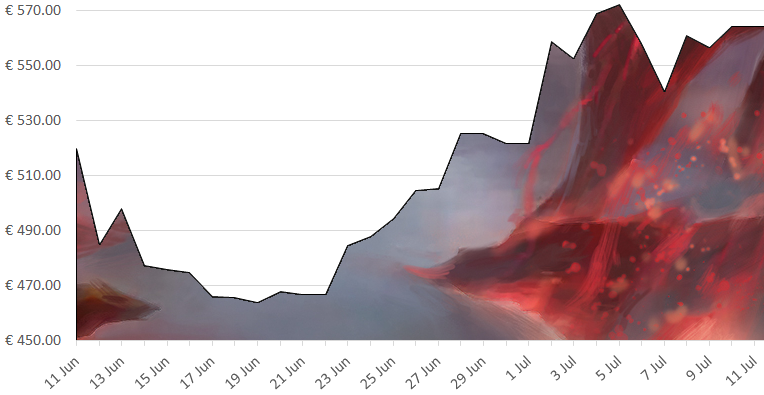
As we all know, there are two categories of Magic players. Those looking to buy their playsets of enemy fetch lands and those looking to buy their supplementary playsets of enemy fetch lands. At least that is the impression one gets when you examine the price development of
Caught up in the wave of "FOMO" (fear of missing out) washing over the Magic community, I studied the tea leaves as laid out by financial cardboard gurus. In the end I decided that this would be right the time for me as well to buy those twenty cards that always seemed to be missing whenever I dreamed of putting a viable Modern or Legacy deck together.
How Much Will A Fetch Fetch You?
I got out my calculator and made the decision to jump in once a playset of each of the five lands could be had for €400. You know, €25 for each blue one, €20 for each Verdant Catacomb, and €15 each for the eight white ones. Somehow I really believed that the cards would eventually drop so far.
So I did what any Cardmarket user would do and created a wants list with the twenty cards in question (in my case the vanilla versions without foil treatment, art extensions, or any other bells and whistles). I ran the list through the shopping wizard a couple of times a day and only kept the lowest result in my spreadsheet.
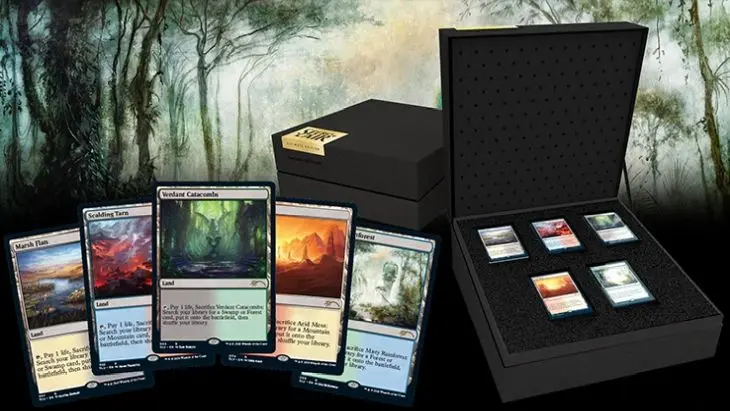
I had the shopping wizard set to look exclusively for sellers in the EU. (Sorry, my English, Swiss, and Norwegian friends—if I had known I'd end up doing an article about this originally purely personal project, you would all have been included.) Besides that, I chose the "Reduce Price" mode each time because I am fine with getting my cards in multiple shipments.
Here's how the total price developed for the first month following the prerelease of Modern Horizons 2, including shipping to Spain:
Looking at that curve it is obvious that things turned out not as I had hoped nor as I had expected, and that begs the question, why? Surely the streets should be paved in cheap fetches by now and it would just be a matter of bending down to pick them up, gently wiping off any milk and honey. What happened?
Let's first take a look at the price at prerelease. If you had the liquid capital in your Magic budget and needed enemy fetch lands, you would very likely have been a bit suspicious about anyone offering you a playset of each including shipping for €520. Quite expectedly, since the market had ten months to adjust to the new influx, prices had already gone down between the announcement and the release.
But future supply is not completely tangible until it is actually on the market. So naturally a further downward adjustment was to be expected. And it did come, when stores and individuals began opening their boxes. The following upward price trajectory was also expected. All that pent-up demand from people just like me who had waited since the announcement of the upcoming reprint. This caused a minor price spike toward the end of the first weekend.
But with everyone back to work, sellers got nervous that no one was buying their cards anymore. So again prices went down. Calmly I watched the numbers crawl downward day by day. They appeared to stabilize somewhere below €470, but I was certain that this was just a plateau caused by those not patient enough still buying in, incentivizing sellers to keep prices unnaturally high before the final crash.

The Only Thing to Fear Is FOMO Itself
I did not understand the impatience of some of my fellow buyers sitting on the demand side. Why couldn't they just hold out a little longer? Together we would make the suppliers sweat and compete for the coins in our piggy banks marked for Magic. But here they were recklessly throwing their savings into the last expensive fetch lands for a long time to come! Or so I thought.
From June 22 to 28 dark clouds gathered. Prices once again climbed despite the wise men of economics still forecasting clear skies ahead. But I knew it was just a passing summer shower when the price curve went flat for the following four days. It had gone back to its prerelease level and naturally there was only one way to go from there. More sealed product would be hitting the shelves every day and very soon I would be able to order my cards.
Payday Panic Price Pressure
Then came the first day of July. But instead of paychecks being spent on boxes of Modern Horizons 2 to crack and flood us with more supply, everyone apparently chose to throw their hard-earned money into buying singles … at any cost! Five days into the new month I would have had to pay €50 more for those twenty cards than before the set came out. Prices soared and went above €570.
Bemused I read about how the cards became ever cheaper day by day across the Atlantic, while the exact opposite happened here in Europe. It is my impression that cards often are cheaper here in Europe because Cardmarket makes it easier for the small sellers to compete. Yet something must have been different this time.
So what made the price curve for MH2 enemy fetches develop in a different way than I had expected? First off is the fact that I am no expert on the subject and my predictions are those of an amateur who listened to what random people on the internet had to say.
While this is very likely an important factor, so is the fact that the demand was just higher than anyone had foreseen. There was the long pent-up demand from all those who who had put off their purchase for the past ten months. In addition to this, there was the more recent demand due to the return of paper Magic after more than a year of restrictions on gatherings.
Fetches Make the Modern World Go Round
Modern has for a long time been the most popular paper format and fetches are indubitably Modern's most important cards making for even more demand. Of course, itself a direct-to-Modern product, MH2 helped to spark or reignite interest in the format.
I have seen it suggested that fetch lands don't appear in sealed product with a high enough frequency to affect single prices substantially. The price decrease in the US contradicts this unless sealed product is a lot more expensive here in Europe compared to single prices for fetch lands.
It could also be that a month is just too short a time horizon. To get a better idea of this, I should probably have made notes on how much supply was available for each of the cards. The idea struck me too late to get any useful data. But in the four or five days between when I first thought of this to when the first month of tracking the prices had passed, I did note one thing. The supply of normal border
In that sense, it could also be the case that sellers do not really have that much success unloading their stock but that the prospect of selling at higher prices is just too tempting to make them lower theirs. I guess in the end only time will tell if supply will build up enough for panic to shift from the buyers to the sellers.
Go Fetch!
There is one thing I learned while spending an entire month waiting to buy cards I had already waited nearly a year to buy. It's that I can wait. If I can wait this long, I can wait a lot longer. In the end, if prices don't come down, I will probably do fine holding out for the next meaningful reprint. I mean, we live in a world where you can get
Anyways. This was just the view of one buyer and a casual one at that. But I would really like to hear your thoughts on the subject. As buyer, as a seller, or as someone who actually has an idea about economics—please share your insight and your fetch land stories in the comment section below!

Opinions expressed in this article are those of the author and not necessarily Cardmarket.