Fifteen Times Green Was the Best at Card Draw

Everyone knows drawing more cards than the opponent is one path to victory. Also common knowledge: blue has the best tools for the job. What color comes next is more debatable. Are you ready to embrace green as the card-drawing runner-up to blue? Because green was ready for that designation since 1993.

forest - ancestral recall


Physically drawing cards (by moving them from the library to the hand) isn't the only possible form of card advantage that takes place in a game of Magic, though it's the most obvious, as well as desirable. Nothing makes us think "I'm going to win this game" with the same conviction as having more cards left in hand than the opponent on an equally balanced board position.

The Colors and Their Card Draw

Different colors specialize in different types of card advantage. White, for instance, has sweepers that can easily neutralize several cards at once, while costing us only one. On the other hand, it's notoriously bad at direct card draw. In fact, there are only eight Eternal (formerly known as "black-bordered") monowhite spells that draw more than one card, and some of them are symmetrical effects.


secret rendezvous thirst for discovery

Blue is clearly the undisputed champion of this race, always getting straightforward "draw X cards" spells, even at lower rarities, as well as better ways to rather than draw blindly. It also employs "," which requires discarding after drawing, but still has a net positive impact on the hand. The number of Eternal cards with a monoblue identity that feature the words "draw" and "card" in their text is a whopping 697. It's the only color marked as primary for card draw in the 2021 Mechanical Color Pie article.

Red is given the reverse of looting, which is called "" and involves discarding before drawing. It can still lead to (effective) card advantage, particularly when the discard is mitigated by pitching surplus lands or dead cards, or when it's a condition and not a cost, so it's possible to . On top of this, red has exclusive access to "," but in that case the cards aren't actually drawn and must be played within one or two turns. As a consequence, there are only 168 Eternal cards with a monored identity that say both "draw" and "card."


reckless impulse deadly dispute

Owning 241 of such cards versus 214, black is green's only real contender for the position of runner-up to blue, especially where the more massive forms of card-drawing are concerned. Both black and green are marked as secondary in card draw in the latest Mechanical Color Pie review. The typical black draw turns either life or expendable permanents into cards. But it's also frequently a one-shot burst draw achieved through instants or sorceries. If we compare the number of permanents that draw cards, green slightly surpasses black (154 versus 151), in particular when it's about drawing multiple cards over time. This conceptually tracks, as black's philosophy is about wanting things done in the present, while green is more inclined to invest into progressive growth.

A little-known Magic tale recounts how Richard Garfield, while designing what would become Limited Edition Alpha, considered putting into green. After all, the name alone evokes memory, which is a blue component, but also heritage, which is a big part of green. It's significant that green was envisioned, from the get-go, as one of the two colors more apt at replenishing the hand, except through a flavor of looking at the past rather than the future. This characteristic of green was later obfuscated by its predominant role as "the creatures color." This notion induced to identify aggro strategies as green's chief domain, often putting it at odds with control, which is more commonly associated with card draw. But green would never cease to be the color that could rival blue's sheer access to the library. For one, both colors are tied for primary in .

The Green Deal

Here are fifteen separate areas that speak to green's card-drawing excellence, listed in chronological order and represented by the card that best embodies each effect. No other color, not even blue, counts as many.

1. (Legends, 1994)

sylvan library

Exchanging life for cards. This is not in green's color pie anymore, more appropriately moved to black, where it became the color's main card-drawing deal. But Sylvan Library remains a beloved staple of Commander and some Legacy sideboards.

2. (Tempest, 1997)


recycle

Play a card, draw a card. Green is very good at generating a flux of continuous self-replacing resources. But in modern Magic this kind of green effect was detached from instants or sorceries, allowing only permanents to be used for that purpose—in particular creatures, enchantments, or lands. Recycle was part of infinite draw combos involving and another extremely powerful, old-school green card, .

3. (Stronghold, 1998)


wall of blossoms

Creatures with enter-the-battlefield draw. It's one of the most effective cantrips in the game, because it gives us board presence without setting us back on cards in hand. The very first instance of this ability was from Ice Age, though the draw in that case had to wait for the next upkeep. It's now a very common effect in green, appearing . Other than the efficient Wall of Blossoms, other cantripping creatures include the simple and the Commander favorite , whose card draw can be repeated via recursion.

4. (Urza's Saga, 1998)


argothian enchantress

Cast an enchantment, draw a card. The iconic "enchantress" effect has been in green since Alpha's . But it became a legitimate engine only with the printing of the cheaper and more resilient Argothian variant. More cards of the same type have been released over the years, including and .

5. (Urza's Saga, 1998)


fecundity

Creatures with a death trigger draw. Single instances of the ability to cantrip upon death are fairly common, with being the most recent and the most rewarding. Fecundity would grant that opportunity to every creature, spectacularly comboing with sacrifice outlets like and token generators like .

6. (Urza's Saga, 1998)


greater good

Sac a creature, draw cards. Green believes in the natural cycle of death and rebirth, so it shares with black the possibility of transforming its creatures into different resources. Green's sacrificial card draw is usually linked to the power of the fodder, a clause we'd find again on cards like and .

7. (Champions of Kamigawa, 2004)


glimpse of nature

Cast a creature, draw a card. This has become green's major source of card draw over the years. Sometimes it's redefined as being triggered by creatures (usually nontoken) entering the battlefield, like in , , and . The original wording is found on cards like , , , and . They both have upsides and downsides: when it's looking at the act of casting, countering the creature spell doesn't prevent the draw; when it's an ETB trigger, instead, it can profit from effects that circumvent the stack, à la and .

8. (Planar Chaos, 2007)


harmonize

Straight-up draw cards. This was a color-shifted and is now deprecated color-pie-wise, but not out of bounds for Strixhaven's Mystical Archive. It's telling that green was the color they chose to host such an archetypal blue effect. Similarly, Planar Chaos had relocating the effect into green.

9. (Eventide, 2008)


regal force

Draw cards equal to the number of creatures on the battlefield. This is as flashy as green card draw can be. Of course it had to be linked to creatures, putting from Mercadian Masques on a stick. The ultimate for applied the draw to the other type of permanent that green most cares about, the lands.

10. (Zendikar, 2009)


oracle of mul daya

Play cards from the top of the library. This kind of ability essentially equals extending the hand size and can result in "drawing" several cards per turn. Among the many, glorious descendants worth mentioning are , , , , , and .

11. (Magic 2012, 2011)


garruk, primal hunter

Draw cards equal to the greatest power among creatures we control. A first attempt with failed at delivering on this front because the spell required targeting, so the entire effect could easily fizzle. This Garruk and the cards that followed his example (, ) fixed the wording.

12. (Kaladesh, 2016)


nissa

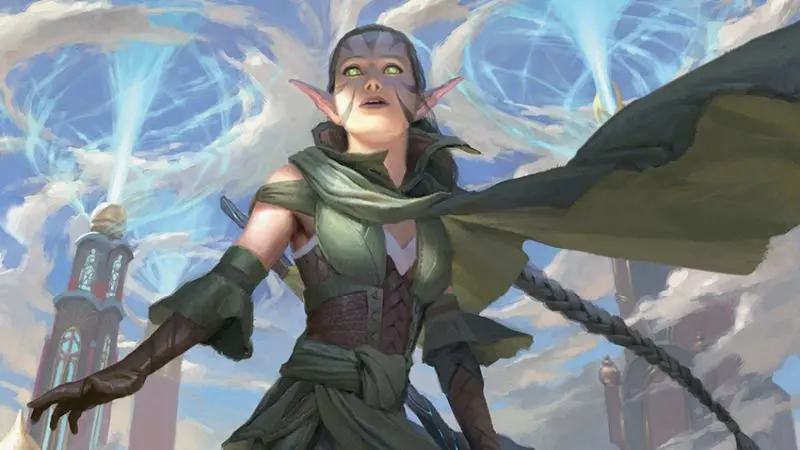
Drop a land, draw a card. Curiously, this ability, which feels as green as they get, has been recently moved to Simic (, ). The easily achieved ultimate of Kaladesh's Nissa remains one of the best iterations of this repeatable card draw that requires the least effort to enable.

13. (Core Set 2020, 2019)


season of growth

Target your creature, draw a card. Of course fight spells are the most efficient way to exploit this ability, as had already demonstrated in its own peculiar way.

14. (Core Set 2021, 2020)


elder gargaroth

Attack or block, draw a card. This is somewhat new technology, despite seeming overly obvious for green. The cheaper provides a different take on the concept.

15. (Kaldheim, 2021)


toski

Connect, draw a card. Toski is the crowning achievement for this kind of "saboteur" card draw. It originated with in 1997, then later appropriately moved to green creatures like , , , and . It also exists in Aura form ( as a color-shifted , ) and as a one-time effect on instants like , which turn it massive.

Honorable mentions go to all green card-drawing effects that are based on the opponent's actions, like , , and . Also, all cards that cheat something into play after looking at the top, like , , and , as they essentially draw the card for us before processing it. In Alpha, was the first of a family of green effects that are more correctly classified as recursion (movement from graveyard to hand or from graveyard to battlefield). They don't necessarily constitute card advantage when they're one-for-one, but qualify.

Bottom line: green might not access the library with the effortless ease blue always displays, since green's card draw typically requires some specific condition in order to take place. But when those conditions arise, no other color is a match for it. That's the reason why green gets "drawing matters" cards like . And when green and blue form their much-feared Simic partnership, well, nothing else can really keep up with their pace, as past and future coalesce into a supermassive, card-drawing singularity.


Opinions expressed in this article are those of the author and not necessarily Cardmarket.