
Once upon a time, when Magic was born in 1993, there was no concept of restricted and banned cards. To be precise, the concept of "maximum four copies of a single card per deck" didn't exist either. I don't know if you ever heard of the format "Alpha40" which only allows cards from Limited Edition Alpha. There you can build a deck without any limit, meaning for example 15
Since those (happy) days many things happened in Magic. The past 26 years saw the introduction of "formats," the blocks, the rotation of expansions, and of course … the banned and restricted list!
No Alarms and No Surprises
Let me tell you a little story: the other day I won a "mythic wildcard" on MTG Arena and I immediately went to the shop to get an Oko. After quick reflection, I changed my mind thinking, "Oh wait! this guy will surely be banned."
Then, just a few days later, the following news came out:
November 18, 2019 Banned and Restricted Announcement
- Standard:
is banned. is banned. is banned. - Brawl:
is banned. - Legacy:
is banned. - Vintage:
is restricted.
Well … I don't want to pretend I'm a genius or a prophet. The banning of Oko in Standard was easier to predict than a victory of Roger Federer against a weekend tennis player. In fact, after 25 years, we as Magic players have developed a pretty good grasp on the logic and the dynamics that lead Wizards to ban and to restrict cards. It's often easy to know them before they get announced.
But … has it always been like that?
No Alarms. But Some Surprises

Let's go back in time. It's January 1994, and the first banned and restricted list in Magic history is released. Some background: at that time, the printed sets were Limited Edition Alpha (August 1993), Limited Edition Beta (October 1993), Unlimited Edition (December 1993), and the first Magic expansion, Arabian Nights (December 1993). For obvious reasons, there was no (or little) information available on decks played and tournament results, nor was there official and reasoned analysis of play aside from what the designers, the playtest team, and the first Magic fanatics contributed.
Last but not the least, the concept of a "format" didn't exist yet, as you were just "playing Magic." Here's what came out:
Restricted Cards
Banned Cards
I don't want to argue about the bannings here: as you can see, they're all "play for ante" cards other than the mighty
Let's take a deeper look at the "limitations"—that's the expression they used at that time. First, there's the obvious restriction of "the jewels" (Moxen,
-
was flash-banned only one month after going on sale. It's true that removal wasn't as common at the time, but … was it worth restricting the card? -
Everyone loves
. It also saw some play in Infect decks many years later. Restricting a card that doubles the power of a single creature and kills it in the process seems dubious nevertheless. -
: maybe someone died from an here? It's true that land destruction was an archetype in 1994, but still. -
: "Big Red" didn't even exist yet. -
was a powerful card back in the days, but there's no call for restricting it.
A Brutal Comparison
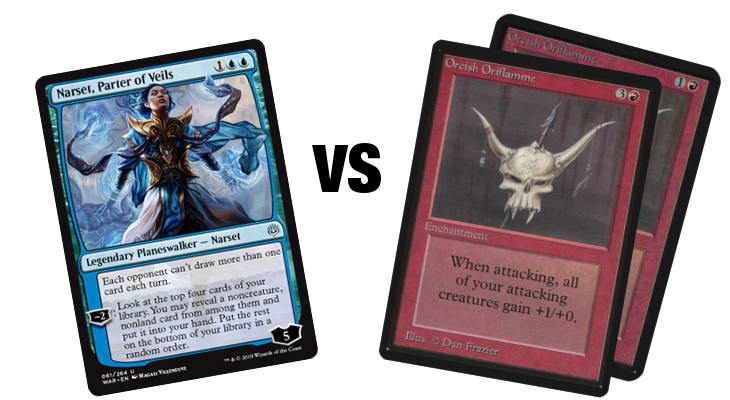
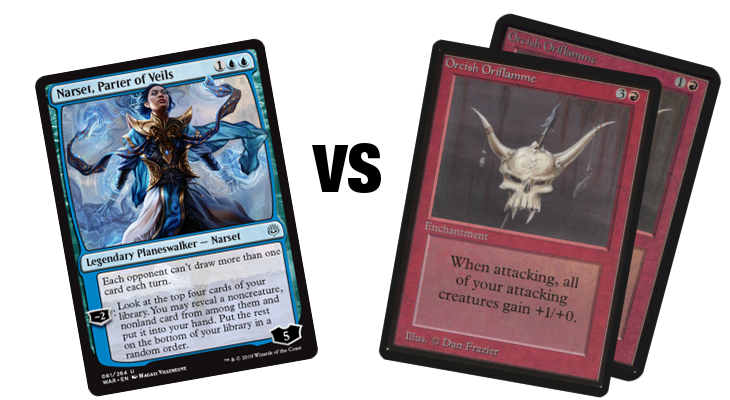
You probably agreed with me on some of the absurdity so far. Now take a look at a card restricted in Vintage in the last few days and a card restricted back in 1994. It's true and important to underline that the Alpha version of
Narset, by contrast, costs only 3 mana, stops your opponent from drawing extra cards, potentially tutors for two cards at your convenience, and isn't susceptible to creature removal. Can you notice a slight difference?
A Matter of Power Level?
Through the years, but more often in recent times, I've read and heard many people arguing that the power level of new cards is much higher compared to old cards. This can be true at a general level, but can it justify the difference in the cards banned and restricted last week compared to the ones restricted back in 1994? And while it applies to cards such as Oriflamme or

I personally think that the experience acquired, the team working on Magic, and the amount of data available now through the web—remember that the first banned and restricted list was published on Usenet—leads to precise and punctual decisions on that kind of matter.
What the Two Lists Have in Common
You might argue that it's obvious that the first banned and restricted announcement has got nothing in common with its equivalent nowadays. And that leads to the crucial point of this article: if now, at the end of 2019, all what concerns Magic is more detailed, tested, balanced, and improved—why do two cards get flash-banned only one month after their release, just like
I'm not saying there was a design error or a lack of playtesting, because maybe Oko and
Conclusion
In these 25 years, the banned and restricted list saved not only the game, but also the sanity and the wallet of many Magic players, that's for sure. I hope you enjoyed this jump to the past. I'm convinced that if you browse the history archives—as I do often—you will notice many other similarities to modern Magic, more than you would think.
For example, who else had a flashback thinking of Shandalar while downloading and playing MTG Arena?
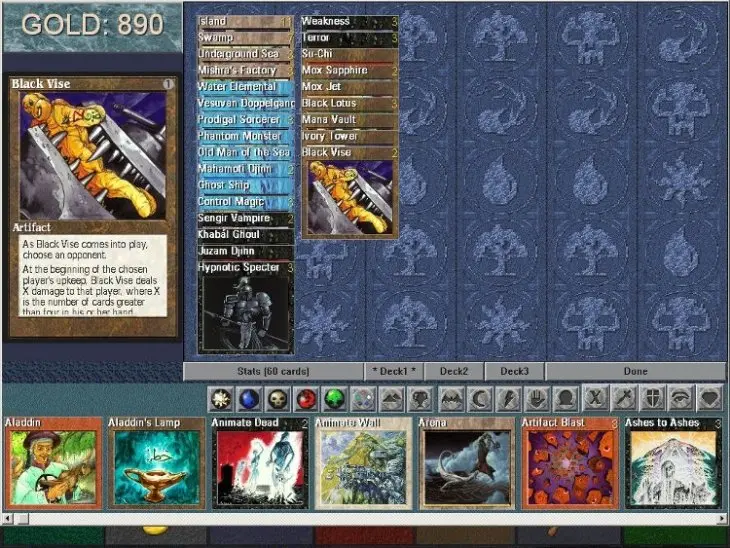
Finally … If you're disappointed about the money you've lost when Oko went from €45 to €25 on Cardmarket, just think of a player that had multiple copies of all the Moxen, Lotus, and
Opinions expressed in this article are those of the author and not necessarily Cardmarket.