
So, how do you draft responsibly?
Step One: Don't Marry Your First Pick
The first step is pretty simple. Don't let your first pick exert too much of an influence over the rest of your draft. For example, I first pick an
Tatyova and Archangel don't overlap in their colors, but neither is going to be very good if the only way for me to play it is to fill the rest of my deck with medium to bad cards. For this reason, as well as the very high synergy elements of the set, you should stay open and pick what you feel is the best card in your first few packs, regardless of what you have picked before. Of course, you can use previous picks as tiebreakers between cards you feel are more or less equal, but the principle still applies.
What you are really looking for when you're staying open like that is as simple as this: You want to find the open colors and try to figure out what other people at your table might be drafting—particular those close to you/to your right.
"But Jonatan, I can't see what cards the other people are picking!" you may say. And while that is true, you're looking for the colors that other people aren't drafting! For example, if you see a
Identifying the open colors has several advantages for you. In later packs you can wheel cards that are great for your deck but a little too narrow for others, such as
Step Two: Find Your Anchor Color
What is an anchor color? It is simply your primary color, the one that constitutes the majority of your cards. I provide a couple examples below.
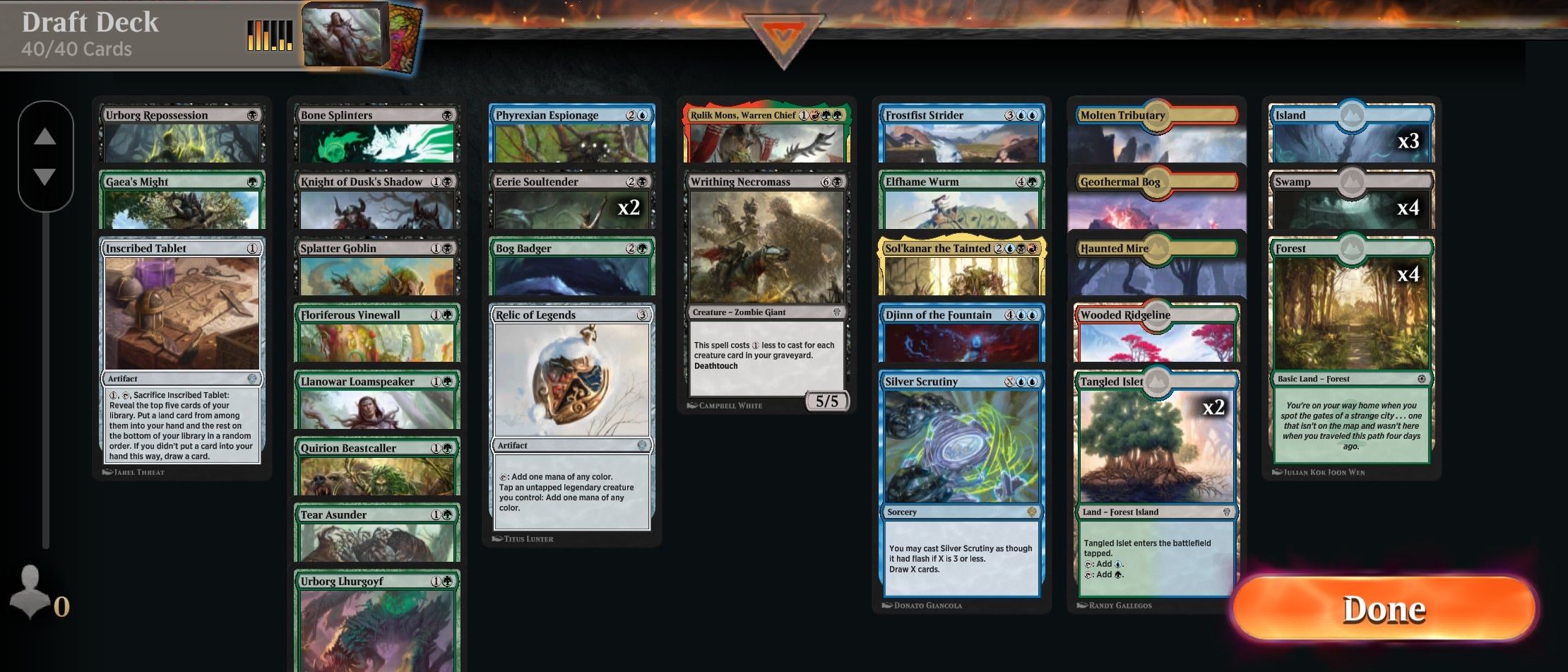
This deck, while containing four colors in total, is firmly anchored in green. The two-drops are mostly green, and the "splashed" cards are higher up on the curve to give you time to find all of your colors. The green cards also help you hit your lands and colors, with
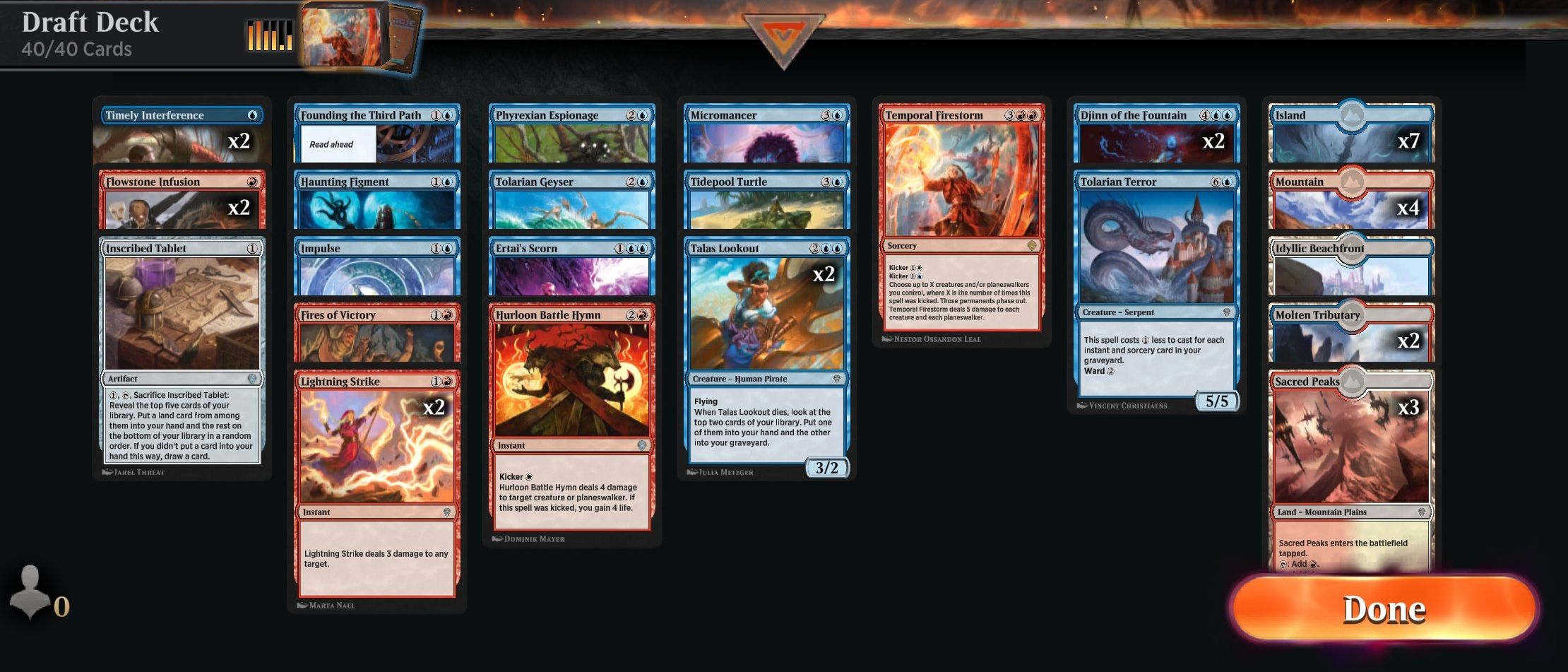
Going down to two colors, we can see a firm anchoring in blue. Red is mostly complementing the deck in terms of interaction, but all the threats and "engine" cards are blue. This gives you a vital advantage in your mana base, as all the spells you want to cast early and proactively are blue, while your reactive cards are in red. It means you are more likely to be able to afford to keep a hand with only blue lands. You can see it as a form of fixing, as your early setup and your mana requirements allow you time to find your colors.
Depending on your anchor color, your Dominaria United draft will likely go in one of the following directions.
| Anchor Color | Archetype Direction | Best Paired With |
|---|---|---|
| White | Go wide tokens | Black, blue, red |
| Blue | Spells matter | Red, black, white |
| Black | Graveyard matters | Blue, green |
| Red | Aggro | Green, white, black |
| Green | Domain | Black, blue, red |
In essence, the heavier you lean into a certain anchor color, the more you will be drawn to a certain theme. This dictates what synergies you are going for, and what dual lands you are most looking to pick up.
Signs from Go(l)d
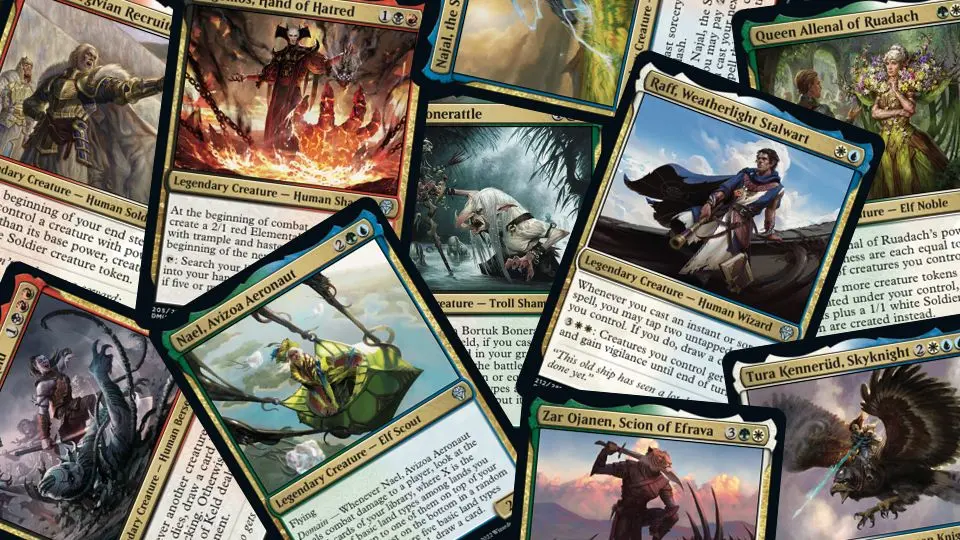
Of course, the signpost uncommons can also help you find a direction. There are two per color pair in this set, for instance
There's also a secret 21st signpost uncommon in Dominaria United. If you've drafted the set a bit, you may already know about it:
Otherwise defender tribal might seem like a meme deck, but trust me, in Dominaria the butts spank you. Or maybe, more specifically, the giant flock of Birds that the Chaplain brings along does. The key to this deck is, apart from the essential Chaplain,
Real Estate
With an anchor planted, we have to consider the question of the common dual lands. How high do you pick them, and how many do you even want? The answer is, as always, that it depends on your deck.
As a rule of thumb, the more aggressive you are, the fewer tapped mana sources you want in your deck. In a red-white aggro deck, I'd be hard pressed to include more than one dual. The first one is very good, as it gives you more consistent mana which is valuable no matter your game plan. However, you still want to curve out as well as possible and spend you mana efficiently. Having to play a tapped land on turn two or four can screw up your plan and let your opponent catch their breath and stabilize enough for you to lose the tempo advantage. As such, any tapped land after the first one is a risky proposition.


Playing tapped lands is always a cost, even in decks that actively want multiples. But the cost can be mitigated via cards that get you back on tempo or stabilize your life total. For example, cheap removal spells like
So how many tapped lands are too many? Of course, the more colors and the tougher the mana requirements of your cards, the more fixing you want. However, you often need fewer than you think if you have a solid anchor color. I would be hesitant to play more than seven dual lands even when my deck is five colors, eight being my absolute cap.
If this sounds like a lot of lands to you, you probably don't pick lands highly enough. The green lands are particularly valuable, as you will likely base your domain decks in green. The first two copies of duals are incredibly valuable to any deck not hyperaggressive. This is especially true in this format. Not only is domain a set mechanic, every kicker cost is off color, ergo not of the same color as the card itself. Being able to get some extra value out of your spells by kicking them can be the difference between winning and losing.
I usually take the opportunity to draft a land midpack if I don't see any other enticing or top-tier cards, rating each green dual in the C+ to B− range depending on what direction I think my draft is heading. Essentially, if I'm going for a four- to five-color strategy, lands will take precedence over any nonbomb card.
I have the same ambition to pick lands midpack even if I'm going for a more streamlined two-color approach, but I won't prioritize lands almost at all beyond the first or second dual unless I have a card I really want the option to kick. Ideally, I have one or two sources of the kicker color in the deck, depending on the value of the kicker. For example,
These are the most important lessons I've learned so far about Dominaria United. Though I'm positive that there still are plenty of things to discover about this format. It is one of the deeper and more rewarding sets of the last few years, with a ton of viable strategies. Maybe you will be the one to discover the next hot tech? I certainly hope so!
Happy drafting!
Opinions expressed in this article are those of the author, not of Cardmarket.