Greetings, everyone! This week I am happier than ever since I finally get the chance to talk about Premodern. It's a relatively fresh format, created only a couple of years ago, and is getting a lot of attention, especially here in my native Spain. A good friend of mine recently won the Spanish Premodern Nationals so invited him to share his experience about the format and the tournament itself. Let's welcome Pablo Suárez!
Background
Rone: Thanks for your time, Pablo. Let's kick things off with some personal info. Who are you and what do you do for a living?
Pablo: My name is Pablo Suárez, I am a 26-year-old guy born in Asturias (Spain), although I live in Valencia. Currently, I am working as a physical therapist in a hospital. I have been playing Magic for more than ten years, and while I enjoy all formats, the ones I play the most are Premodern, Legacy, and Old School.
Rone: What are your main hobbies when you are not playing cards?
Pablo: I love traveling and discovering other cultures or visiting natural places where I lose myself in.
Rone: Back to Magic, which are your previous accomplishments in tabletop tournaments?
Pablo: My best competitive achievement so far was a Top 8 at Modern Impact Returns (an annual tournament held in the north of Spain with almost 300 players) playing Elves, my absolute favorite strategy. Ultimately, my passion for this tribe ended up earning me the nickname of "Pablo of Llanowar."
Getting into Premodern
Rone: Let's talk about Premodern. Tell us about the format in general.
Premodern is a format built by the community, not supported by Wizards. It covers sets between Fourth Edition and Scourge (both included), which is basically the gap between Old School and Modern. The format's main appeal is playing formerly powerful cards that became obsolete as the power creep increased due to Magic's constant evolution.
Rone: Among all Premodern decks, which ones do you enjoy the most?
My favorite strategy is none other than Elves!—again, not just for Premodern but every Magic format viable. Actually I own one deck for each format, from Legacy to Modern.
It all started about six years ago, when I first piloted Modern Elves for a good run. It gave me consistent results, and I enjoyed the play patterns and overall the unique style the strategy offers. Later, I tried the Legacy version and it was love at first sight. Since then Elves has become the deck I have played the most, either the
Recently, Premodern caught my eye when some friends lent me a deck to try and I got instantly attracted to it. That was the moment I thought about assembling my own Elves version. Although I dug for some previous lists, none of them convinced me, so I brewed my first draft featuring
My actual list is super fun to play while having the chance to beat any deck in the format. Midrange and control strategies are favorable matchups, whereas combo, Sligh, and Goblins are the bad ones.
Tournament Report, Swiss Rounds
Rone: Tell us about the tournament. When did it take place and what were your pairings during the Swiss portion?
The Spanish Premodern community is very close, with a lot of camaraderie. We try to make every tournament a fun encounter, aside from the game itself. The tournament was held by a local game store in Madrid (Metropolis Center) over the course of two days in October this year. On Saturday, we played seven Swiss rounds, and then, Sunday was reserved for the Top 8. A total of 74 players from different parts of the country gathered to enjoy a festive and "feel good" environment. I obviously choose my Survival Elves.
| Elves! by Pablo Suárez, 1st at Premodern Nationals 2021 | ||
|---|---|---|
| Main Deck | Sideboard | |
|
|
|
There were three rounds in the morning and four in the afternoon. The pairings went like this …
Round One: Monoblue Control. 2-0.
Overall, this is a favorable matchup, since the deck does not have fast answers to Elves, and the ones they usually play like
Round Two: Landstill. 2-1.
It is both an even and difficult matchup, where
Round Three: Goblins. 1-2.
This is undoubtedly one of the toughest matchups for Elves. During the first game, my opponent ran faster than me, and in the second, between
Round Four: Deadguy Ale. 2-0.
We played this match right after the lunch break, so I don't remember it as well since we ate a lot. Nevertheless it is an even matchup; game one you are favored, but after sideboarding you need to play around cards like
Round Five: Sligh. 2-0.
Rone: Also called Burn, Sligh was the old nickname for the monored aggro strategy (named after Paul Sligh, who played it at a Pro Tour Qualifier in 1996).
I was able to occupy him long enough with my
Round Six: Landstill. 2-1.
Probably the most interesting game of the whole weekend and the most difficult to win. My opponent was a high-level player and he made it very hard to the very end. The key was to hit him little by little without committing too much to the board to play around
Round Seven: Enchantress. 2-0.
Despite the 5-1 record during the Swiss rounds, my opponent was forced to play to get into the Top 8, therefore I couldn't offer him an intentional draw. During the match, I was very lucky game one since my rival assembled the
Game two was a whole different story, as he kept a one-land hand plus
Tournament Report, Top 8
Rone: Onto the Top 8, what was your position and how did the games develop on Sunday?
Winning the last round granted me first place after the Swiss rounds, so I got to choose to start during the whole Top 8, which is an enormous advantage, especially when piloting a fast deck like mine. During the playoffs, we had open lists, meaning everyone knew what their opponent was playing at all times.
Quarterfinals: Goblins. 2-1.
Rone: Another successful monocolored strategy in the format showcases another beloved tribe from history. In this shell you can play some forgotten Goblins like
| Goblins by Xavier Manceras, Top 8 at Premodern Nationals 2021 | ||
|---|---|---|
| Main Deck | Sideboard | |
|
|
|
This pairing gave me the chance to avenge my beloved Elves after the defeat during the Swiss rounds, and I did! My opponent proceeded to beat me easily in the first game with a turn one
For the sideboarded games, my plan is tutor up Sharpshooter plus Anger to clear up his board, while also adding
Semifinals: UWG Threshold. 2-0.
Rone: Before the
| Threshold by Oier Ibarra, Top 8 at Premodern Nationals 2021 | ||
|---|---|---|
| Main Deck | Sideboard | |
|
|
|
This was without any doubt the easiest matchup throughout the whole weekend. The deck only packs four copies of
Finals: Full English Breakfast. 2-0.
Rone: This combo deck uses the interaction of
| Full English Breakfast by Luis Alberto Nuñez, Top 8 at Premodern Nationals 2021 | ||
|---|---|---|
| Main Deck | Sideboard | |
|
|
|
This was a very interesting matchup, with very high-level play. I started by winning the first game relatively easily, whereas the second became harder due to
You can watch the tournament's Top 8, with Spanish commentators though; hope you enjoy it!
Rone: A great run; congratulations for winning the tournament, Pablo! Before we say goodbye, please briefly tell us about the prize pool and what the future has in store for you now that you are the Premodern national champion.
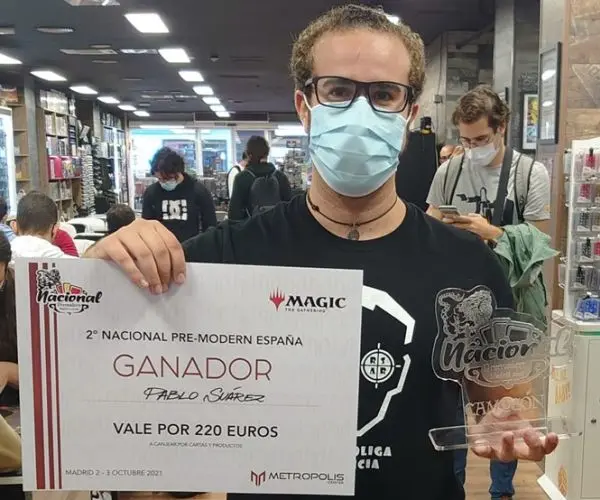
Tournament prizes were very well distributed, since half of the proceeds was raffled off among the players. As for me, I was given an economic prize of €220, the Spanish Premodern Champion trophy, a patch from the Madrid Premodern community, and finally a super cool coaster with a
Regarding the future, I will continue to play every Saturday with my colleagues from the Valencian Premodern Techno League (Technoliga Valenciana de Premodern), where we have a great time playing Magic while enjoying food and beers. Indeed, I look forward to more Premodern tournaments, both nationally and internationally, since the format is lots of fun and growing in numbers.
Last but not least, I would like to thank all the people from Valencia's Techno League for all the support and testing in preparation for the nationals, as well as the Spanish Premodern communities, since together we have organized an incredible tournament with an amazing vibe.
Rone: Thank you so much for your time, Pablo. Hope to have you back here some time soon!Opinions expressed in this article are those of the author and not necessarily Cardmarket.