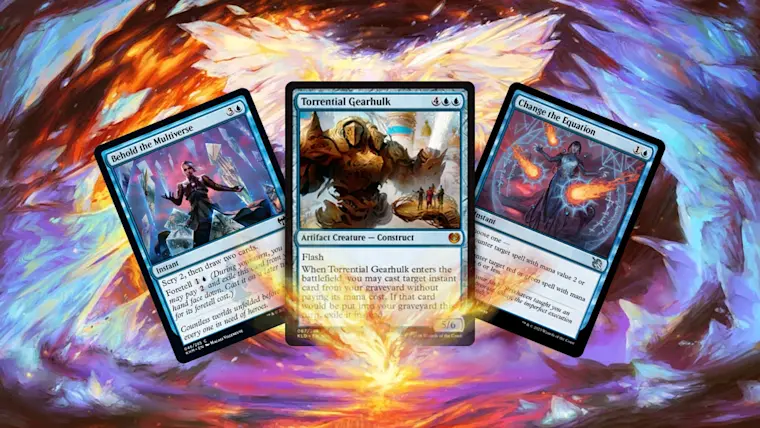
The duo of Indomitable Creativity and Fable of the Mirror-Breaker sits at or near the top of multiple formats. The blue-red Pioneer version in particular still sees changes all the time, and there are always new developments to cover. Here's a qualified look at the latest iteration!
Five-Color Creativity is currently one of the strongest decks in Modern. Ever since Reid Duke's triumph at Pro Tour Phyrexia in Philadelphia the archteype has also risen in popularity in Pioneer. Of course, with neither fetch lands nor , the vast majority of builds here run just two colors, red and blue.
The deck centers around the card , which lets you convert redundant Treasure or Powerstone and sometimes creature tokens into big and powerful monsters, put directly into play from your library. As no Creativity deck contains more than four creatures, you are guaranteed to hit exactly what you desire. Reid Duke's version and the prevalent one at the time of his Pro Tour win used and . Having both in play lets you attack your opponent with a hasty, trampling 30/30 Wurm.
From God to Gearhulk
Even though Duke piloted this deck with great success at the Pro Tour, I wasn't a big fan of that version because it is somewhat easy to disrupt. One well-timed or for example lets the deck fall apart completely. A simple does the trick as well. Even with on board or a followup of can be problematic. Let alone the fact that the opponent can simply have more than 30 life or enough creatures to chump block and leave you dead on the back swing. The Angel deck often does both.
Since then the archetype has evolved, and multiple different iterations have surfaced, some of which are more combo oriented, engineered to one-shot the opponent, some of which are more value oriented, trying to overwhelm the opponent eventually. Popular targets for the value version are either or in combination with . Getting a 4/4 Elemental token, drawing two cards, dividing 4 damage among any number of targets, and tapping two permanents means you will eventually out-resource your opponent, especially since one Opus can easily chain into a second or even third.
The main advantage of the value version with is that it has a reasonable midrange plan. Gearhulk can well be hardcast once you've ramped up to six mana. This lets you transition smoothly from a combo shell to a control shell too: Take out all postboard and operate solely at instant speed during your opponent's turn. You also have the option to cast for five, six, or even seven mana as Gearhulk is not legendary and therefore can simply overwhelm the board with creatures.
At eight mana, it does not happen often that you are able to hardcast , but it is the best possible target out there to flashback with Gearhulk. How this version plays out at its most basic is that you discard Opus at the end of your opponent's turn for a Treasure, then untap, play your fourth land, and target the token with Creativity, flashbacking Opus with the thus cheated into play.
Overcoming Obstacles
Obviously a lot of things can go wrong along the way. I quickly want to go over the most common problems:
shuts down the effect of . doesn't, but even if it took damage earlier and you are able to remove it with , you still lose 4 life for the two cards drawn. So don't forget that has the hidden mode of targeting your opponent's creatures to replace them with other unknown creatures off the top of their library. Obviously this can go wrong as well, but it cannot get much worse for you than a Sheoldred or Elesh Norn on the opposite side of the battlefield.
Besides permanent graveyard hate like or , you also have to consider that your opponent can snipe your with , , or . This means you should only discard and expose your Opus against black if you plan to utilize the Treasure token in some way on your next turn.
Counterspells are another part of the game that make it really hard to resolve . And even if you do so, letting your control opponent untap while being tapped out yourself is not the best feeling. That's why you take out Creativity in most such matchups.
Even though the multicolored and decks aren't known for being interactive, rather for slamming threat after threat, don't overpace against them, thinking they'll have no response. First of all they have access to , which they can often cast for one mana to remove your token at instant speed. Secondly they may have uncounterable interaction in to blink your token in response to . Therefore you should play it safe and cast Creativity on multiple targets to ensure at least one is still legel upon resolution, if the board state allows it.
Card Choices
On June 10 the Regional Championship took place in Athens, and I decided to sleeve up the version. I registered the same list for the Last Chance Qualifier on Friday to get some final practice in.
Blue-Red Creativity by Marcel Reintges, 7-1 at LCQ Athens
Main Deck
Sideboard
4
4
4
4
3
2
2
2
2
2
3
4
2
1
1
1
1
1
1
4
3
1
4
4
2
2
2
3
2
4
I tested the deck quite a lot and came up with this as the ideal configuration. Some card choices may look weird, so I want to explain the reasoning behind them.
Why No Divide by Zero?
is basically an with upside but also some downsides. It doesn't get rid of tokens of any kind. Costing three mana often makes it feel clunky, for example whenever you bounce a spell that costs less. Of course you get to learn and either grab a card from our sideboard or loot. However, losing three sideboard slots to complete the Lesson package in , , and is a hefty cost. The only matchups in which Divide really shines are the mirror—bouncing a or a on the stack—and against Lotus Field combo—bouncing their or . Horror and Dromoka are otherwise really hard to deal with for this deck.
Why No Stern Lesson or Big Score?
This was a close call. In the end I valued the card advantage of a little higher than the ramp and card selection of or . Between and , I felt I had enough card selection already, and I expected a lot of Black-Red Midrange decks that weekend. also isn't the greatest in control matchups, forcing you to discard a card as part of the casting cost.
Fun fact: I didn't encounter a single Rakdos player over the full weekend and an entirety of seventeen matches, even though it accounted for the by far highest meta share.
Why Stern Dismissal?
Some kind of bounce spell still is necessary, mainly to get rid of or for that one crucial turn. I opted for , finding it the most flexible, most mana-efficient option out there in the Pioneer format. has the upside of bouncing your own Torrential Gearhulk and sometimes gives you a scry. However, I valued the option higher to bounce a resolved or , countering it on the way back down or using that small window to go for Gearhulk/.
Why Change the Equation?
While practicing I tried out and must say I was really impressed by that card. It hits almost all relevent spells in Pioneer and improves the Green Devotion and Enigmatic Fires matchup by a lot. The most relevant cards it doesn't hit are , , , and .
Side Lines
Generally speaking the sideboard works in a way that the red cards and come in against Boros Convoke and Monowhite Humans, replacing value cards such as and . For decks, White-Blue Control, Lotus Field Combo, and the mirror match, most blue cards come in while and go out.
The plans against Abzan Greasefang and Spirits are a little different: Board in all the red cards, but this time cut and leave in the value cards. Against Spirits obviously comes in as well. Against Black-Red Midrange, Black-Red Sacrifice, and Green Devotion I sideboard very lightly. Only comes in in these matchups, plus against the black-red decks and against Devotion.
Unfortunately, when it was time for the main event, I wasn't able to repeat the success from the Last Chance Qualifier, where I had finished first after the Swiss among over 200 people. I rallied back from a 1-3 record and played a win-and-in match for Day 2 at 5-3. But I came up short against, what is certainly a rough matchup, Monoblack with two main.
Participating in this event was a blast anyway, and I'll be back for sure, chasing that Pro Tour invite.
Opinions expressed in this article are those of the author, not of Cardmarket.