The Different Colors and Archetypes
This article mainly focuses on the different strategies, colors, and combinations to draft in Theros Beyond Death. Not all of them are created equally, so there's value in knowing what works well and what doesn't.
Black (W/B & B/G)
I think most people agree that black is best color in Theros Beyond Death. First of all, black is very deep, which means the set has tons of good playable black cards. Even if multiple people at the table are drafting the color, you usually won't end up in a spot where you are missing cards for your deck. Secondly, black has three pretty strong commons. is by far the best common in the set, because it's so efficient, triggers constellation, and synergizes well with or . shines in a format where you see more Auras than usual, not to mention escape. obviously depends on how much devotion your deck can muster but usually is a great two-for-one.
You can pair black with any color, but there certainly are power level differences. I would say that White-Black Auras is the strongest color combination, but it also is the one that relies the most on specific cards. If you get the key cards like Rise to Glory, Heliod's Pilgrim, , , , , and Mire's Grasp, the deck is very strong. I think the best color combination to draft is likely Black-Green Escape. It is not hard to get the key cards here, since they aren't overdrafted, and both colors are deep enough to make the deck work most of the time. Important cards are , , , , , and .
Green (G/W & G/U)
There is no surprise that green is the second best color. Like black, green is very deep and has great commons. is basically the green . You probably would play even without escape ability, because a 4-mana 4/4 is fine in Limited. But the ability to put it into play as a 7/7 after it died or got milled pushes it over the top. Similar applies to and both cards are good in Black-Green Escape as well as in the Red-Green Power-4 deck.
Next to black-green, the best deck for green is Green-White Auras. Important cards for the archetype include , , , , , , , , and . Another green deck I like quite a lot is Green-Blue Constellation. Keycards for the deck are , , , , , , Setessan Training, Warbriar Blessing, , and basically every decent enchantment creature. The deck heavily relies on uncommons to become actually good, which means when multiple people at a table are drafting it, you should stay away from it, but when you are the only one drafting Green-Blue Constellation, you should end up with a very strong deck.
White (R/W & W/U)
I think after green and black there's a clear drop-off in power level. It's possible to argue about which one is the third, fourth, and fifth best color. For me it is white. The main reason why I put white over red and blue is that I really like White-Black and Green-White Auras. The by far best white common is , which is splashable and is especially valuable when it triggers constellation or gets brought back from the graveyard. The other good commons are and . The Pilgrim's power level obviously depends on how many good Auras you can fetch, while Daybreak Chimera is just solid in general and becomes better once you have more devotion to white.
As mentioned, I would recommend pairing white with green or black, but when red-white or white-blue is open, you should not miss your chance to jump in. Red-White is an aggressive deck that goes wide. There really aren't any particular cards to look for as in other color combinations. The main goal is to get enough removal — , — and good 2-drops — , . The last combination is white-blue, which I think isn't very strong in general, but of course can work out. is a very strong card and is one of the main reasons why you might end up in these colors. Like red-white, white-blue is more about the power level of single cards than about synergy.
Red (R/G & B/R)
Red is similar to white in that it also works very well with green or black. The best two red commons are and . Both are very important for red decks and you could argue for both cards when it comes to first pack, first pick. The third best common is , which is a fine card, but not really at the same level as the other two.
Red-green benefits from having creatures with power 4. Key cards are: , , , , , and . As you can see, a lot of the synergy cards are uncommon, so you don't have to build your whole deck around the power 4 theme. Same as with red-white, a good curve and sufficient removal are more important for the deck than synergy.
Another good combination with red is Black-Red Sacrifice. Keycards are: , , , , , , , , and . The power of the theme depends on how many Portent of Betrayals you get, but you should also know that black-red can definitely function without the whole sacrifice synergy. It's possible to win simply by having enough removal and good creatures.
Blue (U/R & U/B)
Finally we come to my least favorite color: blue. Blue has the issue that the top commons aren't on the same level as those of the other colors. is the best blue common, but the rest of the commons just aren't great. Do not get me wrong, , , , and are all fine cards, but not really ones I want to firstpick. Another issue with blue is that it does not really synergize with other colors that much aside from Green-Blue Constellation.
Red-blue benefits from playing cards during your opponent's turn. Key cards are , , , , , as well as basically all instants and flash cards. Most of the payoff cards are uncommons, but when nobody at the table is drafting blue-red, you can definitely get there. Maybe there are some other blue-red decks that I did not discover yet, but right now I would not be exciting to draft this combination. The last combination I want to address is blue-black. The deck plays out like a classic control deck, has essentially no synergy, though it can still be pretty decent. Blue can support black very well with some flying creatures to finish the game and card draw to find removal.
Top 5 Underrated cards
5. : A 0/5 blocker is better than I originally thought, because a lot of the creatures in this format have power 4 or less. For just 2 mana it buys a lot of time.
4. : Usually, cards that give the opponent a choice are bad, but Inevitable End plays out differently. Of course there are situations where you wish it would be a straight-up removal spell, but most of the time the opponent has to sacrifice the enchanted creature right away.
3. : In a constellation deck Nessian Wanderer can generate a lot of value. I often saw it pretty late in the Draft, but I would consider it a pretty early pick.
2. : Medomai's Prophecy is just a great card. It gives you so much value and is possibly one of the best things you can do on turn two. I can see firstpicking it.
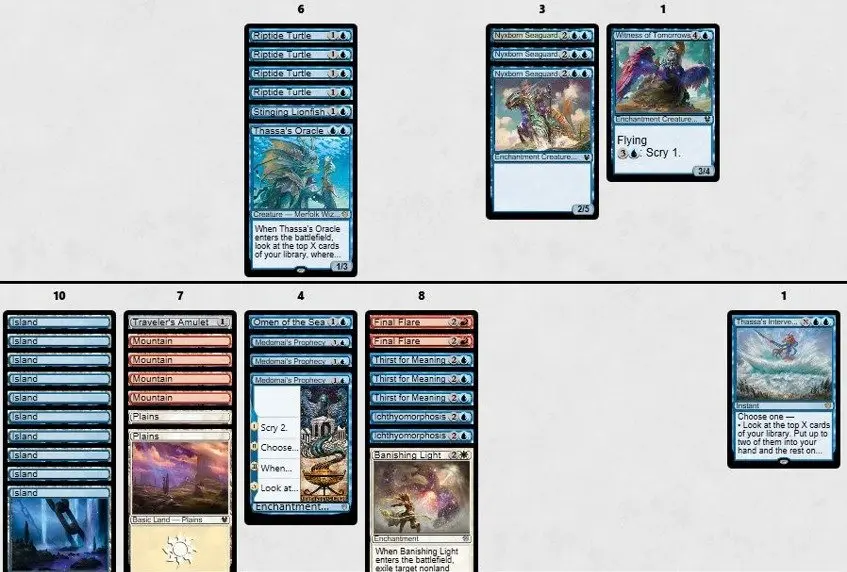
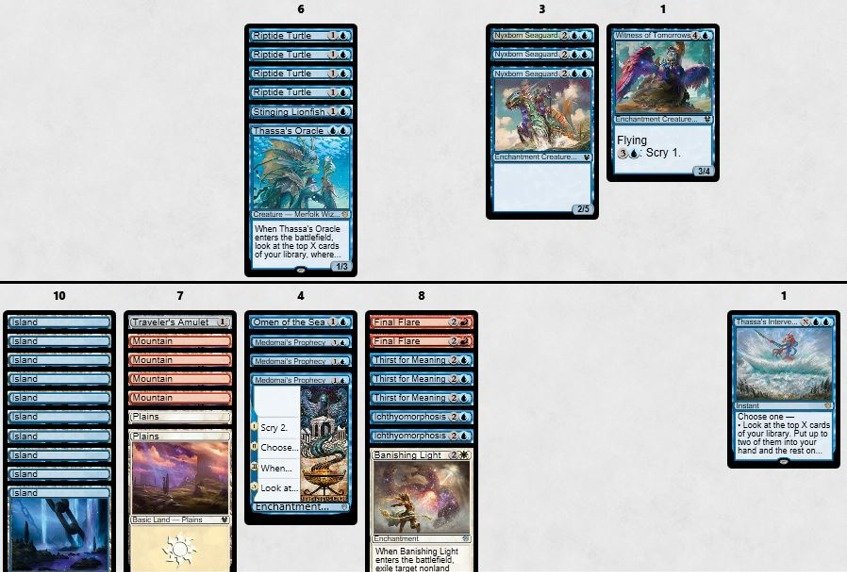
1. : Finally we come to my favorite card in the set. Since Thassa's Oracle is a rare, you won't often get the chance to build a deck around it, but I would always firstpick it. Blue supports the game plan of staying alive and drawing cards perfectly. , , , Riptide Turtle, are key, and when your deck's blue-black, you can even mill yourself with , , , or . Of course, you should make sure to have an in case you mill your . Let me show you an example Draft deck:
Drafting Theros Beyond Death is quite enjoyable. It would be more fun if the colors were a bit more balanced, but I've drafted worse formats in that regard. It is still early on, so some Draft strategies could still be discovered. By the time you're reading this, I hope to have drafted a lot of green and/or black cards at the Players Tour.
Thanks for reading!
Christian