Preparation
As soon as you could play Pioneer on Magic Online, I started testing for the Players Tour. Playing in the early stages of the new format really was an interesting experience. It was a brewer's paradise. Only the fetch lands were banned at the time, but other cards would soon follow. I think Wizards did a great job not banning cards like , , or right away just because people thought they would dominate.
The first deck I tried out was Monoblue Devotion, because I had good memories from back when I played it in Standard. After several leagues, I realized that the matchup against control was just too bad. posed a big problem too, because he could turn all your key creatures into Elks. The next deck I tested was Monoblack Aggro and this one had a great win rate. Unfortunately, its best card, , got banned, and it did not appeal to me anymore afterward. I started testing some other decks such as White-Blue Control, Combo, and Eldrazi Ramp, but none of them stood out for me. White-Blue had issues against various cards and Ascendancy and Ramp were just too inconsistent.
Since the Gräfensteiner brothers were qualified too, I tested with them. Tobias showed me a deck with which he had had good results.
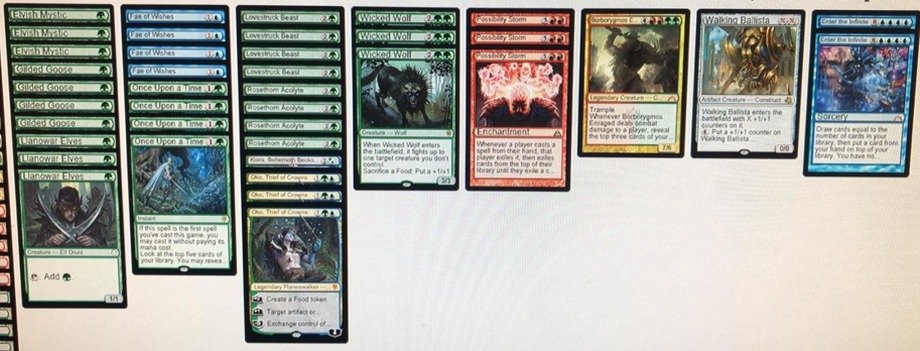
This is an early sketch of the deck. As Oko was probably the best card in the format, we played four in the end, and after 's ban we replaced it with something like . and either acted as an alternative win condition or bought enough time that you could eventually kill them with your combo. The cool thing about the deck was that it could combo off pretty fast and with four you didn't have a hard time finding its key card.
In case you don't know how the combo works: When [Possibilty Storm] is on the battlefield, you cast an Adventure sorcery. Possibilty Storm triggers and let's you cast , since it is the only sorcery card in your deck. You draw your whole deck and put on top of your library. Then, still during the same turn, you cast a creature, for example [Walking Balista], which the Storm again trades in, this time for Borborgymos. Finally, you kill the opponent by discarding your lands.
The deck was pretty good, especially against the most played deck at the time. It was basically a mirror match, but they played other big creatures and you could win with the combo. After the Oko ban, it became much harder to survive and your alternative win condition was gone. Nevertheless, I somehow still liked the Possibilty Storm combo and invested a good amount of time in the deck. I tested various blue-red versions. Here is a list that managed to go 5-0 in a league:
| Possibility Storm by Just4myrage |
|---|
| Main Deck | Sideboard |
|---|
| | |
| |
Other versions included more removal and did not play Fae anymore, because in the developing format you could no longer afford to pay 4 mana for a tutor. The game plan was to survive until turn five, cast to find your pieces, and kill on turn six. I liked the concept, but it had too many problems. Aggressive strategies with disruption in the form of or were problematic, and in particular destroyed the deck because it shuts down the combo. Also, the whole thing sometimes defeated itself when you drew both copies of — not often, but it did happen.
After months of playtesting I still didn't have a deck and was very disappointed. I hoped that Theros Beyond Death would shake up the format and we would find some cool new thing. When was revealed, the Magic community went wild because it was a two-card combo with . Most of the people, I included, thought that the combo would be banned right away. Wizards did not ban it, and after we tested it, we realized that the combo was actually not that broken. It costs a lot of mana and time to set up. We figured the best version would be monowhite, because Heliod should be played in an environment were it can turn into creature. We tested Monowhite Heliod against some of the top decks and realized that it just was not good enough.
Two weeks before the PT we found a deck that was performing pretty well against most of the field — with and :
The deck was good against most of the creature decks, but it struggled against control, ramp, and combo. Playing it would definitely be a gamble. When you get a bit unlucky with matchups, it could go quite badly.
Even though I did not like the plan very much — as it was too reactive, slow, and had some problematic matchups — I wanted to stick with the team's choice. But just before I ordered the cards for it, my friends told me they found the answer to all of our problems. They found …
The Deck
| Blue-Black Inverter of Truth |
|---|
| Main Deck | Sideboard |
|---|
| | |
| |
I only needed to play one match to realize that this was the deck I was going to register for the PT. It just played so smoothly. The deck was more or less a better version of my earlier [Possibilty Storm] experiments, only it featured better cards overall and a better combo. Our team entered about fifteen leagues and boasted a win rate of 75%.
Card Choices
The discard spells help you protect your combo from counterspells, buy time by taking opposing threats, and fill the graveyard for delve. I think six discard spells is a good amount. I can see playing maybe one more , but I do not think it is needed.
I don't think you can go lower than four copies each of and , because casting a delve spell turn five and killing turn six with your combo is the main game plan. On the one hand, I can see cutting a Jace, because he is too slow in some matchups and because having six cards that win with Inverter should be enough. On the other hand, Jace can take over a game in control matchups and can be played on turn five with back-up up or on turn four after discard took opposing counterspells. For example in the mirror, Jace is a great card.
These are the pieces which help you find your key cards. is very important, as it empties your graveyard for the Inverter/Oracle combo. is basically a 2-mana with the upside of putting the cards into the graveyard, and sometimes you do want to cast Dispersal. is the best 1-mana cantrip in the format and you should always run four. You could go with four Dig and three Dispersal, and I am not sure yet which combination is better.
is very important to stop early aggression; between and you can often enough get rid of bigger threats too. is another way to empty your graveyard and can be a great tempo play when cast for 1 mana. It's possible to cut the second Cut, but then I would definitely play four . The single copy of acts as an alternative win condition in case your Inverter gets removed by or . Also it is a card that can win games on its own in certain matchups.
Lands
The mana base is the biggest question mark of the decklist. Full sets of and are automatic, and I also like a combination of and to fill the graveyard and trigger . The one proved pretty important at times too. The hard part is to find the right combination of , , and . The problem is that you really want black mana on turn one for Push or , especially on the draw, but basic Swamps are quite bad when you want to cast or two . Maybe the solution is to play four Estuary and four Pools, but the Temple's scrying is pretty valuable as well. Maybe we figure out another configuration, but right now I think this is fine. I could also see cutting a land, if you want to make room for another card.
Sideboard
We figured the main goal was to have at least six cards in the sideboard to bring in for our removal spells. We also wanted at least six cards in the sideboard to replace our discard spells, which were just bad against Monored or Monoblack Aggro. The latter requirement fulfilled two Liliana, one , two and one — all important cards against aggro decks. I would not go lower than four , because it is just such a great sideboard card against most of the blue decks. I really like the combination of two , two , and one against various decks built around a combo or graveyard. Overall I am quite happy with the sideboard and would not change a single card at the moment.
Conclusion
I am quite happy with the deck and I am looking forward to playing it at the Players Tour. I can only recommend you try it out yourself. It is so much fun and actually plays out differently than you might think. Sometimes, you cast after trading resources and win by attacking three or four times. You also get games where Jace takes over. And of course, often enough, you simply win by turn five after you disrupted your opponent in the early game, played Inverter turn four, and Oracle or Jace turn five. I don't think I have to give you any advice for how to play the deck. You'll figure out yourself when to go for the combo, when to wait, which cards to exile with delve, et cetera.
Thanks for reading!
Christian
Opinions expressed in this article are those of the author and not necessarily Cardmarket.