Ravens, Runes, and Rowdy Riffs: The Art & Flavor of Kaldheim
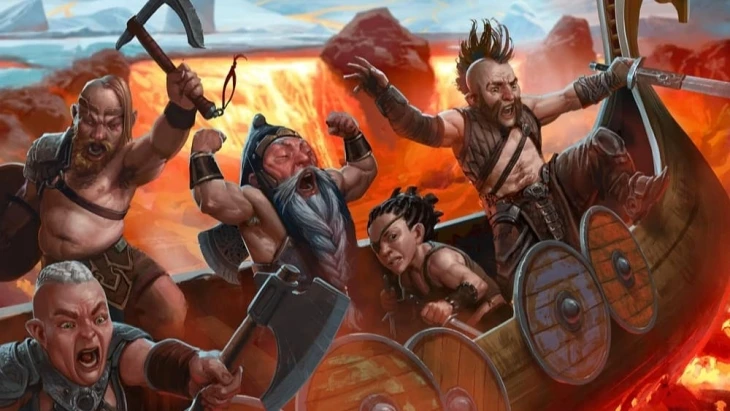
After drifting aimlessly on the waves of the multiversal sea for decades, every Viking of Magic has finally found their home shores on the plane of Kaldheim. Raise your drinking horns and let us sample the flavor of this new set to see if it is able to quench our thirst for plunder and pillage—and our taste for metal.
Being at the very least a , I grew up in a town named after the mighty Allfather Odin himself, and Viking lore and history has been a very living part of my world since early childhood. The town of Odense was home to one of the Viking ring castles built during the reigns of Sweyn Forkbeard and his dad, Harald Bluetooth. The same Harald Bluetooth who on a runic inscription took credit for turning the Danes away from the old gods, and who according to legend took a deadly arrow to his behind—fired by a staunch pagan named Palnatoke from my home island Funen.
Even the streets of Odense bear the names of the past with a Haraldsgade, a Palnatokesvej, and an until the advent of a popular TV show lesser known Regner Lodbrogs Vej. Much of my childhood was spent in a smaller town a few kilometers from the Ladby ship, a buried in a mound where the remains can now be visited.
The swift dragon ships were very real and remains of them are still found around Scandinavia. Odin, however, did not need such modes of transportation. His ravens Huginn and Muninn kept him up to date with the news, and if he had to go somewhere really fast, his horse, Sleipner, had eight legs.
The cathedral of Odense, which could well have been placed where the shrine to Odin originally resided, is named after Canute IV, sometimes considered the last Viking king. He was killed there by angry peasants who got fined for not being ready to man their dragon ships and venture out to reconquer England.
When it comes to my credentials as a metalhead I may be considered more of an . My time as a headbanging more or less coincided with the . To me the truest expression of the combination of the two subjects at hand, Viking culture and metal music, begins with Bathory's album Blood Fire Death and ends with their Hammerheart. Yet, all things considered, it has fallen on me to deliver my on the flavor of the latest Magic expansion, Kaldheim, hailed by its creators as the most metal set in the game's history.
I don't know how particular metal Kaldheim is. I mean, aren't a lot of black and red cards throughout the game's history just metal by default? Of course, does look like something you could just slap a Manowar logo on and be ready to go.
Seize the Spoils of Lore
As you might expect, from those initial words, the main focus of this review won't be to evaluate card strength, pass judgment on the Limited format, or make any guesses as to how the new cards and mechanics affect Constructed gameplay. The main questions I seek to answer are, whether Kaldheim is a cool Viking set and how metal it really is.
Wizards are not alone in looting Viking traditions. But raiding other plunderers to make a card out of the intro sequence from the History Channel's "Vikings" would probably impress even the old Norsemen.
I suppose we all . The biggest surprise about a Viking-themed Magic expansion is probably how long we had to wait for it. Creative companies such as those that produce games just love to mine cultures around the world for or even entire mythologies that they can outright steal. I remember thinking that Vikings would be next upon seeing Champions of Kamigawa booster boxes on display in a store some sixteen years ago.
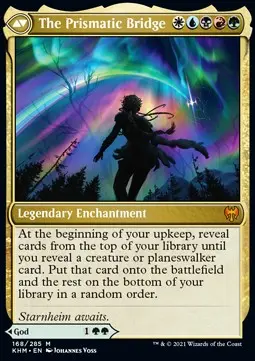
Vikings are more than axes and looted monasteries left in flames: Usually portrayed as either an ash or a yew, Yggdrasil is the world tree connecting the realms of the Viking cosmos. Perhaps less familiar to the outside world is the rainbow bridge Bifröst by which the gods journey to the realm of men. But what about a ? Well, as it happens, the goddess Gefjon is said to have plowed the Danish island Zealand out of Sweden, leaving behind the great lake Vänern. I don't know how metal a plow is, no matter what it is forged from, but fans of the band Plöw do.
While I always found Japanese culture fascinating, I also was a bit saddened that the designers of Magic had run out of ideas for creating their own world and so obviously had to turn to cultural appropriation and picking low hanging fruits. Somehow I did not even think of Arabian Nights as a much earlier example of this. Meanwhile, both Ice Age and Mirage had seemed more like climatical and geographical settings than looting of a cultural .
Of course absorbing the tales and artwork of a culture into a game can be done with more or less sensitivity. Many of you know that Wizards have occasionally burned their fingers in the process. Luckily, while the blood burns red in the veins of many a Viking descendant, few are easily offended when it comes to how their culture is handled for commercial gain. We literally grew up with Vikings plastered on a host of products in their most fake ways—with horned helmets. So I don't think that I speak only for myself when I say, "Do your worst." We can take it with a merry laughter rolling in our Viking bellies.
A lot of Viking imagery was conceived a millennium after the Viking age for various entertainment purposes. Rather than a heavy metal riff, Inga Rune-Eyes brings "Ride of the Valkyries" to my ears. She is just missing the horned helmet, which incidentally was an eighteenth century invention popularized by a Wagnerian costume designer.
One-Legged Walker Rant
As is often the case with the planes where Magic expansions take us, we get to experience the world through the eyes of some planeswalkers from elsewhere passing through or settled there. And perhaps Wizards even went out of their way to by making Kaya and Niko Aris those characters.
My problem with the new Kaya and is not that they challenge conventions that most informed people have long outgrown. What disappoints me is the wordiness of their textboxes. Each of those two cards have more words than any of the s scattered across Scandinavia. I love reading, but recently card design has just gone too far—if I wanted to play an Axis and Allies-like table top game, I'd play Axis and Allies.
Perhaps requiring the designers to actually hand carve the text on a stone before proposing a new card would limit the number of words.
I remember hearing that when speaking at the Thing (the name for an old sort of governing assembly in the lands of the Vikings) you had to make your point short and clear—and if you needed to have the word for a second round, then you could only say as much as you had time for while standing on one leg. Play design might learn something there.
Magic was so much more pleasant to play when you didn't have to read the same card five times each game. Verbosity is definitely a flavor fail in my opinion. But this is not specifically a Kaldheim problem since the lack of concern for readability and keyword soup many a recent set.
Stranger in a Strange Land
Unsurprisingly and foretold by many, the snow mechanic makes a return with the set. Of course it is a flavor win with Scandinavia always covered in snow in the imagination of many who have never set their foot there. And to the best of my recollection the winters of my childhood always had plenty of snowfall, just like the summers were always longer and the strawberries sweeter et cetera. A major disappointment regarding snow cards in Kaldheim is the lack of effective hosers against snow-covered basics, which for now remain the strictly better alternative in several formats.
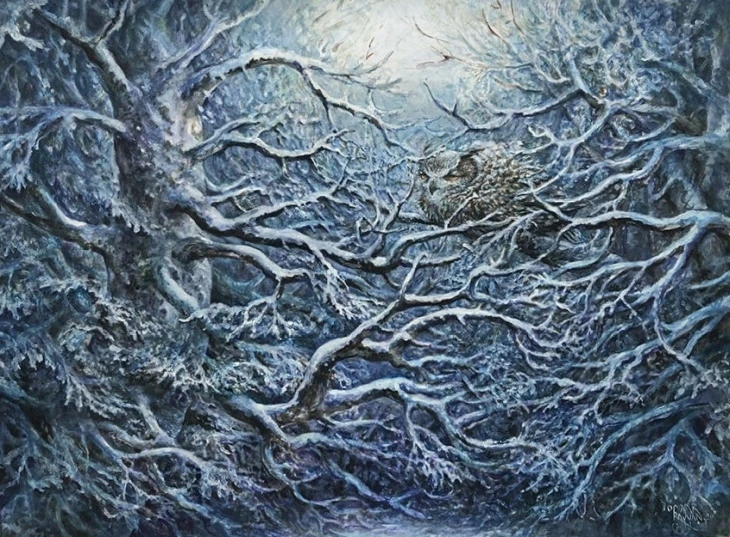
Could this be the most metal card in all of Kaldheim? I think I see the logo of Xavlegbmaofffassssitimiwoamndutroabcwapwaeiippohfffx (yes, that IS a band name) hiding in the branches.
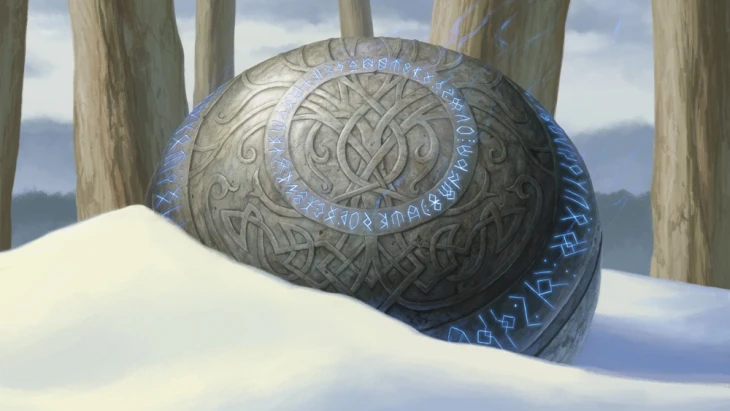
But how about the new mechanics? Boast and foretell. Well the words do fit quite well with a Viking setting. Their religion, like so many other traditions of the past, concerned itself with the foretelling of the future through the reading of runes and the patterns of nature. Boasting was a thing in the olden days too, and it seems to have made a comeback. (The heavy chains of the Law of Jante—"don't think you're anything special" et cetera, as popularized by the Norwegian author Aksel Sandemose—had for long kept many descendants of the Vikings from making themselves the center of attention with some healthy bragging.)
Boast also makes for some fitting flavor texts such as "It was nothing. I once took down a frost giant with a spoon!" from and "Arrogant maggot. You won't be so proud when I rip out your tongue and drink from your skull!" from . If you have ever had a drink with a Dane or perhaps also other Scandinavians, you might have been told the story of how "Skål!" the word for "Cheers!" comes from a Viking tradition of drinking out of the skulls of slain enemies. In fact, the word is even pronounced similarly to the English "skull."
One thing Vikings and metalheads have in common is a reputation for being very thirsty.
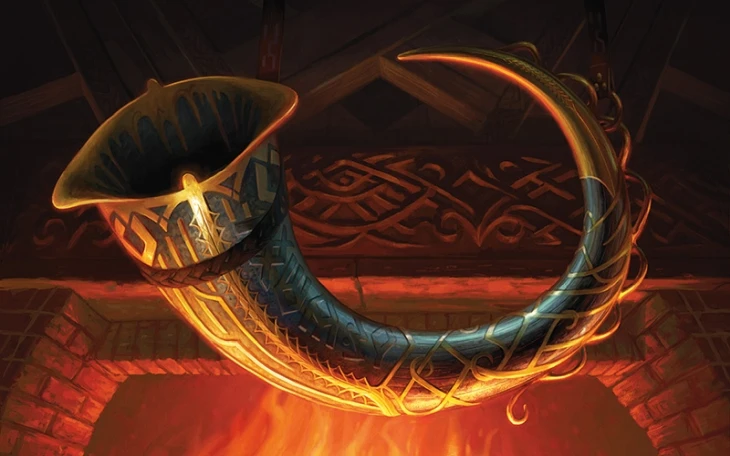
Most Viking-culture afficionados and particularly the metalhead kind nowadays settle for drinking out of horns though. Kaldheim's flavor texts capture this tradition nicely too, for example with 's "Like her well of stories, Birgi's horn never runs dry." and saying: "Mead down! Swords up!"
Vikings had several gods associated with war. Besides the more famous Thor and Odin, there was Tyr, the god of battle. War was so much of an ordinary workday thing that the three ended up giving names to the midweek with Tuesday named after Tyr, Wednesday named after Odin, and Thursday named after Thor.
Fury of the Norsemen
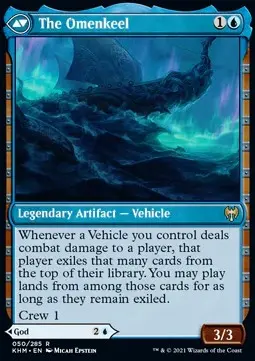
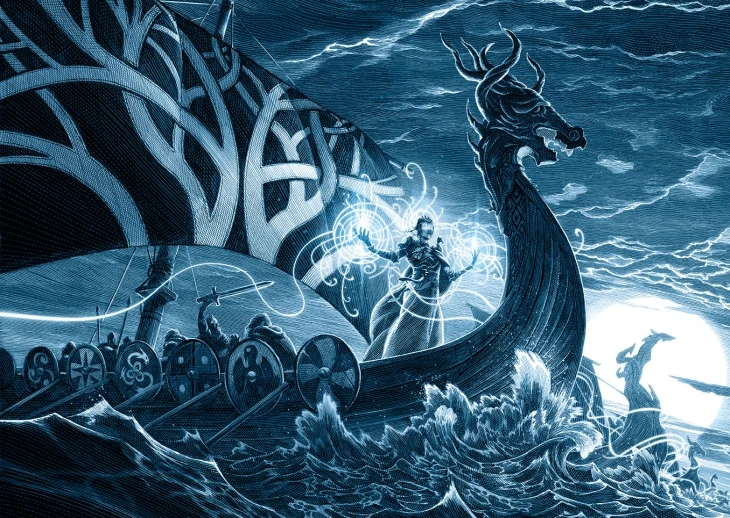
Of course, if Vikings had just been boasting drinkers with a penchant for divination, we would probably not have had a Magic set devoted to their culture. The warrior needed something to boast about, the seer needed to foretell about more than next year's harvest, and the needed good material for his songs. So the Vikings went . Year after year they would to man their fleets of s, each with its own . And wherever they did in their , they would and spread according to tradition, leading their victims to pray for deliverance from the fury of the Northmen.
Combining all sorts of tribal art into a Polynesian, Celtic, Viking, pre-Colombian sleeve is metal to the core. I like to think it's a fine new piece that Joven, the most metal dude in Magic, has made since he was last seen in Homelands. is also quite metal as far as names go, though no match for Slayer's "Raining Blood."
When it comes to injecting some Viking flavor into our favorite game, Kaldheim does a great job. The set has many noteworthy pieces of artwork and the showcase frames are the best since Kaladesh Inventions. I am, however, left with one big question about the claim of this being the most metal set ever: Where is ? Joven is without question and without comparison the most metal dude in all of the multiverse. I don't care what loopholes of continuity the story folks at Wizards have to jump through to get Joven from Ulgrotha to Kaldheim. Lube him up in lazotep, stow him away with Slimefoot on the Weatherlight, or make him dog sitter for Mowu. Just get him there already!
Did I miss anything? I sure did. Perhaps you would have liked me to focus more on the fact that we got another card inspired by Judas Priest's Ram It Down with , or you think that the showcase version of deserved an honorary mention. Did make you think of King Canute the Great bidding the tide to turn? Should there have been more about /Fenrir or the two cats pulling the chariot of Freyja? Let me know in the comments below which metal and Viking art and flavor of Kaldheim you think makes the set a .
Opinions expressed in this article are those of the author and not necessarily Cardmarket.