Core Set 2020 Red Losses
: The first and foremost finisher in builds, which reveled in sinking all their unused mana into its activation, making the team hasty and more likely to attain a lethal alpha strike. A few months later, would join yet not substitute Cavalier of Flame in a similar role. The Cavalier itself wasn't seen too frequently outside of Fires decks, but it was essential there. Grief Factor: 8/10.
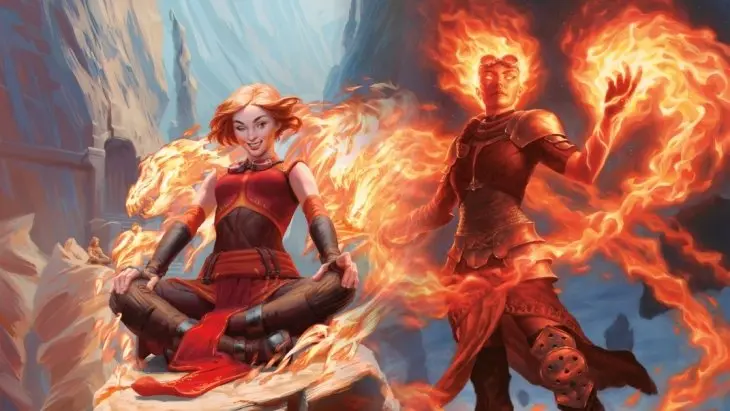
: Core Set 2020 was Chandra's appreciation set, so it included a little "Chandra, this is your life!" parade, with three different versions of everyone's favorite fiery redhead. Here we see her portrayed as a teenager yet to complete her pyromancy studies — that is, practicing how to better set things on fire — at the Keral Keep monastery on Regatha. Acolyte of Flame ended up the most in demand of the trio, especially in sacrifice decks, where her two tokens were given to to sacrifice, or else they would sacrifice themselves at end of turn anyway, and both occurrences made a happy unicyclist. But Chandra's little friends were also Elementals for the Elemental deck, bound to trigger twice, as well as red creatures to be enhanced by in Monored Aggro. The Acolyte was one busy baby Chandra, embodying the ideal form for a three-mana planeswalker – versatile, not too broken, never irrelevant. Grief Factor: 9/10.
: This one was meant to represent a late-teen Chandra, about eighteen, who has reached a greater degree of control over her powers. As a six-mana incarnation, Awakened Inferno might in fact just be the most powerful-feeling Chandra ever printed — excellent against aggro thanks to her sweeping minus, but even better against control, due to her being uncounterable and her emblems providing an inescapable clock that can't been interacted with in any way. Though there wasn't one specific deck built for her, Big Chandra would show up regularly as curve-topper in Grixis Control, Jeskai Control, and some Temur Elemental builds with a longer curve. In the latter, her board sweep would become asymmetrical, cementing Chandra's affinity for the Elemental subtype. Grief Factor: 8/10.
: Tween Chandra, about twelve years old, was the cutest Chandra but also the uncommon one, with a necessarily decreased power level. She wasn't a bad incarnation, though, still rating higher than many of the early Chandras, suitable for casual Elemental builds, and a key component of the very entertaining Chandra Tribal deck, where, alongside Acolyte of Flame and , she could produce a 20-damage strike out of nowhere. Grief Factor: 7/10.
: Core Set 2020 is also where we found out Chandra owns a flaming cat, because of course Chandra owns a flaming cat. (Chandra collects so many fire-based pets these days.) The fiery kitten was mostly meant as a mana dork for Limited and Chandra Tribal, but could sometimes find a use in creature-focused Elemental lists, like those running . Grief Factor: 3/10.
: The centerpiece in Chandra Tribal wasn't even a Chandra. It was the gadget Kiran Nalaar built to help his hot-tempered daughter keep her inner appetite for destruction somewhat at bay. Grief Factor: 3/10.
: This Chandra-related card, originally from Magic 2011, wasn't used in any "Oops! All Chandras!" build. Instead it worked as a reliable finisher in more competitive endeavors — like versions of Monored Aggro built around . Each Calamity ability would trigger the Spitfire, easily resulting in a lethal airborne attack. Grief Factor: 7/10.
: The major target for reanimation strategies of its era — with the demonic as a distant second. This terrifying Dragon with multiple attack triggers was born to be returned and given haste by . It wasn't as appealing when cheated into play by effects that bypass the declare attackers step, like . After Throne of Eldraine, you could also see Drakuseth occasionally hardcast with the help of . Grief Factor: 7/10.
: Another of several reprints from Magic 2011 that found their way into M20, this Goblin "bear" containing a delayed didn't see the play its flexibility might have suggested. Some decks gave it a chance, as its damage output would be straight up doubled by the stern Dwarf king. Grief Factor: 4/10.
: An early red sweeper, neither as efficient nor as widely played as , it offered a couple of upsides — namely the instant speed and the built-in immunity granted to the fliers on our side (supposedly those who are raining fire on their enemies, as strange an action as that would be for Spirits or Pegasi). Grief Factor: 7/10.
: Tailored to hit and out of the previous Standard cycle, this uncounterable answer remained a frequent sight in sideboards throughout its entire stay, even after its original prey had long left the scene. Grief Factor: 8/10.
: An infinite-damage combo involved using to give the Minotaur lifelink and a +1/+1 counter to , so the looting would trigger Buccaneer's ping, and then the lifegain would trigger Heliod, thus placing a new +1/+1 counter on Biomancer. Rinse, repeat. Other combos were conceivable, exploiting the Buccaneer's passion for seeing its controller discard cards. They were all equally janky. Grief Factor: 4/10.
: Dating back all the way to 2001's Apocalypse, Ringleader wore the modern frame for the first time here. It wasn't so much of an event for Standard as it was for Modern, Pioneer, and Historic, which could now build more functional Goblin lists. But, you know, Goblins are always one or two great pieces away from being a thing in any given format, so having Ringleader available could have made the difference. Grief Factor: 3/10.
: One of the three high-profile Dinosaurs from Core Set 2020, alongside and . Each played a part in the revamp of the tribal build that was finally able to rise to the top of the meta, right in their last stretch of Standard since Ixalan reintroduced their subtype. When its older Mesoamerican-flavored siblings rotated, Marauding Raptor couldn't adapt as promptly to non-tribal builds as Regisaur and Ceratops did, so it found itself homeless, barring the sporadic use as accelerator in creature-heavy strategies. Grief Factor: 7/10.
: Despite all Johnnies and Jennies setting their mind on the case, this double didn't make any wave in Standard. Too much was riding on the correct sequence of draws, as Reverberation alone is nothing but a four-mana dead card. Grief Factor: 1/10.
: The most explosive enabler for in Elemental builds, although too expensive to be considered for competitive sacrifice builds. Grief Factor: 6/10.
: This little fire-Lizard was to the monored decks of this cycle what was to those from the previous cycle, that is, their primary one-drop. would later get to share that honor, but Scorch Spitter had a better interaction with both and . Grief Factor: 8/10.
: Yet one more of 's attendants in Temur Elementals, helpfully fishing its master back from the graveyard, so that it could see another day of triggering. All these Elemental cards were inherently made to partake in their collective; the external applications, though possible, were for the most part negligible. Grief Factor: 5/10.
: The card red aggro decks kept in the sideboard during those times when white aggro decks experienced the occasional surge in popularity. Narrow, but effective. Grief Factor: 6/10.
Core Set 2020 Green Losses
: A solid two-drop for Stompy decks, it packed the most power at that spot in the curve, and interacted nicely with and . It wasn't as vital as the two abovementioned cards or , but it's still sad to see it go. Grief Factor: 6/10.
: The Cavalier that seemed less consequential at first sight ultimately proved to be the most versatile and desirable. While the red and blue Cavaliers had exactly one deck to call a home, that is , Cavalier of Thorns was welcome in various builds, both casual and competitive. Being a green card, the strict color requirement it shared with all the other Cavaliers was never perceived as too problematic, thus enhancing its playability. Its gifts were multiple: it would ramp, block almost anything, and regrow another card, any card, on its way out. If that wasn't enough, it even partook in Elemental synergies, slotting comfily within that deck's tribal curve. It's sad to note it, but an extremely dynamic card like Cavalier of Thorns makes fellow five-drops like look bad. Grief Factor: 9/10.
: This land tutor on legs felt powerful at first glance, but it was eventually doomed to irrelevance in Standard by the combination of being too clunky and not having any particularly impactful target to find. There was for a while, but decks based around the Zombie land had . Grief Factor: 5/10.
: Firmly positioned in casual territory, this big guy was unapologetically a Tammy/Timmy card, albeit a crowd-pleasing one. Even in a metagame where Gargos's own kind contributed high-profile specimens like and , exploiting the tribal component amounted to wishful thinking. The fight on demand was hard to enable proactively on a six-drop, as you would need for the stars to align perfectly in order to have you untap with Gargos still alive, a worthy target on the board, and a pump spell still in hand … A veritable Hydra fairy tale. Grief Factor: 4/10.
: For the last three years of Standard, Gift of Paradise has been continuously available — first through Amonkhet, then from the last two core sets — so the odds of seeing it return next year are good, having become a minor staple of green. Right now, though, we must acknowledge its exit, which is happening concurrently with the rotation of fellow land enhancer from War of the Spark. will still be around, but Aura ramp just went down to a bare minimum. Grief Factor: 4/10.
: One of the valuable mana accelerating creatures leaving the Standard pool. Second to , it proved more useful than , due to the chance of doubling the mana output as well as its Elemental membership, which made it a bit of a package deal with . Among the minor green Elementals going away we can also count and . That tribal trajectory is definitely over for now. Grief Factor: 7/10.
: Arguably the only Leyline to see some play, fueling a strategy that wasn't the best iteration of the ramp archetype in this era, but still pretty darn effective, potentially hitting the largest figures of mana production. There was at some point in Standard a sort of pseudo-Monogreen Tron that used this Leyline, a bunch of mana dorks, and 's static ability to toss on the board expensive colorless artifacts like , all fetched via 's wishboard. Grief Factor: 7/10.
: The card that single-handedly pushed Monoblue Tempo into reinventing itself as Simic Flash. The Ambusher was one of the most powerful creatures in the format, fully capable of taking over the game if left unchecked. Its archetype established itself immediately after Core Set 2020 released and invariably resided in the upper echelons of the meta throughout the rest of the cycle. Grief Factor: 10/10.
: A strong card-drawing engine for aggro decks, it made a convincing argument to some players to relocate from Boros to Naya, and figured in Aura strategies later on. The requirements to make it work were severe — a deck running targeted enhancers was strictly needed — but if satisfied, Season of Growth would perform like gangbusters in offsetting hand consumption. Grief Factor: 7/10.
: Green's main way to beat blue decks. was its one sworn enemy able to defeat it, but for the rest, it felt great to have a big hasty trampler that couldn't be bounced — and even stopped fliers when required. In time, Ceratops branched out of Dinosaur builds and into the sideboard of any deck that could afford to run it. Grief Factor: 8/10.
: Despite being a defensive card, this specialized hoser became at some point so oppressive that it had to be banned. Yup, that's seriously a thing that happened in this Standard cycle, we had to protect Esper Control from the tyranny of green. (Veil would later get banned in Pioneer and Historic as well, for what's worth.) Grief Factor: 8/10.
: The third Vivien incarnation was, to date, her most powerful, easily outclassing most creature-based planeswalkers of the same cost, for example . Two separate +1/+1 counters, trample, bite, and even a (rarely used) wishboard — it'll be hard to match this Vivien's sheer power. She'll be missed terribly, not just by Monogreen Aggro, but by any deck that could muster the triple green mana. (Looking back at the cost of this Vivien and Cavalier of Thorns, it's really a pity that green devotion had no payoff whatsoever.) Grief Factor: 9/10.
: A potent scalable fighter, with the alternative option of just dropping onto the battlefield as a huge trampler. In the era, would rise as the preferred source of fighting. Voracious Hydra could also prove too expensive at times. (It starts being really efficient at six mana, and offers more for the same investment.) Meanwhile, ramp decks had as their mana sink of choice, but Voracious Hydra remained nonetheless a very playable two-for-one. Grief Factor: 7/10.
Core Set 2020 Multicolored Losses
: Nowhere near as crucial as in decks featuring the / combo nor as important as other members of the Knight family, this horse-riding Zombie still made some supporting appearances from time to time, most likely as the payoff of infinite creature loops. Grief Factor: 6/10.
: The most accomplished Elemental builds tended more toward ramp than pure aggro. However, the latter case was bound to feature Trailblazer alongside go-wide cards like . Grief Factor: 4/10.
: The lord of the fliers. Decks all-in on didn't necessarily care for a three-drop, aiming to accumulate an early critical mass of flying critters to herald the coming of the big Angel asap. But an anthem effect is always relevant to swarm strategies. Grief Factor: 7/10.
: None of the tribes whose "zenith" Kaalia seeks (whatever that means) had actually a consistent build at any point — with the possible exception of Angel, at least in the final days of the and era, though then again not in Mardu colors. People attempted Kaalia brews, mostly to honor the random return of , but they were tragically positioned as unadulterated jank, shooting for a very unlikely triple draw. Here's hoping a third incarnation will one day grace our leggy redhead with a third incarnation worthy of her first one. Grief Factor: 3/10.
: The reign of Kethis in Standard was brief but brutal, the unforgiving combo with and quickly rising to the top tier. Once these companions left the format, the graphomaniac Elf was forced to spend the remainder of its time in Standard looking for a new killer interaction that never came. Grief Factor: 8/10.
: Out of the cycle of wedge-based triple-colored legends from Core Set 2020 Kykar found perhaps even less employment than the disappointing Kaalia. The "sacrifice a flier for one red mana" ability was sketchy to begin with and never amounted to anything, and for the rest, would do the exact same job as Kykar without requiring three different colors. Grief Factor: 4/10.
: Izzet Aggro was intermittently a thing, especially while was still around. A cheap two-powered hasty flier that's also a Wizard perfectly fit that archetype. Grief Factor: 5/10.
: A tribal card by design, Omnath was the pulsing heart of Temur Elementals, providing some interaction in an otherwise heavily creature-based build, boosting itself or others, and ultimately even drawing additional cards. The upcoming fourth incarnation of the renowned Zendikari Elemental adds white to its mix. We'll see whether or not it'll make for an improvement for this Temur celebrity. Grief Factor: 8/10.
: The M20 Buy-a-Box promo was definitely a gimmicky card, but not one that couldn't have received some love had it been in a different combination of colors. Unfortunately, Naya was basically never a thing for the whole duration, the infrequently three-colored lists aside. Granted, Rienne could have also used a more appealing form of recursion, but in a multicolored shell à la or , it was akin to a , meaning the creature the opponent has to kill first. There was some untapped potential here. Grief Factor: 5/10.
: The high-octane engine of Elemental decks, it could also power up non-tribal ramp decks that would run it alongside a few other Elementals, most likely and . During the fourteen months of its tenure, the quantity of cards put into the hand of Risen Reef players — notably circumventing the passive denial of — must number in the billions. Even more so since people started to the marine Elemental, the most daring among them even going as far as ing. Grief Factor: 10/10.
: Boros Aggro had stopped being prominent long before Core Set 2020 hit the shelves, so Skyknight Vanguard didn't end up having the career that its strong go-wide ability might have warranted in different circumstances. Attempts at revitalizing Boros Deck Wins would often feature it and Knights did so sporadically. Grief Factor: 6/10.
: An elegant enabler for Dimir Reanimator. Slower than , but capable of retaining significance on the board with its deathtouch and connection trigger. Grief Factor: 6/10.
: A very powerful doubling effect, Yarok first achieved notoriety in decks, allowing the signature land to raise its undead army twice as fast. But its applications were endless, provided the color requirements weren't an issue. Temur Elemental decks have been known to branch out into black just for the chance of watching in awe as Yarok supercharged Risen Reef and Omnath. And in Brawl, it made for a powerhouse commander. Grief Factor: 8/10.
Core Set 2020 Colorless Losses
: A clever design that allowed for the recycling of the hand in a way that avoided the loss of value usually connected with looting. Bag of Holding wasn't as successful as , but it enjoyed some amount of play in casual builds concerned with digging into the library for specific cards. Grief Factor: 4/10.
: This ridiculously over-the-top equipment was certainly one for the memes in Standard, albeit without a to equip it for cheap nor to brandish it for lethal. Too bad it won't be around to meet the new Nahiri from Zendikar Rising, as she would have known how to handle the cumbersome weapon. ( from War of the Spark didn't offer much help with that.) Grief Factor: 4/10.
: Reportedly, Magic's R&D department uses core sets to experiment with cards of power level higher than usual, since they're the set in the Standard rotation that remains legal for the shortest amount of time — about fifteen months versus the two full years of a September release. And yet, three months was the longest Standard could tolerate the absolute dominance of Field of the Dead before it proved necessary ejecting it from the pool. (The same fate was later going to befall Pioneer and Historic, too.) In all honesty, Field of the Dead shouldn't have been there to begin with, and it'll never be back, as no one in their right mind would want it to. I guess certain experiments fall squarely within a mad scientist's purview. Grief Factor: N/A.
: If the Standard-legal printing of Field of the Dead, with its inescapable Zombie apocalypse that made a mockery of control while at the same time inviting its owner to unleash massive control elements to stop aggro, was already close to inconsiderate, simultaneously providing a way to fetch the fearsome land directly onto the battlefield crossed over into pure folly. This doesn't even mention the fact that Golos would also exploit a multicolored mana base to reap further benefits with its activation. Once the Zombie nightmare was over, our legendary scouting robot was left free to still roam the environment. While it didn't lead to anything major, Golos could still be sighted helping lists or profiting from 's unused mana. It reunited with Field of the Dead in Brawl, until that team-up was also dissolved by yet another banning. Grief Factor: 10/10.
: Dark Ascension had given us one of the best countermeasures against graveyard strategies in the game, and Core Set 2020 brought it back to Standard after seven years. We'll have to hope it won't take seven more for Grafdigger's Cage to show up again. Grief Factor: 8/10.
: Arguably a more playable version of . Post-Ixalan block, the linear tribal synergies in Standard were few and most of the better ones (Dinosaur, Vampire, Knight) didn't have room in their ranks for this kind of three-drop. But whenever a brewer would try a more unusual tribe, Icon Ancestry always had a good chance of ending up part of their list. Grief Factor: 7/10.
: There were two main ways to play this card in Standard, none of which was the straightforward way of just trading two lands for a land that taps for three (which is fundamentally a zero-sum game). The first method involved a well-timed , , or to cancel the downside. The second, and by far the more popular of the two, relied on to untap Lotus. Grief Factor: 5/10.
: This expensive all-purpose removal available to all five colors debuted in Core Set 2019 and continued its course in Core Set 2020. Even if Core Set 2021 doesn't feature it, Meteor Golem has become such a familiar presence that it seems destined to come back one of the next times. Grief Factor: 5/10.
: This neat for colorless cards didn't get past a few cool but inconsequential Standard builds, usually employing the discount from to chain a series of two-mana artifacts off the top for free. Once again, this wasn't the right time for artifact shenanigans. Grief Factor: 6/10.
: A combo card by nature, designed along the lines of , the Salvager replaced as a way to streamline the byzantine combo, involving an infinite loop of . That was the only really important interaction that came from this Construct while it was in Standard, although others were endeavored. More would have surely been possible going forward, were it allowed to stick around. Grief Factor: 6/10.
: A staple of Robots decks since its debut in Magic 2011, Steel Overseer had no business being part of a Standard pool with very little in the way of artifact synergies. Still, it's the kind of card that can suddenly be weaponized by the addition of the right thematic set. So it's sad that its time never came during this cycle. Grief Factor: 6/10.
Opinions expressed in this article are those of the author and not necessarily Cardmarket.