Core Set 2021 White Losses
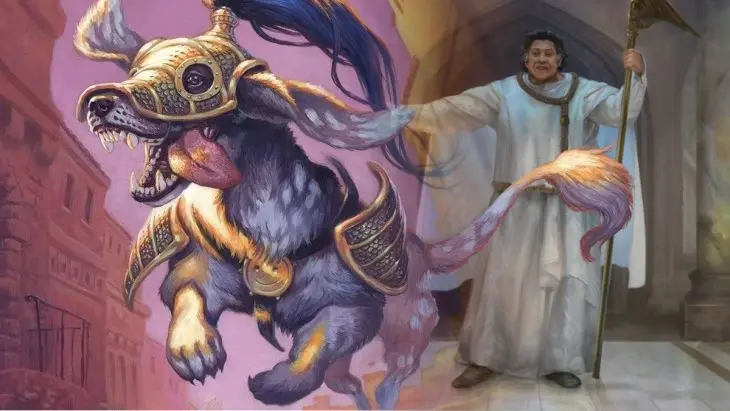
: This somber St. Bernard that apparently answers to the name "Dover" looks like something that barely makes the cut in Limited, but was actually sighted a few times in Constructed. All because it's part of the canine team that will fetch for free. And since the Houndmaster is Human, and the Watchdog is not, decks took notice. Grief Factor: 3/10.
: How times change. Back in 2009, when Baneslayer first appeared in Standard, it became so influential and and commanded such high prices on the secondary market as to earn the nickname of "Walletslayer." Skip to twelve years later, and its new turn in the format went by mostly unnoticed. Even the Angel tribal lists that emerged after Kaldheim didn't really care for an easily killable five-drop. Sic transit gloria Baneslayeri. Grief Factor: 5/10.
: In keeping with a post-War of the Spark trend, all the new planeswalker cards from Core Set 2021 are good, not great. The newly introduced Basri, an Amonkhet survivor who still believes in Oketra, is one of the less forgettable of this group. His skill set benefited various Monowhite Aggro builds, although not enough to establish Basri as a necessary component. In fact, those decks were quick to phase him out with the arrival of more critical three-drops like , , , and . Grief Factor: 6/10.
: The Lieutenant was a valuable beater with plenty of additional value, but the Monowhite Aggro lists from this era didn't really do four-drops. The only creature of that cost that the archetype ran with some regularity was , and even then, just one or two copies. The latest iterations could also include a singleton . And those are fliers, giving the game plan some reach. Basri's best boy was pretty far from qualifying for that job. Grief Factor: 4/10.
: A prominent Legacy hatebear, reprinted for the first time in a premier set. It found some use in Standard, appearing now and then in sideboards. However, it couldn't stop from doing its thing. (It could with , but that was less of a factor.) This was a big issue that prevented the Priest from becoming more significant in the meta. Grief Factor: 6/10.
: This cantripping combat trick carried over from War of the Spark. But the moment its main combo partner left the building, its steam dissipated. Grief Factor: 3/10.
: The 2019–2021 Standard cycle confirmed the hypothesis that Monowhite Aggro doesn't really need anthems to prosper. Of course, a three-mana enchantment with no other benefits was bound to compare poorly to both and anyway. Grief Factor: 2/10.
: There's a sad story being told through this card. It's a rare that was clearly attempting to do something cool, giving white a unique form of card advantage. But it was so convoluted and required so much setup to properly function that in the end nobody really cared even to find out whether it was good or bad. Though it was probably not that good. Grief Factor: 1/10.
: Much in the same way of a supplemental set, a core set constitutes the right place to revisit old or unusual legends from throughout all of Magic's history. M21 made a whole cycle of cards depicting characters from Teferi's past, including this new iteration of the great mediator as its monowhite member. Four-drop Mangara looked and operated like a card designed for Commander and Brawl, giving white some of that much-needed card-drawing capability—or at least threatening to, since the opponents could play around it, if at the cost of slowing down their game. It wasn't entirely unseen in Standard, but nowhere near a major player. Grief Factor: 5/10.
: This flavorful but tricky card wasn't really designed with Standard in mind. Played straight, it eventually still loses you the game. Paired with , it creates a potent lock against damage-based win-cons. Unfortunately, Solemnity is legal in Historic, but it hasn't been in Standard since late 2018. Of course this didn't stop Jennies and Johnnies to dream up outrageously complicated plans where Nine Lives was gifted to the opponent through or , which also implied using to fabricate an enchantment on the opponent's side, or the exchange couldn't happen. The game-winning move was then either or . It goes without saying, this entire maneuver was unspeakably silly. Grief Factor: 2/10.
: Dog tribal was meant to be a real thing in M21, being the set where the taxonomic switch from Hound took place. Pack Leader made for an effective lord for the canines. To the point that it also occasionally showed up in decks, which were already featuring a few Dogs due to . It was definitely a good boy and is now preventing combat damage to all of its friends on the nice battle farm in the sky. Grief Factor: 4/10.
: This old Shadowmoor answer to everything became the card everybody would consider sort of playable yet nobody actually put in a list. White devotion actually mattering could have probably helped its case. The one time Runed Halo made the news was when it was preemptively banned in Brawl, in order to stop it from neutering opposite commanders. Alas, it would have at least been a chance to see it in play. Grief Factor: 1/10.
: The MVP of Monowhite Aggro. It inherited that position from , a two-drop beater that was similarly hard to kill during the thriving iteration of the archetype from two Standard cycles ago. The Hallowblade would eat cards, a much more critical resource than life; although, the cost of keeping excess lands in hand to activate its indestructibility was pretty minimal in the long term. It would also block much more profitably than the Vanguard. Grief Factor: 8/10.
: Another crucial element for the success of Monowhite Aggro in this era. It was the deck's chief protector alongside . For a while, the two one-drops co-existed peacefully, but in the latter period, the Dog took over from the Nymph; it was less versatile but self-sufficient mana-wise. Grief Factor: 7/10.
: A strong payoff for life gain decks. It would have liked to share Standard with for a longer period, and to meet at all, but it established a solid work relationship with . Grief Factor: 6/10.
: A card with some potential, which ended up being dismissed as a bad impression. Grief Factor: 1/10.
Core Set 2021 Blue Losses
: This with additional benefits was outstanding if paired with , reasonable anywhere else, but played only sporadically. Grief Factor: 6/10.
: One of the two larger-than-life blue spells that Core Set 2021 had to offer. The competition was overwhelming in favor of , though, causing Discontinuity to be mostly ignored. Ending the opponent's turn in the upkeep feels really cool and powerful. However, as perfectly demonstrated, taking an extra turn altogether is still better. Grief Factor: 2/10.
: For a while, spellslinging decks and storm-like builds took a liking to this progressively more effective draw spell. The fact that it essentially required to invest a full four slots to make sense kept it out of those builds that weren't especially dedicated to library-digging. Grief Factor: 4/10.
and : M21 featured a minor Spirit tribal theme, and these were the two high-profile rares for that archetype. In the end, this Standard couldn't count on enough of a spiritual mass to make it work, but other formats adopted Shacklegeist as a new staple of the Spirit lists. Grief Factor: 5/10.
: The counterspell of choice for flier decks. It had to compete for space with in Dimir Rogues, but found other homes during its tenure in Standard, like Izzet Spells with and , or residual forms of Monoblue Tempo, and the occasional Azorius Fliers list with . It's a card that would always have a modicum of relevance as a quasi-hard counter in the right build. Grief Factor: 6/10.
: Last call for Opt! It was printed both in Throne of Eldraine and here. Will it be back? Common sense says yes, but from Midnight Hunt looks like a possible long-term replacement. Grief Factor: 8/10.
: The big sea monsters represent the Timmy/Tammy component of the generally more Spike-oriented blue. This marvelous Moby Dick homage didn't exactly see a large amount of play outside of Limited, but at least it wasn't an embarrassment to its color. Grief Factor: 3/10.
: This Urza's Saga remainder can function as a zero-cost hard counterspell … provided we were keeping four mana open in the first place. It's still an excellent card with the flavor of a bygone era, and its long history alone earned it some appearances in flash lists. But, as it turns out, modern countermagic has to be fully operative earlier, even in Standard. Grief Factor: 5/10.
: This was a strictly better , with a clause that turned it into a bona-fide draw three. It wasn't easy to exploit in Standard though. It would require something like (which rotated just a couple of months after See the Truth was released) or . Grief Factor: 5/10.
: An extremely powerful card that would go on to make waves in larger formats, particularly in Modern. In Standard, it had a minor yet satisfying time in Izzet Tempo decks. Grief Factor: 8/10.
: The tempo play to end all tempo plays. Decks with enough ramp capability to consistently get to six mana enjoyed the wild swing in board state that this spell engendered. It was a truly delightful experience to get a , a , a , a , and an extra card, all at once. It was easy enough to stumble onto a battlefield where three or four of its modes were simultaneously applicable. Future over-the-top blue plays are going to feel much less flashy now. Grief Factor: 8/10.
: Arguably the best planeswalker of this lot. Which is fitting, since "Life of Teferi" was the closest thing to a theme M21 had in store. While not even remotely near the power level of his two previous versions, namely and , this monoblue Teferi could dig deep into the library. He also pioneered intriguing innovations, like the return of phasing or the activation of loyalty ability at instant speed and outside of our turn. All this made the Master of Time a welcome and generically useful addition to many blue lists, if essential in practically none. Grief Factor: 8/10.
: At four mana, this draw duplicator felt kind of a win-more card in most cases. Being legendary didn't improve its position. Grief Factor: 4/10.
: One of the main reasons why milling as a win condition became surprisingly feasible with Core Set 2021. Grief Factor: 7/10.
Core Set 2021 Black Losses
: An ancillary but nifty element of sacrifice decks and black aggro lists in general. Its main partners in crime were and . Sadly, a large majority of the archetype's cards are now rotating out. will survive thanks to the reprint in Kaldheim, but other than that, the strategy will have to be rebuilt from scratch. Grief Factor: 6/10.
: Very reliable creature-boosting Aura. It didn't show up in any top-tier list after the departure of , but the ability to recur from the graveyard is often what makes the difference between playable and unplayable Auras. Grief Factor: 5/10.
: This timeless oldie, a prime sideboard tool against combo decks that originated in Urza's Saga, has been reprinted in Standard a quantity of times. In recent years, it was first in Ixalan and then in all the core sets since their reintroduction in 2018. Will this be the end of the line for Duress? It seems highly unlikely. Grief Factor: 6/10.
: An important and appreciated two-mana removal. Granted, it was conditional, but so is . Amusingly, the planeswalker clause remained relevant for the shortest time, since the rotation of War of the Spark left only a handful of very specialized three-mana walkers in the pool, like and . Grief Factor: 7/10.
: If was a more expensive , Grasp was at home. But Standard has to make do with what it gets, and there have been worse removal deals than a −4 instant toughness modifier for two black mana. Grief Factor: 5/10.
: Admittedly, the first historical reprint of this tutor since its original appearance in the obscure Starter 1999 was entirely in service of Commander players. In Standard, to spend three mana, 3 life, and potentially an entire turn just to fetch a combo piece rarely made sense, since it wouldn't likely be able to engineer a win the next turn. Still, it was fascinating to have such a prestigious card in the Standard pool for a while. Grief Factor: 3/10.
: Deathtouch as a build-around theme enjoyed better success after was released in Kaldheim. Fynn decks try to win via poison, but the Blightfang could still have a role as a secondary path to victory. It didn't happen often, and the archetype was a semi-casual, low-tier affair to begin with, but this scary-looking Snake gained a devoted fan base nonetheless. Grief Factor: 5/10.
: Kaervek was part of the "Teferi, this is your life!" cycle. For such an influential character in the Mirage stories, his card had a very straightforward, kind of boring ability. A control deck wouldn't mind the permanent minus against creature builds. But upon reaching four mana, control players need to be able to outright sweep the board, not apply a mere −1/−1 to it. On top of that, all that was needed to strike back at Kaervek was a . Grief Factor: 2/10.
: This disrupting Pirate from Ixalan sat a Standard cycle out, before coming back in M21, and now it's leaving again. The first time around, it had a larger impact due to a better developed tribal component, but it's always a valid two-drop for monoblack. A Freebooter throws a wrench into the opponent's plans while also threatening evasive damage in a way that similar cards can't match. Grief Factor: 5/10.
: Her last incarnation before assuming the identity of was definitely not the best Liliana ever. It was also meant as a centerpiece for a discard-based list that simply didn't come together. Grief Factor: 4/10.
: Returning almost a decade after its original stint in Mirrodin Besieged, this big bad Wurm didn't exactly find a home but was a beloved curve topper in Brawl and certain monoblack lists. Grief Factor: 6/10.
: This spell was meant as a reworked /. It made it into some sideboards, but without ever becoming exceedingly popular. The cost wasn't comparable with , it didn't offer the uncounterability of , and gifting the opponent a bunch of Zombie tokens could be punishing for Necromentia casters that were just trying to erase a lethal combo from their future timeline. Grief Factor: 4/10.
: This card was all about its creepy art and the combo with . For a handful of hardcore enthusiasts, this was enough. Grief Factor: 3/10.
: The recursion of this unique Zombie/Vampire hybrid was theoretically easy to enable, either within a tribal shell or otherwise. Unfortunately, nothing in Standard was able to do it consistently enough to turn into a meta factor. Grief Factor: 5/10.
: The star one-drop of Dimir Rogues. Most of the other creatures in that deck came from Zendikar Rising, but the Enforcer's exit (alongside , , and ) will likely signify the end of its viability. Grief Factor: 7/10.
: This fan-favorite new legend, belonging to the Vampire conquistadores of Ixalan, came into the light promising a lot of intense comboing. A potential that people indeed expressed, if mostly in Brawl or through casual builds. Some of these were using (since doubling life means gaining that much life), at least while both cards were Standard-legal at the same time. But even having in the format probably wouldn't have changed Vito's overall status in the meta. Grief Factor: 6/10.
Opinions expressed in this article are those of the author and not necessarily Cardmarket.