Ikoria: Lair of Behemoths White Losses
: The mutate mechanic defined the entire world setting of Ikoria, which was more about monsters changing forms than about the titular "behemoths." It appeared in every color, but white was definitely the least developed in that regard. This rare Cat was the only monowhite mutant to see some amount of play, but never in a competitive fashion. Grief Factor: 2/10.
, , and : The cycling deck became a top-tier competitor very soon after the release of Ikoria, and it still maintains a presence in the meta at the finishing line of its legality. White provided three of its central payoffs, especially the Fox to go tall and the Rescuer to go wide. But at the end of the day, we're either going to grieve for the entire archetype, or we won't care that it's gone. There's literally no other application for these cards outside of the very specific deck they were created for. Grief Factor—for "cycling matters" as a whole: 7/10.
: A hatebear of sorts, the Magistrate was a card purposefully designed as sideboard support. Its scope went beyond Standard, affecting Eternal abilities like cascade, flashback, suspend, as well as the Command Zone. But it also ended up shutting down quite a few cards and mechanics throughout the sixteen months of its Standard tenure. Adventure was the most obvious as the creature side is cast from exile, then also escape, foretell, , and, for a while, companions—until their rule was updated so that they move to hand before being cast. While all of this actionable hate wasn't enough to earn the Magistrate a main-deck slot most of the time, it did warrant a place in the sideboard of all creature decks running white. It was reassuring to know such a powerful hoser was in the pool, in case you needed it. Grief Factor: 6/10.
: One of the best combat tricks to emerge in Standard in recent memory. Running a mix of Humans and non-Humans was often the incidental consequence of running a large creature quota. For one mere mana, we could make two of our beaters larger and indestructible, easily warping an entire combat step in our favor. Grief Factor: 6/10.
: We have to mention this guy only because it marked the much-awaited return of Squirrels in black border, after almost twenty years of being considered too silly. As a card, the Glider is pretty meaningless, but it was the first foot in the door, overturning years of hostility by the creative team and rewarding the patient pushing by Squirrel enthusiast Mark Rosewater. It would lead to more consequential Squirrels in half the premier sets released since Ikoria, plus a whole archetype for the little nutcrackers in Modern Horizons 2. Grief Factor: 0/10.
: The cycling deck's gameplay was ridiculously simple. A few payoffs that reacted to the cycling, a whole lot of cheap cycling cards, plus to close the deal. The most important enablers were those that would cycle for one generic mana. This Dinosaur did, but initial versions preferred 's companionship, and later, more multicolored versions went for cards whose spell side was more appealing. Grief Factor: 1/10.
: The concept of using mana value to define protection was introduced in Theros Beyond Death with . The Venturer offered a less explosive but more easily handled iteration, giving the player greater control over the mechanic. It resulted in a solid, adaptable three-drop in white. Its relative lack of actual play was only due to the three-drop slot being very overcrowded in white creature-based lists. Grief Factor: 5/10.
: Versatile utility card that would pop up in the sideboard of various decks, even at competitive levels. It was very efficient when needed, as the extra life was useful to offset aggression, while the enchantment hate had prime targets in several major archetypes throughout the cycle. It'll be easy to replace on both counts, but probably not with just one card. Grief Factor: 4/10.
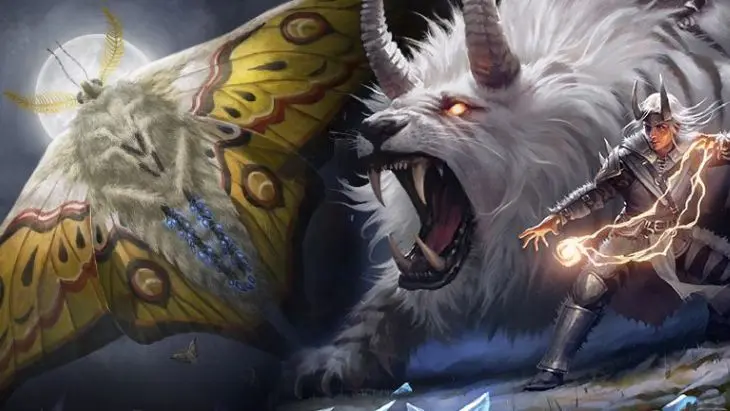
: Ikoria's most impressive white creature. It took a page from the book of from the previous set, but now the returned creatures are the very same ones that died, not tokens. They're also not reduced to 1/1 bodies, they're in fact improved, exploiting the set's inclusion of ability counters. To be fair, there hasn't been a single archetype built around the Broodmoth, but it feels like a missed opportunity that other metas would have taken. The brews that embraced this Mothra reference invariably did terrific things with its free recursion, yet they never coalesced into one well-rounded build that could climb the ladder of competitive play. Maybe it needed a viable infinite combo, as those that were devised with the Broodmoth were always too convoluted. Grief Factor: 7/10.
: The Mythos cycle was much admired, little played. The color requirements for getting the full value out of the cards were a bit too steep and often out of sync with what the meta favored. This one is a perfect example of the issue. Cast it for white, it's just a bad . Bringing it to full Mardu makes it more appealing, but what Mardu deck could be interested in this effect? None of them, that's the problem. Grief Factor: 2/10.
: An unassuming combo card, although firmly in the department of silliness. After Zendikar Rising introduced the world to the magnificence of , the last line of text in Solid Footing suddenly made people excited. You just had to add vigilance to the mix, and that's what was created for. Grief Factor: 2/10.
: This cycler failed the test of efficiency, since it required a whopping two mana to be pitched, one of which even had to be colored. But it had the big upside of potentially turning a gigantic into a lifelinker. Cycling players might sometimes dedicate a couple of slots to this endeavor. It technically could benefit any deck with large finishers, but it was practically never used that way. Grief Factor: 3/10.
: Another weird, somewhat lacking, perpetually prospective combo card. It was reminiscent of other gluttons for punishment like and . Except, instead of drawing a bunch of cards or killing the opponent, the funny-looking Capridor would merely grow big. Hardcore Johnnies and Jennies threw anything at the flying Goat, from to . But the results proved underwhelming even for a jank deck. Grief Factor: 2/10.
Ikoria: Lair of Behemoths Blue Losses
: Much reprinted "fixed" , it was seen first in Dragons of Tarkir, last in Core Set 2020. There's no doubt blue players wouldn't mind to see it back as the most generic digger Standard is allowed to have. Grief Factor: 6/10.
, , and : Blue had more one-mana cyclers than any other color, tied with white, but none of the payoffs, so it wasn't initially a main element of the archetype. When lists with , some countermagic, and sometimes even came into favor, having the Boon became a boon in particular. Grief Factor: 1/10.
: This evergreen conditional counterspell debuted in Magic 2010. Since then the longest Standard had to go without it were the two and a half years between September 2014 (when its iteration from Magic 2014 rotated out) and April 2017 (which marked the release of a new Essence Scatter in Amonkhet). We might be facing a new Scatter drought now, although it's more likely that we'll see it back in one of the next few sets. It's not an essential component of a Standard meta. In fact, it's not even that common to see it included in competitive lists. But it's sort of a safety blanket for permission players. It makes you feel better to know you could easily counter a creature on turn two, if you so wanted. Grief Factor: 6/10.
: The reprint of this classic freezing critter ensured its continuous stay in Standard after the exit of Core Set 2020. Before Ikoria, it had appeared exclusively as a core set creature, since not every plane is suited to host a blue Elemental Cat. It typically doesn't have much of a function outside of Limited, though this time around it at least interacted nicely with the flickering effect of . Grief Factor: 2/10.
: The blue Mythos had a more acceptable fail-case than , but cloning any permanent for that cost is still not particularly exciting. Temur lists usually had better things to do than to leverage a conditional four-mana fight spell with upsides. Grief Factor: 3/10.
: Possibly the best three-mana hard counterspell of this era. Any variant must bring a very valuable extra gift to the table in order to be competitively viable. In this case, it was the ability to cycle the counterspell away when it wasn't needed that made it golden. It's almost unbelievable this additional effect had never been used before, but there's a chance Neutralize will return at some point. Cycling is close to be a deciduous keyword, and they seem to have chosen a name that can fit any setting. Grief Factor: 6/10.
: Casting for one mana is an attractive deal. Not many decks running blue were able to satisfy the "Human and non-Human" condition. But Dimir Rogues typically included eight cheap specimens of each, and players were happy to add a little more card draw to this line-up. Grief Factor: 5/10.
: It may take a while to release the Kraken through this flavorfully named enchantment, as satisfying as that would be. Not the most competitive token factory ever created, but pretty great for casual play and for Brawl. Grief Factor: 5/10.
: The mutate platform of choice, shared by all the decks built around the mechanic. How to evaluate the sadness of seeing it go? The moment we accept the mutate archetype is leaving Standard, we have no reason to wish this little Frog would stick around, now, do we? Grief Factor—for mutate as a whole: 8/10.
: While the mutate enablers are completely useless in isolation, most mutate creatures aren't inherently parasitic. This Shark can drop at instant speed, bounce a target, and enhance its host, in any meta. It was the favorite tempo play of mutate decks, but it would be strong enough even on its own. Grief Factor: 5/10.
: Of all the mutate creatures, this Octopus is probably the easiest to disengage from the mechanic. At its core, it's a saboteur with the ability. Strangely enough, Ikoria had another of those in . The difference is that the Octopus could use its mutate action to ensure a surprise connection, almost ninjutsu-style. It sort of doubles as an Aura to place on evasive creatures, à la . The mechanical reference will prevent it from coming back in a premier set not based on the same setting, but we wish it could. Grief Factor: 7/10.
: The most popular blue card in the set, hands down. It was rarely hardcast, but many control and ramp decks used this Sharknado homage to engineer an uncounterable threat in the late game, or a small board presence plus a cantrip in the early goings. It especially improved the win ratio of decks running , basically overnight. Grief Factor: 10/10.
: Sharks were blue's totem animals in Ikoria. This one proved less popular than similar "counterspell creatures" such as and , due to its higher casting cost. It was still a fine mix of countermagic and beater, and a superior card for Brawl. Grief Factor: 6/10.
Ikoria: Lair of Behemoths Black Losses
: Exactly one deck emerged competitively that employed this enchantment as one of its win conditions, namely the Rakdos Sacrifice build running and . It wasn't even the most successful iteration of the Sacrifice archetype throughout this era, but placing a few Bastions on the board and having them witness a mass sacrifice of tokens and other expendables could be game over. The Golgari version lasted even less, despite sporting more life drain triggers, like 's. Both fell just short of greatness, albeit a in enchantment form is bound to be welcome in any meta, even if the Bastion's casting cost was probably one mana too high to be fully competitive. Grief Factor: 6/10.
: This double for small creatures found a perfect home in decks running as companion, therefore already restricted in regard to the mana values of their creatures. In particular, the combo with was widely exploited, trying to conjure an early 5/5 Demon onto the battlefield. But the Call already provided enough value with the recursions of a couple of key creatures, one of which would even get improved with a menace counter. Being able to return to action a dispatched Lurrus was also important. A spell with this degree of versatility would have certainly found ways to be put to work in future low-to-the-ground black decks. Grief Factor: 8/10.
: This frequently reprinted cheap removal isn't as good at face value as , and this Standard even ended up getting a decent impression of the latter in . This said, the enchantment theme of Theros Beyond Death added weight to the type. Its interaction with and Lurrus had its fair share of enthusiasts. Grief Factor: 5/10.
: Much like white, black wasn't a crucial color for mutate builds. This Bat was the only possible exception, only because it could double as removal at instant speed. But it was pretty slow, and outright terrible when there wasn't a mutation target in sight. Grief Factor: 3/10.
: Not quite as formidable as , but definitely the best four-mana sweeper in black for the past year and a half. The fact that we could never be sure the board would be left thoroughly wiped after an Extinction was counterbalanced by its surgical quality. Its performance from game to game was more unpredictable than with a non-conditional sweeper, but sometimes things would align so that one of the two modes would play in our favor. Grief Factor: 8/10.
: The closest we've gotten to having a go-to two-mana spot removal in black in the past Standard. The meta contained a surprising number of creatures Heartless Act can't quite destroy. (On top of all the +1/+1 counters, there were also those pesky ability counters.) But at least it still retained some use even then. The fail cases sometimes pushed players to search for alternatives, like or even the more expensive . Its direct predecessor was slightly more consistent, but Heartless Act was still acceptable and performed its task well for a long stretch of the cycle. The jury's still out on where ranks in the category, but it already feels like a valid replacement to Heartless Act. Grief Factor: 6/10.
: This card was designed as a strong three-drop for a black deck that never really came to be. It enjoyed a brief moment in the sun when was all the rage at the Players Tour Finals. Otherwise, the Nightmare was a threatening beater that wandered the meta in search of a stable home for many months, and then its time ran out. Grief Factor: 4/10.
: The one contribution black gave to the cycling archetype. Its actual effect could occasionally be useful to disrupt the opponent's plans. Cycling decks didn't want to run black sources at the expense of others, but and meant they didn't have to do so. It's possible to look at Memory Leak as a three-mana with an upside, but Standard usually has no shortage of those. Just to name a few similar spells, we recently had , this cycle also had , and the next one will keep having . Grief Factor: 2/10.
: Another Mythos, another card that required the full three colors to go from mediocre to okay. In this case, Abzan mana would gets us an instant-speed quasi-. Otherwise, it was a more splashable . Grief Factor: 3/10.
: One of the favorite sacrificial lambs of this era. Well, sacrificial Scorpions, since a lamb doesn't actually harm people when you sacrifice it, like this one does. It was good only in very specialized builds that naturally craved a one-drop with a death trigger. Grief Factor: 5/10.
: One of the main reanimator spells we had to work with if we ever wanted to try our hand at that universal archetype. Unsurprisingly, it wasn't a very viable archetype in this era. Grief Factor: 4/10.
: This black impression had the additional copies of itself summoned directly to the battlefield. They weren't fliers, though, so it was mostly a way to fetch more fodder. As such, it was very briefly seen in sacrifice decks. Grief Factor: 2/10.
Opinions expressed in this article are those of the author and not necessarily Cardmarket.