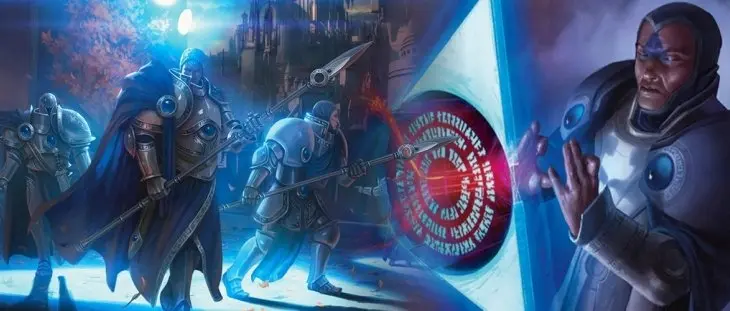
Ravnica Allegiance Azorius Losses
: This Standard cycle contained the mirrored pair of Absorb and . The former, a classic counterspell that originated in Invasion, was more relevant in the metagame, since control decks want to buy time and survive the assaults of aggro more than they want to deal random damage. Esper Control and later Azorius Control embraced Absorb with open arms, even in a world plagued by the . After all, when starting on the play, you get a chance to absorb Teferi himself. Grief Factor: 7/10.
: Flier decks occasionally found some use for the two little Thopters-cum-lifegain from the Deploy side. But that's about it for this card. Grief Factor: 2/10.
: The printing of a on legs was undoubtedly bound to leave a mark on the format. And it did, with many creature-based builds like and enjoying the removal option, even with the return clause making it somewhat ephemeral. To every deck that could access its colors, the Deputy was also an answer to the Zombie hordes of and similar token infestations. Grief Factor: 8/10.
: Another card with very narrow applications, mostly used to create more Thopters for the flier archetype helmed by . Grief Factor: 3/10.
: A control list with Acuity as its centerpiece emerged along the way, without ever rising to top-tier glory. It was easier to set up than the deck, but more or less gravitated around the same intermediate territory, even while building a solid following of aficionados for itself. Grief Factor: 6/10.
: This cycle's resident fair was too pricey to be played straighit t. But it became a part of some juicy combos, chiefly working alongside , to negate the symmetry of the draw, and , producing your own massive Treasure trove to use in combination with , or just for mana. Grief Factor: 6/10.
: Most Azorius cards seem to have been the extremely specialized focus of individual gimmicks. High Alert actually had three separate applications, one for each of its abilities. The first made it into a payoff for toughness-heavy aggro lists running in conjunction with big-butt one-drops like and . In a similar way, it was also one of the enablers of the "defender matters" strategy, a second-rate build that lost all steam once rotated out last fall. Finally, High Alert's non-synergistic activation was briefly exploited before the companion nerf kicked in, when its interaction with and would shape an infinite mana engine — not on par with that caused Zirda to be banned in Legacy, but powerful enough to generate some buzz. Grief Factor: 7/10.
: Well, Lavinia wasn't meant for Standard, that much is sure. The card's a formidable hatebear that was designed to turn off, among other things, Urzatron, delve, cascade, Moxen, and . But the it was born here in Ravnica Allegiance and existed in Standard for almost two full years. And who knows, maybe we'll find out the card's going away right when it would have mattered. Grief Factor: 1/10.
Ravnica Allegiance Rakdos Losses
: As expected, Rakdos offered a good number of removal pieces. The Bedeck half presented the double use of boosting the damage output of one of your attackers or, more commonly, removing one of the opponent's creatures, with its conditional three-toughness clause finding significant targets in the majority of the games. On the other hand, the quite expensive Bedazzle half would rarely be cast at all. So at the end of the day, all the text on this card amounted for the most part to a two-mana instant that kills one creature with toughness lower than 4. The versatility brought about by the hybrid mana cost and the general hunger for cheap removal made it into a minor success. Grief Factor: 6/10.
: The major Rakdos removal spell of this era ranked right there with its two direct forerunners, and . In fact, if not for the stricter color requirement, Bedevil would almost outclass Putrefy entirely — give or take residual regeneration concerns that don't affect Standard anyway. Even as planeswalker destruction is becoming more frequently attached to creature destruction, it remains a big deal to have both so efficiently paired. Grief Factor: 9/10.
: No deck really ramped into black and/or red payoffs, as they were largely the opposite colors of ramp. Too bad for this marvelous enchantment finisher, which was maybe a bit too slow in sealing the deal. (It had to put on a show, after all!) But it amusingly reminded us of the Rakdos Cult's "evil circus" theme. Grief Factor: 3/10.
: The least played Rakdos removal was still of some consequence, as the Carnival half was able to take care of a small creature on turn one, while the Carnage half was 's country cousin. Grief Factor: 4/10.
: Extremely devoted Rakdos builds would run this guy as a hasty two-drop, but it wasn't the most effective sacrifice outlet. Grief Factor: 3/10.
: When sacrifice decks running and became prominent, this diminutive fella became one of the most desirable one-drops, fielded alongside and , and only recently supplanted by . Grief Factor: 7/10.
: One of the centerpieces of Rakdos Sacrifice for a long time, Judith was ultimately displaced by the overabundance of three-drops in the archetype, with taking precedence over the fearsome diva. And when Rakdos Sacrifice turned into Jund, the room became even smaller, while the advent of completely pushed out anything costing more than two. Judith's overall career before her Sunset Boulevard remains glorious. Grief Factor: 8/10.
: It pains me to say this — which would make Rakdos happy — but the latest incarnation of the leader of the Rakdos Cult didn't stop any show. The coin-flip-based enter-the-battlefield destruction was too unreliable to warrant the investment of six mana, even with a big demonic frampler in tow. The flavor was sublime, though. Grief Factor: 4/10.
: This card advantage engine was a little too clunky to be the Rakdos-flavored it wanted to be. This said, decks that were easy on the spectacle occasionally ran it, despite the inherent contradiction of having to give up on turn three while piloting the kind of deck that has to maximize the early damage output to get the job done. Grief Factor: 6/10.
Ravnica Allegiance Gruul Losses
: One of the most valuable sideboard cards Gruul had against control and creature-light combo. Many an Esper or Azorius opponent found themselves doomed by letting this unassuming enchantment slip through the cracks of their countermagic web, the incidental extra damage pushing the amount to lethal. On top of that, it also gave you a effect at the ready, with even more damage added to the deal. Grief Factor: 9/10.
: A candidate for best split card of the entire cycle, both halves of Collision // Colossus were almost equally useful, providing an answer to fliers in the color combination that most needs it and, more importantly, enhancing one attacker by supplying it with a power boost and evasion, something that frequently spelled game over upon resolution, particularly once entered the equation. Grief Factor: 9/10.
: Slightly too slow at four mana for the kind of deck he wanted to be in, the late Domri would luckily give one last proof of his worth . It's not that his Ravnica Allegiance version didn't have an array of useful abilities, chief among them the very flavorful riot-granting plus. But it lacked the more immediate impact of his future three-mana self — barring having a one-drop to cast with the single mana produced by the Chaos Bringer, which on turn four isn't too likely. Grief Factor: 7/10.
: The workhorse of Gruul Aggro. Under its straightforward appearance, the Spellbreaker hid many talents. It could be a sturdy 4/4 on turn three, or it could pressure life totals and planeswalker loyalties with haste. And preventing all targeting on the player created unexpected additional benefits; for a little while, it was even able to shut down ! Grief Factor: 9/10.
: In theory, doubling your mana should pay big dividends in Gruul. In practice, though, there are cards you want to play in these colors that aren't creatures, so Nikya never went past oddity status, and was all but forgotten after showed up. Grief Factor: 2/10.
: A six-mana curve-topper needs to be able to make waves on the battlefield from the get-go in order to justify its presence. Ravager Wurm could swing right away and fight one creature or destroy one land, so it sort of qualified. Soon its unevasive body started to feel inadequate, though, and the acceptable curve for aggro couldn't go up to six anymore. (Midrange declined.) Plus, the only land with an activated ability that deserved targeting . Grief Factor: 6/10.
: Here's another card that suffered the increasing necessity for aggro to put the pedal to the metal and close the game before being crushed by control and combo's late game, which meant no time to drop a do-nothing enchantment on turn three. It's kind of ironic, given that Rhythm of the Wild's whole purpose was accelerating the aggression in the following turns, while protecting the aggressors themselves from being countered or removed at sorcery-speed before they could connect. Both these abilities are nothing to sneeze at, and invite a modicum of respect, even in view of latent combo shenanigans that didn't actually turn up, like speeding up 's activation. Grief Factor: 7/10.
: A secondary bite effect, now eclipsed by . The alternative 4/4 trampler for four was never the major attraction of this card, but it was a nice option to have available. Grief Factor: 5/10.
: One of the primary two-drops of Gruul Aggro for a long time. It kept being somehow easier to cast in its archetype than from Core Set 2020, and the potential haste mattered. {c=Robber of the Reach} and would later compete for this fierce Goblin's slots. Grief Factor: 6/10.
Ravnica Allegiance Orzhov Losses
: One of the best creatures in the decks, and one of the only two cards in the "double double-colored" four-drop cycle to see competitive play, along with . Bell-Haunt had two worthwhile enter-the-battlefield effects that invited the abuse via flickering or bouncing and recasting, and a body that aligned well against many early attackers. Grief Factor: 7/10.
: Despite the high cost, this powerful enchantment showed up in some competitive sideboards, severely impairing go-wide strategies while procuring an army of fliers and some late-game graveyard hate. It was well-worth the expense for those decks that could afford it. Grief Factor: 7/10.
: This two-mana instant saw some play after left the format, within Orzhov Sacrifice builds especially. It wouldn't take many sets to find better alternatives, though. Grief Factor: 4/10.
: A solid afterlife creature, this dignified Orzhov grandma could swing for two and still be ready to trade defensively and turn into a Spirit. If didn't exist, the card would be the best two-drop of its kind. Grief Factor: 3/10.
: Kaya did a couple of specific things very well, namely fighting graveyard recursions and exiling one-drops, at least those that couldn't be sacrificed in response and . But overall her skill set was too narrow and not too many decks required her services so ardently to be willing to spend the whole of turn three on her. Her lifedraining ultimate based on the exiled cards was easy to reach and could be made into a win condition — with the help of , for instance — a strategy that was however more cute than effectual. Grief Factor: 5/10.
: This Standard cycle's — that is, until showed up and made it so Jeskai decks didn't feel left out anymore and Esper decks were allowed to go back to Azorius. Grief Factor: 9/10.
: We mentioned this removal spell from Guildpact as one of the precursors to , and they actually got to share a run in Standard. It's still a great card after all these years, and the enchantment hate was particularly crucial in the environment, what with cards like , , and often deciding the outcome of a game. Grief Factor: 7/10.
: This new take on didn't really find a home during its Standard tenure but wasn't a bad impression of the original. Sure, the Pontiff requires one mana per activation, but deathtouch makes it harder to deal with and stronger as a defensive measure. Grief Factor: 3/10.
: A majestic Angel, proficient in both attack and defense, able to trade with anything, and resilient against removal to some extent, due to the double afterlife. It stayed relevant and present in the metagame for as long as Orzhov Midrange was viable — which unfortunately was not too long. Grief Factor: 8/10.
: Afterlife decks with Teysa as their centerpiece were attempted, because they looked fun and flavorful, and everybody loves Teysa. The card's first ability suggests different death-trigger-related build-arounds too, although it's all predicated on a four-drop with no real board presence. All in all, Teysa's more appropriate residence seemed to be the command zone — of Brawl decks at first, Commander and Historic Brawl in the near future. Grief Factor: 6/10.
Ravnica Allegiance Simic Losses
: This Mutant did what would do before it was cool — except not as a companion, and only for creatures, so the combo decks it engendered ended up being more niche. It was also primarily meant to assist with adapt, so cards like and were its best friends. But even just halving the activation cost of something like had merit. It might leave Standard with untapped potential. Grief Factor: 5/10.
: Very close to be a strictly better , if we consider that the fourth mana in the Snake's cost in all probability would be paid with green anyway. The Lizard Wizard has had a successful career in Simic Flash, and its successor, , is nowhere near its power level. Grief Factor: 8/10.
: If Simic Ramp and its more colorful offshoots — including while it was around — dominated the meta the way they did, it's in no small measure due to the introduction of this instant-speed , which created a consistent pattern of mana development. Its advanced rotation might well signal the end of this era of ramp. Grief Factor: 10/10.
: Every good ramp deck needs a rewarding payoff, and this cycle's Simic had one of the best to ever grace a Magic battlefield. Who would have thought an X-cost Hydra would one day get a flying body, while also drawing cards and gaining life? Could we ask anything more from Hydroid Krasis? I don't think we could, and we certainly milled every ounce of value out of this crazy Jellyfish. Grief Factor: 10/10.
: There were strong library-digging spells in green in this cycle — the ban-worthy , to name just one of them. None that would go as deep as Incubation, and for some decks seeking specific pieces that extra depth mattered a whole lot. Incongruity's pseudo-removal effect mattered a lot less, but it could prove useful in a pinch. Grief Factor: 7/10.
: The loveliest of protoplasmic Oozes brought back into Standard, although in a more fragile creature form. Once enough untappers like and were printed, Vannifar got to be the enabler of a combo kill involving and that was pretty darn effective. And in general, with the assistance of , Vannifar consistently found itself at the center of the most entertaining toolbox builds the format had in store. We'll miss you, Vannie. Grief Factor: 8/10.
: The Simic cards of this cycle have become notorious for being the most efficient and cutthroat in the meta. Of the nine cards banned in Standard over the course of 2020, seven were either blue or green, two were both. But they also had at least one jank build, and Simic Ascendancy is hard evidence of it. Grief Factor: 3/10.
: Vannifar's main political opponent as well as her predecessor as guildmaster of the Simic Combine was given an incarnation more oriented toward beatdown, albeit with the bonus card draw required by being Simic. Zegana has rarely seen play in high places, which is a pity because it was a pretty decent beater that could turn into in a heartbeat while also weaponizing the whole team. Grief Factor: 4/10.
Ravnica Allegiance Colorless Losses
, , , , and : The same that was said for the first five shock lands applies to the rest of them. They were Standard's lymphatic system, and now they're gone, and the straits will be dire. Grief Factor: 11/10.
: The Gate deck's big attraction, empowered in equal measure by its evasion and recursion. Grief Factor: 4/10.
: No multicolored decks really cared about the anthem from this nifty artifact, which perhaps deserved more love. Grief Factor: 1/10.
and : The Gates completed their cycle, which marked the real beginning of their dedicated synergy deck — and some budget-friendly mana fixing elsewhere. Grief Factor: 1/10.
Opinions expressed in this article are those of the author and not necessarily Cardmarket.