Throne of Eldraine White Losses
: Throne of Eldraine wasn't structured as a tribal environment per se, but the Arthurian side of the setting pushed a large support for the Knight type. It ended up the most popular tribe of this Standard cycle until the advent of the Rogues in Zendikar Rising. Eldraine's Knights had white, black, and red as their designated colors, although Standard progressively abandoned the former in favor of a pure Rakdos setup. In earlier Knight builds, though, the Contender would do a solid job as hand refueler. Grief Factor: 3/10.
: Neither artifact-based aggro nor Bogle-like concoctions ever rose to top-tier prominence in the past two years of Standard. But this pseudo in Aura form would occasionally emerge as an explosive win condition, especially in sub-formats like Artisan, more so while was legal and could do a reasonable impression of via or . For a while there, All That Glitters was the king of budget decks. Grief Factor: 5/10.
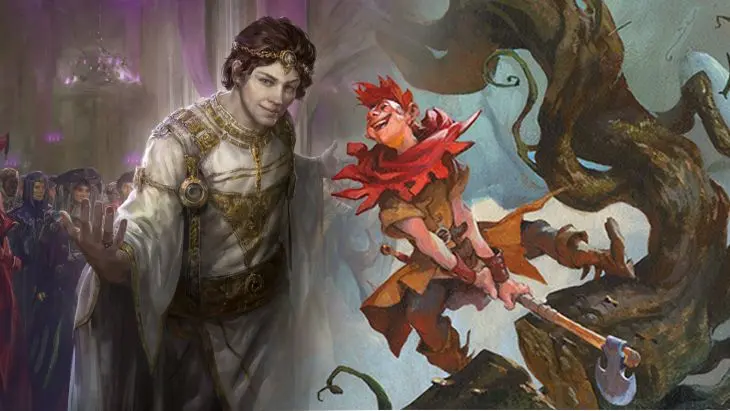
: This brilliant pun-made-card (Prince Charming from the fairy tales but also a prince casting a ) wasn't just a novelty design. Its modal versatility proved as winsome as the character's looks. The potential life gain synergies never really materialized, but scry made for a proactive turn two play, while the flickering would interact with various ETB abilities—up to the extremely lucrative partnership with . Here the slight Noble and winged Serpent would take turns blinking each other, in a never-ending loop of value. Grief Factor: 7/10.
: Adventure cards have been, hands down, the absolute winners of this Standard era. They became relevant from the get-go and never stopped fueling an array of top decks for two years straight. Their mechanical gist was very simple: each represented two cards in one, and not as modal options, the kind of which we had seen many times in the past, but as two bona fide spells to cast one after the other, if in a precise order. Even an unassuming card like the Guidemother, which wasn't exactly the most prevalent, at one point found a home in Naya-colored Adventures builds, where it helped catapulting the likes of or , beyond enemy lines. Grief Factor: 2/10.
: Magic's take on Jack, the slayer of giants from the Cornish fairy tale, was an acceptable tapper, less efficient than from Standard 2019–2020 but still deserving of a place as a tactical element in Monowhite Aggro lists. What took the card from good to great, though, is the Chop Down Adventure, arguably the best white removal of its time. Once again, this kind of double-feature card will be very hard to replace. Grief Factor: 8/10.
: A cheaper, conditional is something that has existed for a long time, at least since Zendikar's . However, its current state of white staple is a relatively new development that was kicked off by the one-two of in Rivals of Ixalan and in Dominaria. The Casket moved the effect to an artifact shell, primarily for flavor reasons, but also because artifacts mattered slightly more than enchantments for a few Eldraine cards, most notably . Forgotten Realms' descends directly from this card, but it might be too narrow to fully replace it. Grief Factor: 6/10.
: This Faerie and its striking, controversial artwork have lived through a few different meta evolutions that kept updating the card's role. At first, it was mostly a hoser, with strong enough stats to earn the occasional main-deck status. Then lifelink came into focus in the context of some synergies, chiefly those involving . Finally, certain combos emerged where it would counteract negative enter-the-battlefield abilities, like 's. It was always a vital component in any of these decks, even if none of them have ever been tier-one material. Grief Factor: 7/10.
: The Buy-a-Box promo was an exclusive card not showing up in booster packs, and while not as format-breaking as , it still made an impact on the competitive environment. Granted, that impact was initially confined to the Jeskai Fires archetype, which would funnel all the excess mana into the three in-color activations. Later, it gained a second career as one of the best hits for . There were other, more casual decks making use of Kenrith as well, particularly of the powerful black ability. All this not even mentioning the card's huge popularity as a five-color commander in Brawl. What could simply read as a flavor insert in the end was everything but. Grief Factor: 7/10.
: All the triple-symbol monocolored legendaries from Throne of Eldraine were well-received by the competitive scene, to different degrees. Linden sat around the middle of the scale—big in Monowhite Life, of little interest anywhere else. Grief Factor: 5/10.
: For a minute there, long before Kaldheim introduced a completely different take on the concept, Naya had a viable Giant tribal deck, based on the strength of their Eldraine members and on this one-sided sweeper in particular. Even without the tribal advantage, Cast Off remained a serviceable board wipe that doubled as a finisher, until it was obsoleted by faster options— at first, more recently. Although it never ceased to be a Brawl staple. Grief Factor: 6/10.
: A minor white Adventure card that had its moments, the Shepherd was at its best when picking up . Grief Factor: 2/10.
: Every color of Knights had its own high-profile one-drop. Grandma Knight was the least exciting of the three—one of the reasons why lists eventually dropped white. But its workmanlike attitude had its merits. After all, 2-powered one-drops have been at a premium ever since . Grief Factor: 3/10.
: The most compelling incentive to include white in Knight decks. Before the archetype took the " or bust" route, Knight players relied on this card's worthiness to take over the board. The two-drop was capable of supporting a go-wide strategy all on its own, in a way reminiscent of in the previous rotation, except more strictly related to a linear aggro strategy. Grief Factor: 5/10.
Throne of Eldraine Blue Losses
: One of only two mythic Adventures in the set (the other was the more cumbersome ) and perhaps the clearest demonstration of the mechanic's huge power level. Drawing a Borrower meant suddenly having in our hand both a and an evasive beater with the speed and effectiveness of fellow Faerie —an all-time great that the Borrower managed to rival, leaving its mark in more than one format. In Standard, it nearly single-handedly encouraged the expansion of Adventure decks from the Gruul base to their most successful Temur-colored incarnation. But it was also sighted everywhere else blue was a factor, from Simic Ramp builds to Izzet Tempo to, as counterintuitive as it seemed, decks as well as control decks running . More recently, its other subtype made the Faerie a consideration for Dimir Rogues, though usually trumped by 's companionship. All in all, one of the most widely played cards of its age. Grief Factor: 10/10.
: This functional reprint of was the variant of choice for decks that cared about milling as a win condition or else were eager to unlock various abilities by filling the opponent's graveyard, like Dimir Rogues does. This card also saw the debut of the "counterspell with a cheeky name," a genre that later would give us in Kaldheim. Grief Factor: 3/10.
: Eldraine's own Lady of the Lake didn't give birth to combo decks in Standard to the same degree that some of the Johnny/Jenny creatures from 2018–2019 did, like . But brews employing the card's knack for artifact retrieval were many and rich, running the full gamut from casual to competitive. Grief Factor: 7/10.
: The other blue Adventure card of major renown. It wasn't as omnipresent as , due to its need for a more specific setup, namely a deck with access to enough mana resources to allow for the tutoring and casting of the desired card. Temur Adventures exploited this wish well while was still legal. It also made key appearances in decks with a flair for going big, like Jeskai Fires. Grief Factor: 8/10.
: A reasonable flash beater for tempo decks, though not as profitable and easy to grow consistently as from the previous cycle. Izzet's "draw two" mechanic was relatively popular but never too relevant at higher levels of competition. Grief Factor: 4/10.
: This burst of card draw with a tactical board controller attached showed up in some blue decks but much fewer than expected, possibly due to its steep color requirement. After Theros Beyond Death, the brief emergence of devotion lists running gave our Merlin lookalike a place to call home. Plus of course the card never ceased to be a fixture in Brawl. Grief Factor: 6/10.
: The secret star of mill decks, it reached its first peak once Core Set 2021 paired it with . Later it scaled even greater heights when it became a fixture of the Rogues' gallery. Grief Factor: 5/10.
: Basic mill enabler doubling as an early blocker. It was used both for the purpose of self-milling, particularly while was legal, and aggressively against the opponent, particularly after Zendikar Rising printed . Grief Factor: 2/10.
: This slow mana rock chiming the hours until the time of a one-sided wasn't extremely significant in regular Constructed, but close to indispensable in Brawl. Grief Factor: 5/10.
: Another card with largely untapped potential, possibly because it may have been designed with more casual formats in mind. Admittedly, the card's scope wasn't exceedingly wide, but we might end up missing its presence in the pool of options. Grief Factor: 1/10.
: During the height of the Temur/Simic dominance over the meta, basically all Standard decks ran several copies of this counterspell in the main deck or wished they could. The chance to nullify any critical blue play for just one mana won't present itself again anytime soon. Grief Factor: 7/10.
: By now we're used to having this little yet oh-so-important cantrip in Standard, considering Opt has been part of the format continuously since 2017, when it was reprinted for the first time in Ixalan. We've come to see it as a fundamental, irreplaceable element of blue. But it's on its way out, alongside its latest reprint from Core Set 2021. (The Mystical Archive version doesn't confer legality.) No time to panic yet, though. Chances are we'll get it back sooner rather than later. Grief Factor: 8/10.
, , and : Throne of Eldraine was the first, and to date the only, set to be accompanied by four preconstructed decks designed for Brawl. A few of the exclusive cards from these products had some effect on Standard at large, where they were fully legal. This trio of Faerie-based or artifact-related blue cards came under the tutelage of the pixie mischief-maker . They didn't appear anywhere in competitive Standard and weren't afforded much love in Brawl either. But they were intriguing curve toppers with a larger-than-life quality that felt more akin to proper Commander cards, and it's a pity they'll leave the format before getting a real chance to prove themselves. Grief Factor: 1/10.
Throne of Eldraine Black Losses
: Like most members of this cycle, the Shadow Queen of the court of Locthwain was hindered by the demanding triple-pip casting cost. Monoblack brews loved the card, though, as it would provide incidental life drain, a sacrifice outlet, card draw, and a ton of devotion to enable a finishing move, further cementing the alliance between Throne Eldraine and Theros Beyond Death—a stronger bond than to any of the sets that followed them. Grief Factor: 6/10.
: Solid entry in the black Knights roster, able to play tempo and double as pseudo-removal. Grief Factor: 5/10.
: One in a handful of cards that will be remembered as the defining features of this Standard era. The "cat in the " combo looked like a meme at first, but quickly emerged as one of the most efficient and consistent interactions of its time, fueling an entire archetype of which it was the undisputed, nearly unstoppable centerpiece. Grief Factor: 9/10.
: Despite its appealing stats and rule text, this flavorful Troll never entirely fulfilled its potential. It was just too easy to stop its aggression, and the resulting card advantage couldn't quite compare to the explosiveness of contemporary powerhouses like and . Even in a team with , it remained firmly in the sole purview of enlightened jank. Grief Factor: 4/10.
and : Minor removal spells for big and small creatures, respectively. The sorcery speed mostly relegated them to Brawl territory, where they did a decent job at providing redundancy. Downfall was the more popular of the two because of its exile clause. Grief Factor: 2/10.
: Versatile one-drop for Black-Green Adventures but also decently playable in generic black builds, where it could hold the ground early on and replace itself when drawn later in the game. After the release of Kaldheim, it was hired by the popular deathtouch squad led by . Grief Factor: 4/10.
: A prime removal spell for much of its tenure in Standard. The Adventure side is essentially , which satisfies both prerequisites for modern creature spot removal: instant speed and the option to hit planeswalkers, a crucial factor while War of the Spark was in the meta. The creature side is largely a bonus, but it helped control decks establish a board presence and offsetting the life loss from Swift End, which could add up at times. The graveyard-skipping clause might prove a hindrance occasionally ( hated it), but the shuffling produced by the ubiquitous could bring a fresh Rider back into the fold. Grief Factor: 8/10.
: A valuable mix of recursion and evasion, the latter element a very helpful one to pressure planeswalkers. It didn't translate into a top-tier card only because the Adventure ran the serious risk of being wasted in the early goings, and the inability to play defense was a bit of an issue in general. Grief Factor: 4/10.
: This flavorful design was clearly devised for casual play, but within that framework, it was a raving success. Janky brews adored the slow yet steady stream of menacing Rats as well as the eventual Hamelin trick of stealing the opponent's "children." Grief Factor: 3/10.
: An outstanding midrange flier whose reputation hit its zenith during the heyday of sacrifice decks. As those builds lowered their curve more and more, Rankle's influence on the meta waned a bit, but the card never found itself entirely homeless, as many a casual deck would still enjoy pulling a dark prank or three on opponents. Grief Factor: 7/10.
: The main black payoff for running a dedicated Knight tribal deck. Unfortunately, the concept quickly devolved into decks simply running a few good Knights but mostly winning by equipping on improbable targets like . The Swordmaster had no place in those builds and was sadly put aside, left to marinate in forlorn musings of unrequited love. Grief Factor: 3/10.
: The "Syr" cycle of uncommons was mainly intended for Limited play. Konrad, while still being too slow for regular Constructed, had some minor incidence in Brawl, where its trigger could be made into a legitimate win condition. Grief Factor: 2/10.
: This very conditional sweeper would have been huge in a different Standard era, but the past two years saw very few tribal builds taking the spotlight. Still, it could be a valuable sideboard option to bring in against token decks, or to punish other occurrences of heavily replicated subtypes. That is, until almost entirely obsoleted it. Grief Factor: 3/10.
Opinions expressed in this article are those of the author and not necessarily Cardmarket.