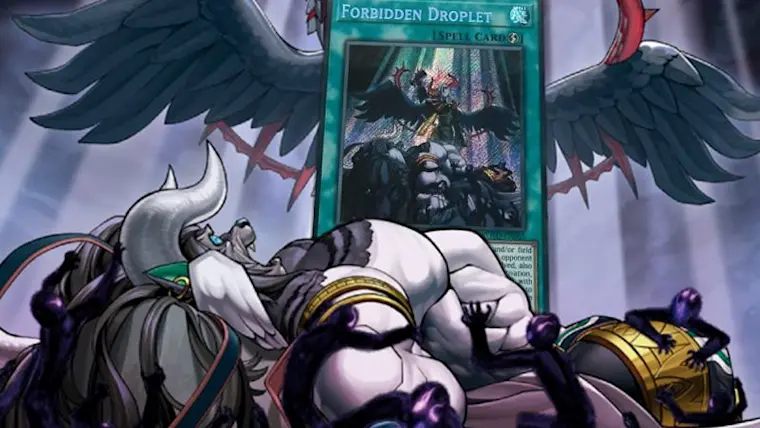
Forbidden Droplet
|
Hence, Droplet can negate monster effects as well as change their attack, making its use quite versatile. Moreover, depending on the cards sent to the graveyard as cost, the opponent might not be able to respond to Droplet's activation. Now, let's dive right into some frequently occurring scenarios that involve Forbidden Droplet.
Forbidden Droplet Versus Apollousa
The interaction that is probably the most confusing to many players is when Forbidden Droplet is used to negate the effects of
The same is true for all the


This is because the Zoodiac xyz monsters all have continuous effects that constantly check how much attack (and defense) they are supposed to have. Apollousa, on the other hand, does not have a continuous effect that sets the attack. The effect setting Apollousa's attack only applies once upon summoning. If the card's effects are negated, Apollousa will not remember what value the attack had been set to upon summoning. Hence, its attack will decrease to zero after Droplet has stopped applying.
Forbidden Droplet Versus Gren Maju
All that has been said before also applies to good old

Forbidden Droplet in the Damage Step
The damage step in Yu-Gi-Oh! is probably one of the most complex parts of the game. Only certain types of cards and effects can be activated during the damage step. This includes cards that negate card/effect activations (such as


So, you can use it to negate a monster's effects during the damage step, because you can also alter its attack, right? While the answer to this question is yes, you still have to be careful because Forbidden Droplet cannot be used during the entire damage step. I will briefly explain in which substeps of the damage step Droplet can be activated. The damage step consists of the following five substeps:
- Start of the damage step
- Before damage calculation
- Damage calculation
- After damage calculation
- End of the damage step
Cards that change the attack or defense of monsters can only be used up to and including before damage calculation. From damage calculation onward, this type of cards cannot be used anymore during the damage step (unless they also include an effect that negates activations). This means that you can only use Forbidden Droplet during the start of the damage step and before damage calculation substeps.
There is a pitfall here: Flip effects such as those of the infamous


You have to keep in mind these intricacies, as the possibility to negate an effect or not might well determine the outcome of a duel. If you have performed damage calculation already and your opponent wants to resolve any flip effects activated by the attack, but you have not used Droplet yet, you have missed your chance to use Forbidden Droplet to negate a monster's effects.
Forbidden Droplet Versus Macro Cosmos
Forbidden Droplet's activation cost is the sending of any number of cards from the hand or field to the graveyard. In Yu-Gi-Oh!, costs have to be paid as they are written on the card. This means that you have to actually send the cards to the graveyard. When
There are other similar cards like Macro Cosmos with somewhat weaker effects. For example,


Forbidden Droplet Versus a Changed Number of Monsters
The last scenario deals with what happens when some monsters leave the field before Droplet resolves. Let's assume your opponent controls two monsters whose effects you wish to negate with Droplet. You activate Droplet and you send two cards to the graveyard. Your opponent then chains a card such as

Your opponent is now left with only one monster when Droplet resolves. However, you have sent two cards to the graveyard with Droplet and you are required to choose two monsters. Since you cannot do this, Droplet will resolve without effect. You will not be able to negate the remaining monster's effects in this case!
This concludes my survey on Forbidden Droplet. I hope this article helps some players to better understand how Forbidden Droplet works and makes people aware of some scenarios in which you have to be particularly careful while using Forbidden Droplet.
Opinions expressed in this article are those of the author and not necessarily Cardmarket.