
For all its flaws, Arena still is the best digital rendition of Magic gameplay we ever got. It's beautiful enough to look at, easy enough to navigate, and close enough to the real deal. It's fast paced and does a lifelike approximation of how Magic works in real time against real opponents. It also afforded many of us an opportunity, affordable too, to play Magic during times when real-life encounters had to be limited. Much like shouting at anti-vax relatives, we're mad not because we don't care for Arena but because we do.
The Advantage of Digital
Cardmarket's pretty great, but when you want to complete a top-tier deck on a minimum of either time or dime, Arena has us beat. Mind, the sharp end of the stick is you can't use your Arena deck or its components on any other platform, including tables, and can't sell anything off again. But you can get in a lot of reps anytime of the day or night, which makes Arena the perfect test environment.
It also makes a neat deal for Wizards because they can sell people the same cards multiple times over. A player may own four physical copies of
Well, the powers that be have determined it's more lucrative to invest extra resources to develop even more new cards and to redesign the ones they already got. Synergy effects? How about we specifically aim to avoid any synergy by making sure the new cards cannot ever appear/work in physical reality?
No one has been asking for any of that, and many of us have been asking them not to do it and to, oh god, please, stop it. Yet here we are.
The Alch-nemesis
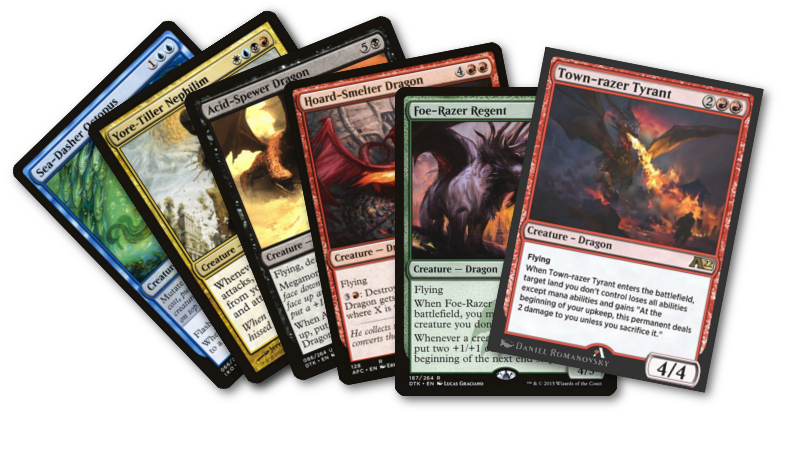
To be fair, they don't invest a lot of resources into developing the Alchemy cards. They couldn't even be bothered to let their usual editors take a look at the cards' names. Once upon a time, if you saw a Town-razer Tyrant, you knew it had to be fake because a real card would be called Town-Razer Tyrant.
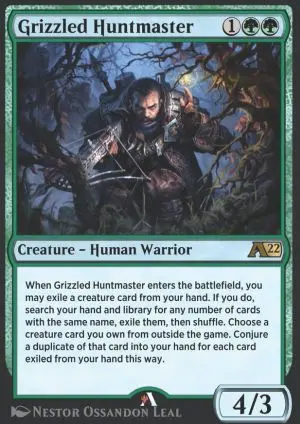
Granted, this is merely one minor-type typo, a case of mistaken case. Grizzled Huntmaster, on the other end of the spectrum, features so much text for so little gain. Do you get what it's trying to say? No? Don't feel bad. You only need to note the volume to know it begs for an editor to come in and clean that stuff up. It's like a baby in a soiled diaper that way.
This is a true story.
The exchange took place on Twitter in 2021.
Out of respect for the dead, the names are being omitted.
In the interest of the survivors, the rest is quoted exactly as it was posted.
| Pro Tour champion: |
|---|
| I'll give you my unpopular opinion [on Grizzled Huntmaster]. Sure its really complicated, more than most cards, but I think it's unique in way that makes it interesting ACTUALLY worth it. |
| Player with three Pro Tour Top 8s: |
|---|
| Why is thinning the deck a little ACTUALLY worth the extra text? Care to explain? |
| Pro Tour champion: |
|---|
| if I exile more copies from my library, don't I get more of them into my hand, but as duplicates? |
| Player with three Pro Tour Top 8s: |
|---|
| Ya that's not what it does |
| Pro Tour champion: |
|---|
| So if you exile a creature from your hand, you have another one in your library, you can grab two from your sideboard? |
| Player with three Pro Tour Top 8s: |
|---|
| Try again |
| Pro Tour champion: |
|---|
| Ok I guess you can get any creature from the sideboard? So if you exile one from your hand, three from your deck, you can get a duplicate of that creature 4 times? |
| Member of the Hall of Fame: |
|---|
| getting colder :( |
| Pro Tour champion: |
|---|
| I give up |
The Crux of a Rotating Format
In the beginning Arena only knew one competitive Constructed option: Standard. But if you want players to invest—not just time and/or money but also effort, thought, emotional attachment—into game pieces for a rotating format, you need some kind of legacy format where the rotating pieces remain relevant. This goes double for a platform where you can't trade your cards away. This was the original purported raison d'être for Historic. This was supposed to be a place where all the cards rotating from Standard, sans banneds, would live out the rest of their lives in peace.
Alas, things didn't quite turn out that way. If you look at the most recent championship's Top 8 Historic lists, you'll find the average main deck containing more than fourteen cards that have never been in Standard in Arena's lifetime. If you only look at nonland cards, the statistic becomes worse. One deck even featured an even split: eighteen spells that are/were Standard legal and eighteen from extracurricular releases.

Historic is not a best-of of Standard seasons past. The best of Historic includes the likes of
A nonrotating format—take Modern for example—grows and grows until the card pool is so large that, eventually, Standard sets rarely exert a meaningful influence anymore. At this point in its lifecycle, you get Modern Horizons and Modern Horizons 2 and, soon, Tales of Middle-EarthTM. Historic, by contrast, bypassed the initial stage of organic growth and went straight to the degenerate stage of special releases specifically aimed at the format. Looking for a format where your old Standard cards remain relevant? Well, don't look at Historic and, by extension, don't look at Arena.
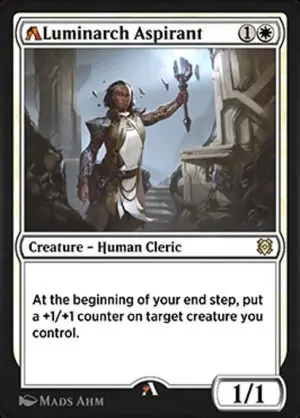
But wait, it gets better. By which I mean worse. Alchemy doesn't just add new cards at an unprecedented rate, making your old Standard staples look even older. No, it also changes how the most workable of your Standard cards work once they rotate out of Standard. Historic is a place where you can cast

The (Real) State of Arena
Let's sum up the various competitive Constructed options the program offers.
-
Alchemy: Although based on Standard, this format is all about cards that do not and cannot exist in real life, and about cards working differently than they do in Standard/real life. It also requires considerable investment since you don't get any compensation when your cards are downgraded into obsolescence, and most of the Alchemy cards are of higher rarities.
-
Historic: Here you have to contend with even more digital-only cards and even more inexplicable changes to known cards. It also draws from a huge card pool, pulling important cards from as far back as Urza's Saga. The last time I built a Historic deck, I already owned many of the format's staples plus all pieces from Arena Standard, and still I spent 27 rare wildcards. ("The last time" likely doesn't mean the latest but the final time.)
-
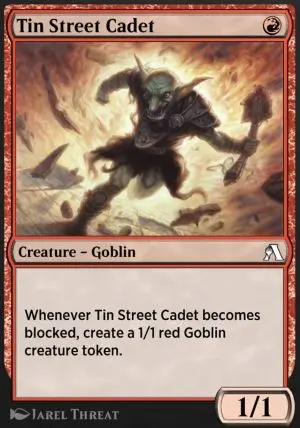
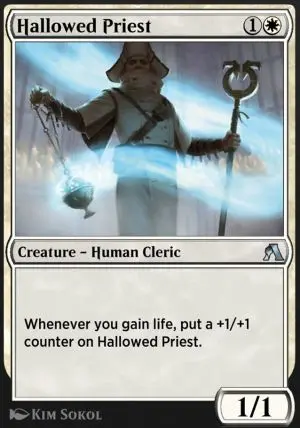
Standard (best of one): You might expect Standard to mirror the real-world experience, but no. If you play single games, you can face decks with
and , both of which aren't in Standard, and an even better one-drop Goblin that doesn't exist offline at all. You may also run into the digital native "Ajani's Half-Mate."
-
Standard (best of three): Okay, but surely this at long last offers the same deal as the official tournament format we all know and love (to hate), right? Indeed it fulfills the minimum requirement of not allowing cards that aren't allowed in Standard. However, for several months now, Arena has been using a system for ladder play that allows a player to win the first game of a match, concede during the subsequent sideboarding intermission, and have this counted as a win. Don't like your (postboard) matchup? Why, do we have good news for you!
So that's the state of the program. What started out as the closest digital approximation of Magic we ever had now offers close to zero Constructed options that are analogous to the analog game. Instead we get bombarded by an endless array of gimmicky pseudo-cards exclusive to Arena. That may be nice if you're looking for a video game loosely based on Magic. But if you were hoping for a program to connect the worlds of cardboard and bytes, as Arena originally set out to do, you can't help but feel disappointment. The thing is, Arena could do both. Unfortunately it's focusing on the video game aspects at the expense of Magic's roots, discarding history and alienating tabletop players left (out) and right (on).
The erosion of standards marches on. Even keeping in touch with Standard is becoming increasingly difficult because even Standard doesn't work like Standard anymore. No less, it's becoming increasingly hard to justify the expense. Here's a list of the most recent sets and what fraction of their mythics I've collected on Arena …
Throne of Eldraine: 100%
Theros Beyond Death: 100%
Ikoria: 100%
Core Set 2021: 100%
Zendikar Rising: 100%
Kaldheim: 100%
Forgotten Realms: 100%
Midnight Hunt: 74%
Crimson Vow: 55%
The New Year's Resolutions
Player feedback: Hey, Wizards! If you have so much bandwidth to create and implement so many wholly new Alchemy cards, can't you use some of that to build toward Pioneer again? It doesn't even have to be the full card pool at first. Just spare a few special releases to add the most relevant cards. We hear Pioneer's going to be the next big thing in paper play, maybe because it still is one of those organically growing formats. We could really use one of those. The synergy effects would be massive. We could even recommend the program again to people who want to get into actual Magic.
Wizards: No.
Player: Can we get some UX updates like default choice of basic lands, spectator mode, et cetera?
Wizards: No.
Player: Can you give us a wildcard refund when you change the cards on which we've spent our hard-earned wildcards?
Wizards: No.
Player: Could you at least remove the digital-only cards from best-of-one Standard and fix the sideboarding bug in best-of-three?
Wizards: No.
Player: Is there anything you can do for us?
Wizards: Glad that you asked! If you're unhappy with Standard play, you'll be happy to hear that Alchemy offers a unique and constantly fresh experience that we're sure you'll love. All you need to unlock the full card pool are 40 mythic wildcards, 44 uncommon wildcards, and 168 rare wildcards. But don't worry, more cards are underway, and the ones you already got are bound to change without warning or recourse.
Player: Thanks, I hate it.
Padme: At least we don't have to be concerned they're setting a precedence, right? In the real world, they won't just print untested designs, then change how the cards work later, right?
Padme: We don't have to be concerned about that, right?

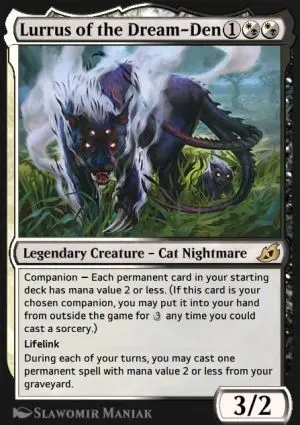
Opinions expressed in this article are those of the author and definitely not Cardmarket's.