
Introduction
Hello dear reader, my name is Anaël, and I am here to regularly share with you in-depth insight about the Modern metagame. In my articles, I'll provide graphs and analysis of the results of the main archetypes, using the R programming language and data scraped by Phelps-san. Initially just done for fun, it became a project for my master in statistics, and I've been developing my tool ever since. Now you get to see the results on Cardmarket!
This article acts as an introduction to Modern for those who would like to become more familiar with it. We start with a definition of the format, then take a look at what happened to it last year. We check which archetypes are its pillars and focus on the recent news—the release of Kaldheim and the huge update to the ban list that followed—before concluding with the first results from post-ban Modern!
What Is Modern?
Announced in May 2011 and officially added to the professional circuit a few months later, Modern is your usual 60-card-deck Constructed format. It has the following restriction on the card pool: only cards printed in once Standard-legal sets beginning with Eighth Edition—which marked the game's tenth anniversary—are allowed. Two exceptions: as usual, a ban list; and a specific type of additional set, called Modern Horizons.
The goal was to provide a nonrotating format where people could play without Reserved List cards, which were already considered hard to acquire back in 2011. The cutoff was chosen to be the set that introduced a new frame to Magic.
Nowadays, the format is often seen as the competitive environment with the most diverse metagame overall. That, the nonrotating nature, and the absence of Reserved List cards are among the biggest pulls of Modern, making it one of the most popular forms of Magic. While you can't play it on MTG Arena (and probably won't be able to for the foreseeable future given that its little brother Pioneer is not expected for at least several more months), it is the main format of competition on Magic Online. It has been a format at the highest level of tournaments on that platform—the Magic Online Championship Series—for years and used to be part of the Pro Tour circuit when paper play was possible.
2020 and a Short History of Modern's Ban List
Just like most formats, Modern had a turbulent year, to say the least. 2020 saw the highest number of bans since the year of Modern's creation, without even accounting for the companion errata. 2021 did not disappoint either with as many bans in six weeks as in the entirety of 2020, and a rules change as well.
Looking back at the format's infancy, the ban list started with just eleven cards:
| Year | # of Bans | Bans/Unbans |
|---|---|---|
| 2011 | 6 | |
| 2012 | 0 | |
| 2013 | 3 | |
| 2014 | 1 | |
| 2015 | 3 | |
| 2016 | 3 | |
| 2017 | 2 | |
| 2018 | 0 | |
| 2019 | 4 | |
| 2020 | 5 | |
| 2021 | 5 |
The 2021 bannings constituted the final fallout from faulty cards released in 2019/2020. Besides, the 2020 bans happened on several different occasions, leading to a large meta shift each time. However, after the release of Zendikar Rising in September 2020, the card pool and rules did not change until Kaldheim in 2021. So rather than covering the entirety of 2020—as I already did on Reddit—this article will focus on the period from Zendikar Rising to the huge ban list update, in order to give you the tools to understand what happened.
The Zendikar Rising Modern Meta
This—the main part of today's article—is where I try to present the major archetypes of the format as it existed at the tail end of 2020. To do so, let us start with a pie chart depicting the Modern metagame, based on available results from official competitive events between Zendikar Rising (released on Magic Online on September 17, 2020) and Kaldheim (January 27, 2021).
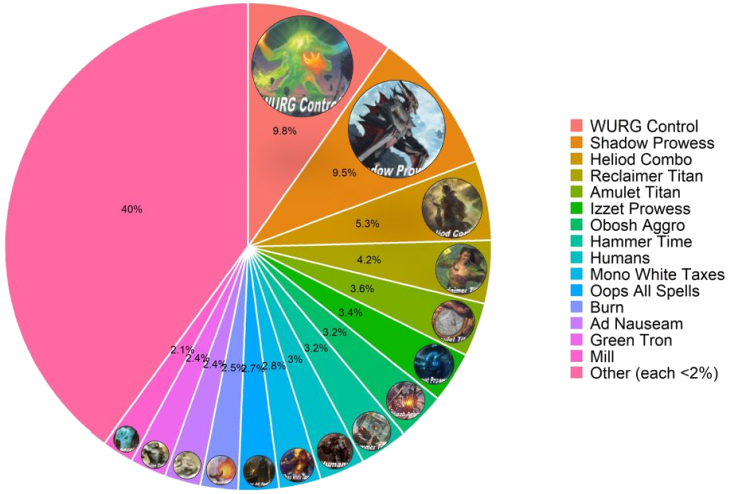
This chart reflects data from all the Preliminaries and major events such as Challenges, Showcases, or Qualifiers that took place during that period. However, only the best results of those tournaments are available—Top 32 of major events and decks with at least three wins in Preliminaries—so you might call this the "winner's metagame." (More details about the MTGO competitive structure to come in a future article.) Also note that the chart covers more than four months, which is quite long. It does not show how some archetypes rose and/or fell over time, just their average presence over that period.
Two decks maintained their position as the best in the format: WURG Control and Shadow Prowess, claiming a share of almost 10% each of the winner's metagame. Basically, you had a chance of one out of five to encounter one of these two decks if you played at the top tables in post-Rising Modern, and one out of three to meet one of the top five decks. If you are used to Standard data, you might think that this is really low. But it is completely normal for Modern! After all, as mentioned earlier, one of the reasons why the format commands such a large player base is its deck diversity. (This can make it hard to prepare for a tournament, since you might face a lot of unusual strategies—the "Other" category represents 40%, so it is disagreeable to people who want to tune their deck to beat a limited amount of archetypes.)
I like this chart because it includes at least one example of almost every defining strategy of the format. I'm using the four macro archetypes of the game to order the sections below, with one small caveat: there's no deck in the "midrange" category; however, the "big mana" category is distinct from combo or control. The classification might be debatable, but it should give you a good idea of the dynamic of the format. Why no midrange deck? Because most decks that could be considered midrange also fit another category very well. For instance, Obosh Aggro veers into midrange territory but borrows a lot of tools from Red Deck Wins. Likewise, the control player community debated whether WURG Control was a midrange or a control deck, but well … The debate raged within the control community, which means that the rest of the world already considered it a control deck. No "pure" midrange deck made it to a chart position.
For each archetype, I'm listing the deck that acquired the highest number of points in a single event, including Top 8 matches. If tied, I chose the most recent. All the archetypes that appear in the pie chart above also appear below. Note that this breakdown is far from exhaustive, and dozens of additional archetypes exist in the format.
Aggro
Death's Shadow
Lower your life total with your mana base and spells, and you almost get to play a 13/13 for one mana:
The latest version gets to harness the power of
| Rakdos Shadow by D00mwake, 1st at MTGO Showcase Challenge on October 3 | ||
|---|---|---|
| Main Deck | Sideboard | |
|
|
|
Red Decks Win
So the main win condition in Magic is to lower your opponent's life total to 0? Let us just play a bunch of spells that do that then. As in every format, the goal of Burn remains the same. Play all the best burn spells, add in a few efficient and cheap creatures able to deal damage quickly, and you got a deck. The Modern version has the particularity of usually running a white splash, providing strong hate cards out of the sideboard.
| Burn by jvidarte, 3rd at MTGO Super Qualifier on January 23 | ||
|---|---|---|
| Main Deck | Sideboard | |
|
|
|
An alternative to having spells that simply deal damage is to have spells that deal damage and boost your creatures. The prowess keyword is all about that and allows pilots of the deck to kill their opponent in a flurry of spells and a few attack steps. While it is more sensitive to creature removal than Burn, it is also better equipped to handle the hate, and the now common blue build can incorporate bounce and counterspells to protect your creatures or slow your opponent down.
| Izzet Prowess by Gobo2009, 1st at MTGO Champ Qualifier on December 20 | ||
|---|---|---|
| Main Deck | Sideboard | |
|
|
|
A monored version exists, but it is rather on the grindy side, trying to harness the power of slightly more expensive cards such as
| Obosh Aggro by Tweedel, 1st at MTGO Challenge on November 28 | ||
|---|---|---|
| Main Deck | Sideboard | |
|
|
|
Tribal
Running a lot of creatures of the same type provides a lot of synergies, with "lords"—such as
| Humans by Darkiundsa, 1st at MTGO Challenge on October 18 | ||
|---|---|---|
| Main Deck | Sideboard | |
|
|
|
Weenie
You can also follow this strategy without tribal synergies but more disruption, and then you get a nice Taxes deck.
| Monowhite Taxes by 6argamel, 3rd at MTGO Challenge on October 31 | ||
|---|---|---|
| Main Deck | Sideboard | |
|
|
|
Combo
Creature Buffs
Some decks take the idea of buffing a creature to the extreme. What if you equipped your creature with a
For now, the deck mostly replaces the Infect archetype, which was looking to pump and protect
| Hammer Time by Laplasjan, 6th at MTGO Super Qualifier on January 23 | ||
|---|---|---|
| Main Deck | Sideboard | |
|
|
|
Creature Toolbox
Creatures, again? Indeed, and this time with actual A+B combos.
| Heliod Combo by JUJUBEAN__2004 , 4th at MTGO Showcase Challenge on December 5 | ||
|---|---|---|
| Main Deck | Sideboard | |
|
|
|
Spell-Based
Do not worry, you could also combo without any creature (or without casting a single one at least). Note that the following deck was hit by the latest ban list update and the main combo lines are no longer available without
The goal of this deck was to resolve
| Ad Nauseam by Aardos, 1st at MTGO Challenge on January 23 | ||
|---|---|---|
| Main Deck | Sideboard | |
|
|
|
Also winning mostly through spells, and by removing all the cards of the player's library, Mill is actually closer to a Burn deck in essence. Use all the most efficient mill cards in the format to deck your opponent and win on their next draw step. With
| Dimir Mill by TheEnzym, 1st at MTGO Challenge on September 19 | ||
|---|---|---|
| Main Deck | Sideboard | |
|
|
|
Graveyard
How about winning from a different zone? The graveyard is a resource after all, and sometimes even an extension of your hand. Thanks to the double-faced spell/land cards of Zendikar Rising such as
With
| Oops All Spells by Sodeq, 1st at MTGO Showcase Challenge on November 7 | ||
|---|---|---|
| Main Deck | Sideboard | |
|
|
|
Big Mana
Big mana decks in Modern are a special kind of beast. They can take multiple forms between combo, control, toolbox, and even tribal to some extent. But they are always centered around one of two cards:
Primeval Titan
The prime
The deck lost Field in the latest round of bannings but existed for years without it and should still be relevant going forward. Though one might have to re-include the old
| Amulet Titan by bigjc00, 1st at MTGO Champ Qualifier on November 15 | ||
|---|---|---|
| Main Deck | Sideboard | |
|
|
|
An alternative used
Tron
1+1+1=7!
| Green Tron by tkcheungab, 2nd at MTGO Showcase Challenge on December 5 | ||
|---|---|---|
| Main Deck | Sideboard | |
|
|
|
Control
Great counterspells, great removal, amazing planeswalkers, lands that create creatures for free, loads of life gain and card draw, ramp, spell recursion, big mythic creatures … WURG Control did almost everything a control mage could dream of. It was the main control shell of the Zendikar Rising period, although many, many other color combinations could be seen, as detailed by Skura. They do not appear on the pie chart because they were too numerous and came into/fell out of favor as time passed.
WURG was also known as "Money Tribal" or "Banned Card Tribal" due to its cost both online and in paper as well as the amount of cards it included that were banned in other formats. Three of its cards eventually landed on the Modern ban list too.
| WURG Control by kogamo, 1st at MTGO Super Qualifier on January 23 | ||
|---|---|---|
| Main Deck | Sideboard | |
|
|
|
The Kaldheim Modern Meta
After four months without any change in the Modern card pool, people hoped that Kaldheim would help shake up the format. Indeed, players got used to fast changes in 2020 and also became increasingly frustrated with multiple cards. "Broken" mythics banned in other formats including
And as it was wished for, Kaldheim definitely impacted the format! But not quite in the way people had hoped …
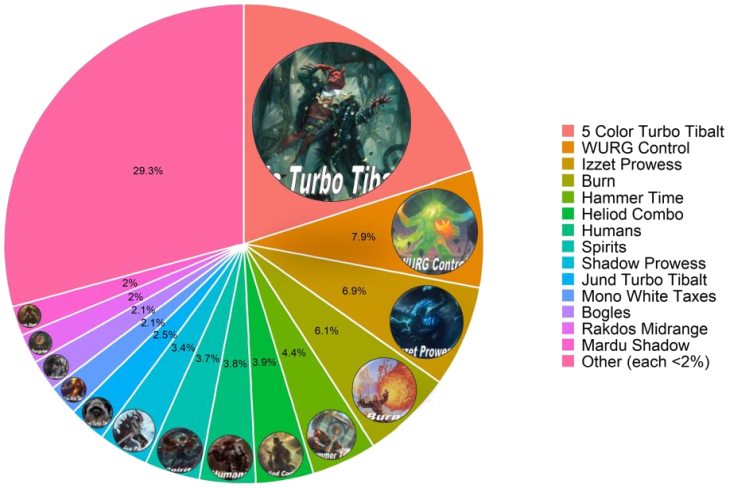
The set released on Magic Online on January 27. Only about two weeks later, on February 15, a super quick update to the list of banned cards followed. What happened in those two weeks to require such fast action?
Soooo … Yes, one of the pieces of this pie is not like the others. The new big thing was all about abusing cascade spells such as
Did I mention that the deck did not really appear much during the first week and made up most of the ground during week two? Yes, it claimed more than 20% of the winner's metagame … even though it only was present in half of the events. And it was also terribly expensive, even more so than WURG Control, and the cards were a bit hard to get online since it was right after the release of the set. To put it simply, this was a broken deck that used most of the strengths of WURG Control and added lines that could pseudo-win on turn one or two. Here is an example decklist:
| Turbo Tibalt by SpiderSpace, 1st at MTGO Champ Qualifier on February 14 | ||
|---|---|---|
| Main Deck | Sideboard | |
|
|
|
A Jund variant also existed:
| Turbo Tibalt by SmokinBacon27, 1st at MTGO Challenge on February 6 | ||
|---|---|---|
| Main Deck | Sideboard | |
|
|
|
By the way, I don't think I mentioned the fact that a large part of the field already had hate cards for Turbo Tibalt before it appeared. Indeed, on the first week another turbo deck based on cascade spells appeared, again related to Tibalt: Trickery Combo, using cascade spells to find
With that deck, you simply abuse the London mulligan to find a cascade spell, cast it, and win. Easy. You could also sideboard into a
| Trickery Combo by avb, 16th at MTGO Challenge on February 6 | ||
|---|---|---|
| Main Deck | Sideboard | |
|
|
|
And if a turn three Trickery was too slow, you could accelerate it with
| Trickery Combo by Draccon136, 20th at MTGO Challenge on February 7 | ||
|---|---|---|
| Main Deck | Sideboard | |
|
|
|
The Bannings
This led to the fastest ban list update in Modern's history—which also doubled as the biggest since the year of the format's inception.
Modern:
Rules Change: Additionally, we are updating the rules for cascade to address interactions in older formats. This rule will be implemented on Magic Online on Wednesday, February 17. The new rule for cascade is as follows: 702.84a. Cascade is a triggered ability that functions only while the spell with cascade is on the stack. "Cascade" means "When you cast this spell, exile cards from the top of your library until you exile a nonland card whose converted mana cost is less than this spell's converted mana cost. You may cast that spell without paying its mana cost if its converted mana cost is less than this spell's converted mana cost. Then put all cards exiled this way that weren't cast on the bottom of your library in a random order." |
This rule change of course targeted
What about the cards that Wizards banned? In fact, they could have banned most of them even before Kaldheim given the reasons they gave, but the set forced action, and it seems like they chose to deal with all of Modern's troubles at once instead of eventually having to run multiple updates in a row.
Do you remember when I mentioned earlier that there was no real midrange deck in the format in the past months?
It is worth noting that the word "community" is mentioned five times in the banned and restricted announcement, showing how much Wizards of the Coast took into account the public's feedback when making their decisions. The word "fun" also appears four times, half of the time specifically in the Modern part of the announcement, suggesting that they really tried to improve the gameplay and not just acted based on win rate data as they usually do. We have to assume this was a big reason why they got rid of Field and Sanctuary in addition to Uro.
Last,
Where Does Modern Go from Here?
With two weeks of data in the books since the bannings, including events such as the NRG Series and the Manatraders Series in addition to the official events, we quickly got a decent picture of the format, and for the most part, it feels very much like "old-school Modern" to a lot of players. But there are still some recent cards impacting the format in a major way.
Following the bans, people mostly expected a lot of aggro decks to rise on top, especially since they hardly lost anything and were already strong contenders. Rakdos Shadow and Blue-Red Prowess were expected, using 2020 additions such as
But the elephant in the room turned out to be Green-White Heliod, another strong contender pre-ban that was not hit either, enabled by another 2020 card,
With so many other top-end tools being hit, Green Tron is back as one of the decks with the best late game, quite capable to overpower slower decks, but also able to ignore the infinite life combo of Heliod, thanks to
Last, grindy decks such as Jund Midrange and White-Blue Control were also expected to make a return, as the presumed best slow fair decks. The reasoning was that, without
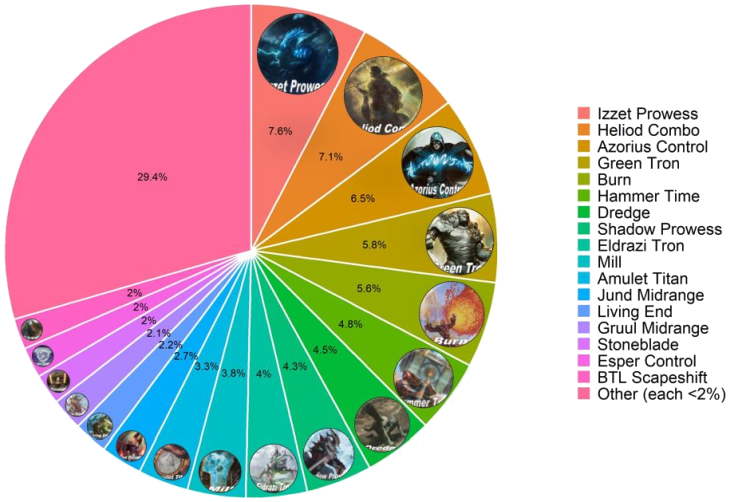
What has happened so far? Below is the pie chart of the "winner's metagame"—the decks that had a good performance in major events such as Modern Challenges, meaning, in the context of this article, the Top 32 of each, since this is the data Wizards of the Coast provides. In order to compare comparable data, I limited the sample from the two unofficial large events that took place since the bannings to their Top 32 as well, even though we have the entirety of the results from both the NRG Series and the Manatraders Series.
List of MTGO major events between 2021-02-17 and 2021-03-01:
- Modern Challenge 2021-02-20
- Modern Challenge 2021-02-21
- Modern Challenge 2021-02-27
- Modern Challenge 2021-02-28
- Manatraders Series - February 2021 - Modern 2021-02-28
- NRG Series MTGO Open - February 2021 - Modern 2021-02-21
Compared to the pie charts you saw earlier in this article, you may notice that the most represented archetype actually has quite a low presence, at only 7.6%! So the bannings definitely improved deck diversity, though that could decline again once the metagame settles.
Most of the anticipated archetypes are here. Several of them returned to a structure closer to how they looked in 2019, such as Amulet Titan (still keeping the
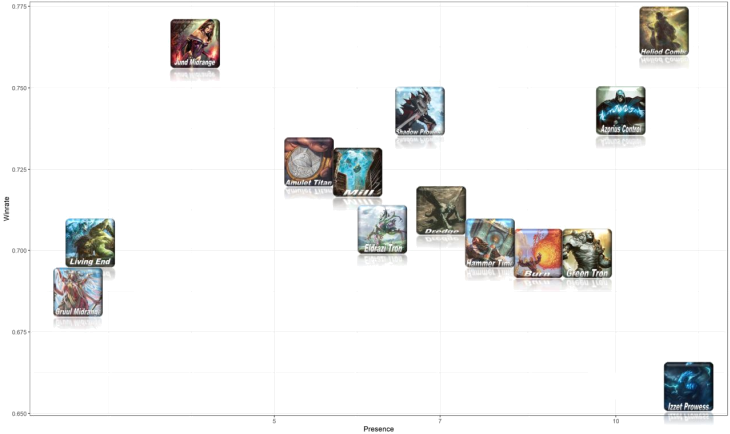
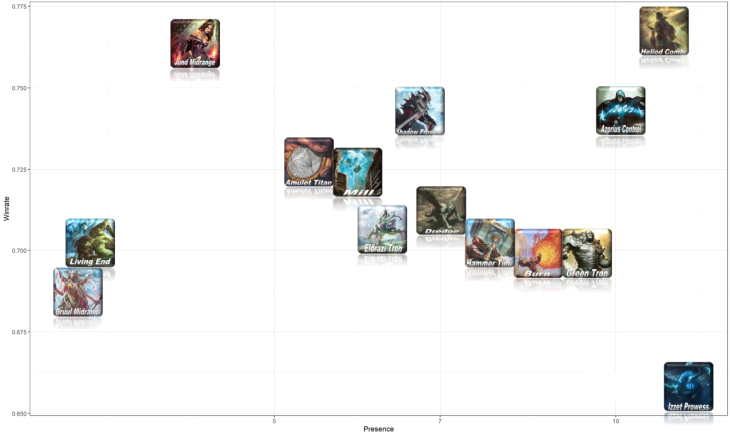
For example, what if we also checked the win rate of each of these archetypes? It is indeed possible since we have the number of wins and number of rounds for each deck. However, it is quite biased by the fact that our sample only contains decks that already reached the Top 32 of an event, meaning that the computed win rates will be very high. You can think about it the following way: "Among the archetypes that had good results, how good actually were those results on average?"
Here is a quick glance at what we will do. Below is the graph displaying only the archetypes with a presence above the average presence among all the archetypes. The archetypes are positioned relative to their presence on the x-axis and relative to their win rate on the y-axis.
Last, through a combination of both metrics, the presence and the win rate, we can provide a data-driven tier list for the main Modern archetypes!
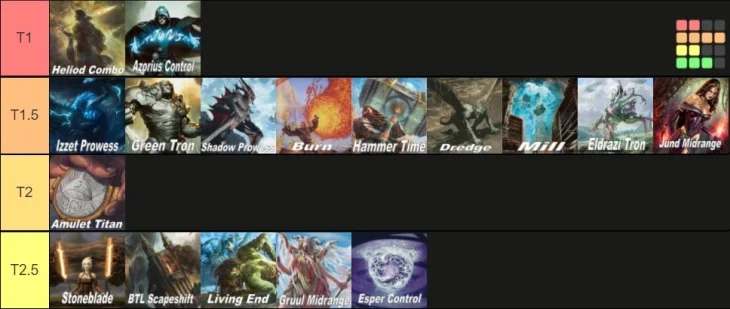
Do you want to know how this tier list is created? This will be the goal of the next article, which will contain even more data as there will be more events by then.
Hopefully this could shed some light on the format if you did not know it well before, and if you did, you might have learned some historic details and at least could make use of the last part.
See you next time for a deeper analysis of this new Modern!
Opinions expressed in this article are those of the author and not necessarily Cardmarket.