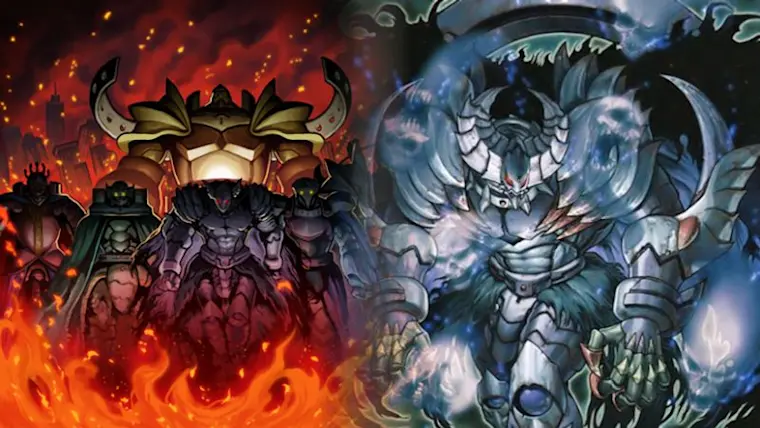
Let me take you all the way back to the "Good Ol' Days" of 2004—Chaos took all top four slots at the World Championship, the Forbidden and Limited lists were announced and implemented in April, and two months later Ancient Sanctuary would be released. Printed at super rare, the first member of today's article subject comes into the spotlight:
One By One, They Came
Zaborg's distinction would only become aparent as time went on, being a level five monster where his fellow Monarchs were level six, but Zaborg was the clear prototype for what the rest of the archetype would become eighteen years from then, a tribute-based deck controlling the opponent's battlefield by removing key pieces. This concept was further cemented when in October of that same year, in Soul of The Duelist, another monarch was printed,
From April of 2004 to November of 2010, every newly released set would include an individual monarch, and the pantheon would grow in order:
So here we are in 2010. The meta has shifted quite a bit, synchro summoning is the new thing, and the decks are a bit more split up between Blackwing, Quickdraw, and X-Saber. Where do we go from here? Let's fast forward to the year 2013 and the release of Shadow Specters.
A Mega Return
With Shadow Specters we would see the
Following Shadow Specters, we got another three-year period of releasing monarchs one at a time, namely:
All of this culminated in the 2015 release of Crossed Souls, which featured massive support in the form of the field spell
A Short but Memorable Reign
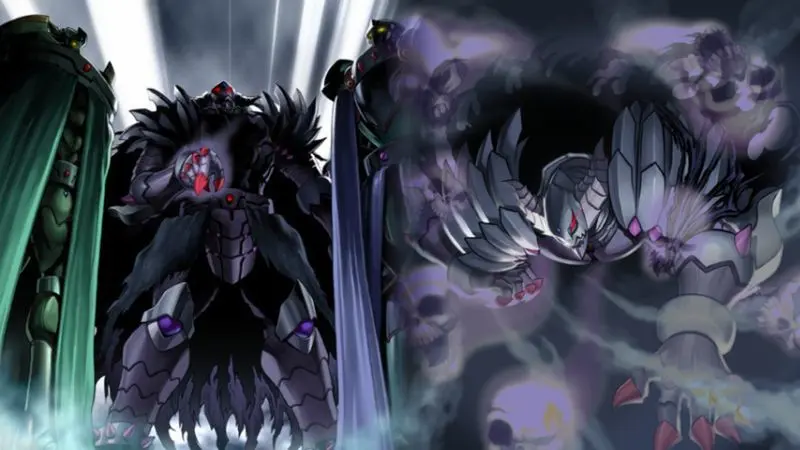
Released on January 28 of 2016, Emperor of Darkness took the archetype to a new level and solidified its foundation as all the final pieces were now set in place. The structure deck featured plenty of new cards such as
At the time, the structure deck was very well-received and praised for its mixture of cheap cards and synergies that one could actually use without too much modification. The archetype began showing up at the top tables at a time when Kozmo, Dracopals, and PK Fire were seeing heavy play. Then, something massive happened. Pepe was emergency-banned a week after the release of Emperor of Darkness.
With one tier zero deck out of the picture, the floor was open, and decks like Monarchs and Blue-Eyes filled its space. Monarchs swept qualifiers across the planet in 2016. It was everywhere from North America to England to Colombia, and placed 17th at the World Championship, piloted by Sato Kai, in spite of the August ban list limiting Ehther, Pantheism, and Stormforth earlier that month. In 2017, the archetype continued to be popular at qualifiers but didn't see a championship spot. The deck just wasn't consistent enough in comparison with the likes of Altergeists or Trickstars.
Lapse of the Crown
As I previously stated, in August of 2016, Monarchs saw three of its key cards limited to one, and it was all downhill from there. The archetype began to see less play, mostly due to its consistency issues and eventual failure to keep up with the times. It was a tribute-based deck, and while yes, it did have the power to lock players down, that wasn't really what the meta was about at the time. Special summoning was the big thing with decks like Blue-Eyes in 2016 and Trickstars in 2017.
Ehther and the others would be unlimited in 2019, and after two years of seeing practically no play, the archetype was free. It was only a matter of time until its surprise return.
An Unexpected Appearance
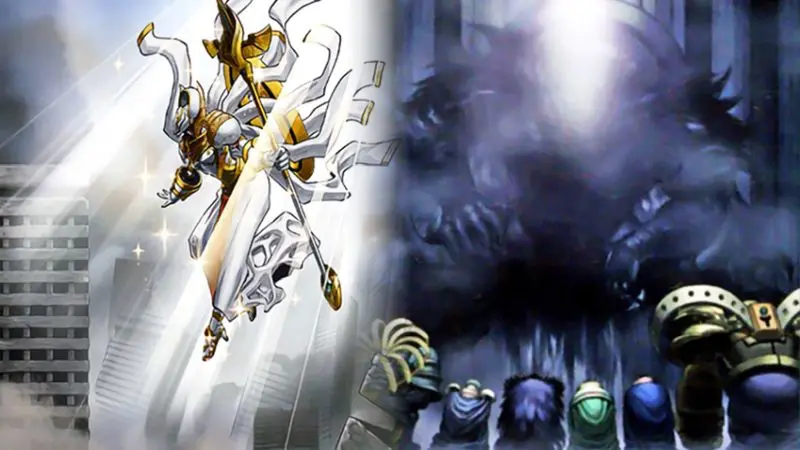
Fast forward to 2020, a time where pro play isn't really happening. Due to the COVID-19 pandemic, Worlds was cancelled. However, Konami held a"Remote Duel Invitational," an event consisting of mostly Yu-Gi-Oh! content creators. With Lithium2300 piloting a Monarch deck, it was here where the archetype would see its return to a "pro scene" table.
It was a strange pick. Lithium himself stated as much reviewing the deck after the event, but would go on to say, "The three Pantheism and Domain and Vanity's Fiend are very ignorant cards, they are very powerful, right?" And indeed they were, helping Lithium win second place at the Invitational. Clearly, the deck was still strong, having fully embraced its lockdown-based strategy.
A Royal Legacy
That is the story of the Monarchs archetype up to this point. From theme to archetype to Worlds, to the decent deck that's kind of just out there at eighteen years old today, the archetype still has some power to it. With all of its cards unbanned, it may yet see more play. It sure has left its mark on players and the history of the game as a whole structure deck, with Emperor of Darkness now being the measuring stick for how most people judge good structure decks. Will Monarchs ever come back? That's hard to say, but in Yu-Gi-Oh! the future is never certain. We could definitely see the Monarchs return to the meta with a new wave of support.
Let me know, did you buy Emperor of Darkness? Are you a Monarch player? Thank you all so much for reading, and have a good rest of your day!
Opinions expressed in this article are those of the author and not necessarily Cardmarket's.