
Don't know what I'm writing about here? Check out this article for an introduction to Old School! Already a fan of Old School? You'll find some interesting deck choices below, ranging from the classic "The Deck" passing through powerful

The First Old School Main Event at the Series
I'm very happy that the Old School tournament at the Cardmarket Series was upgraded to the status of main event. Many of you may be thinking that this is a niche format dominated by expensive cards, with few deckbuilding choices and no room for skill or innovation. But personally I love the atmosphere of this kind of tournament and the sensation of seeing so many iconic cards on the tables, all with more than 25 years of history. If you can't imagine why Old School is unlike any other format, take the time to read my last tournament report.
Speaking of the metagame, don't take for granted that a static format without rotation or addition can't change in terms of strategies. When I started playing Old School, "Arabian Aggro" and "Ernhamgeddon" were among the top decks alongside Monoblack, but when people started including cards like
Also, the different banned and restricted lists used across countries and tournaments is a defining factor for the metagame …
A Few Words on Different Rule Sets

Despite its limited player base and reach, Old School doesn't have a uniform set of rules. The two main rule sets are the original Swedish, most popular in Europe, and the ones from Eternal Central, most played in the United States and used during the famous and widely attended Eternal Weekend.
The main differences are:
- EC rules allow Fallen Empires cards. Swedish rules don't.
- EC rules include "mana burn" while Swedish don't.
- EC rules allow Collector's Edition cards. Swedish rules don't.
- EC allows any language. Swedish rules allow only English cards.
- EC allows up to four copies of
, , and , which are restricted in Swedish rules. Swedish rules allow up to four copies of and , which are restricted under EC rules.
Old School rules used at the Cardmarket Series, which you can find in full here, are very close to EC rules: Fallen Empires, four
The Top 8 Breakdown
Coming to the core of the tournament, here's a quick breakdown of the decks that reached the Top 8:
- 1 The Deck
- 1 Mardu Good Stuff
- 1 Four-Color Control
- 3
Robots - 1 Esper Skies
- 1 Goblins
Although this breakdown could speak of a varied and totally open metagame, you will see from the decklists that the artifact and control decks are quite similar, sharing much of the main shell. In the whole Top 8, there's no trace of cards commonly and often played in various decks:
Nevertheless, some interesting choices are here to be analyzed: you will see that every noncontrol deck plays four


Below I will try to analyze in some depth the deck choices the players made starting with the quarterfinalists, then moving on to the Top 4 players and to the finalist, with a dedicated section on the winner's deck.
The Decks
| Top 8 – Philippe Royer's The Deck | ||
|---|---|---|
| Main Deck | Sideboard | |
|
|
|
Philippe is a well known Old School player, here with a quite peculiar version of the most classic, loved, and hated deck of the format. Old School experts will immediately notice some strange features of Philippe's list. The main one is the choice of colors played: white-blue-red with just a splash of black for
On the other hand, I like the variety of the sideboard and in particular the choice of
- PROS: Solid and consistent.
- CONS: Slow. Could suffer from the lack of artifact mana.
| Top 8 – Julien Raeis's Esper Skies | ||
|---|---|---|
| Main Deck | Sideboard | |
|
|
|
An interesting evolution of the classic Skies deck, with the introduction of black to gain access to
Nice sideboard choices too, with
- PROS: Considerable early pressure with back-up for the midgame.
- CONS: Bad against
and creature hate. Would play at least three Chains and three Flux in the sideboard to see them more often.
| Top 8 – Laurent Brighini's Monoblue Robots | ||
|---|---|---|
| Main Deck | Sideboard | |
|
|
|
Here you can find a version of Robots that's monoblue. I will discuss the archetype further when we come to the blue-black build in the Top 4. In comparison, the one without black loses obviously powerful cards like
I also like the sideboard Disks and the
- PROS: Very solid and synergistic shell.
- CONS: Missing real and effective solutions against creatures like
.
| Top 8 – Gael Bailly-Maitre's MUD Aggro | ||
|---|---|---|
| Main Deck | Sideboard | |
|
|
|
Here's a nice example of what you can do with four
I like very much the
- PROS: Quick and deadly deck with a synergy.
- CONS: Suffers from mass artifact hate like
and .
| Top 4 – Xavier Wangermee's Goblins | ||
|---|---|---|
| Main Deck | Sideboard | |
|
|
|
I love this shell! Always good to see the old Goblins as first seed at the end of the Swiss. Xavier reached the Top 4 playing an aggro Big Red with some original choices: only two copies of
The sideboard adds the white cards and useful tools like
- PROS: Devastating against slow decks/starts and those without specific hate.
- CONS: Missing recovery tools. Lack of important hosers like
.
| Top 4 – Guillaume Denoix's Robots | ||
|---|---|---|
| Main Deck | Sideboard | |
|
|
|
Guillaume is a very good player and famous Old School collector. In Paris he played the "deck of the moment," Blue-Black Robots. To give you an idea, this deck is competitive and even quite strong in the Swedish metagame, where only one
This build is quite classic, with the usual assortment of beasts supported by
- PROS: Powerful, quick, and efficient, with zero dead cards.
- CONS: As any Robot deck, it suffers from mass artifact hate like Flux and
.
| Finalist – Arnaud Aubert's Four-Color Control | ||
|---|---|---|
| Main Deck | Sideboard | |
|
|
|
Here we are with the first player reaching the final. Arnaud played quite a classic control deck mixed with White-Blue Skies:
While I believe that four copies of
- PROS: Solid and able to face every metagame and matchup.
- CONS: Too many one-ofs, especially in the sideboard.
The Winner

| The Champion – Romain Laroche De Roussane's Mardu Good Stuff | ||
|---|---|---|
| Main Deck | Sideboard | |
|
|
|
Romain played a deck that truly incarnates the Old School spirit, featuring some of the most iconic creatures of the format:
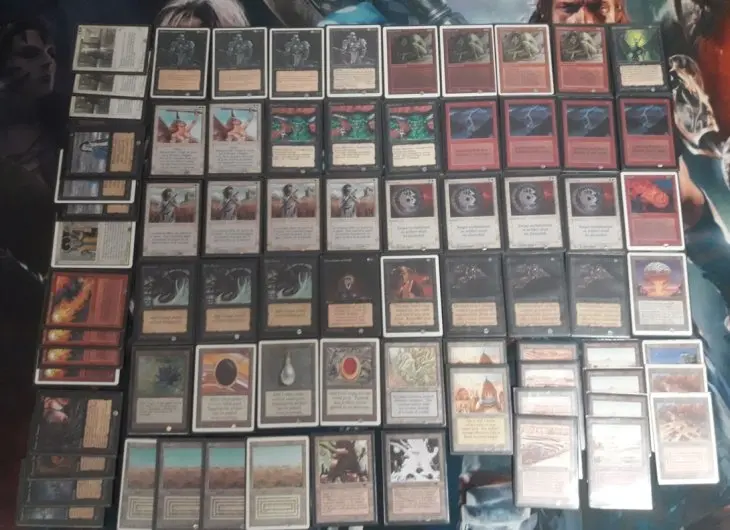
Rest of the deck is built around utilities like
The sideboard too features a sweet mix: four
- PROS: Consistent and synergistic with strong sideboard options.
- CONS: Vulnerable to
and creature hate. Few solutions against strategies that aim to outdraw.
As always — if you want to comment, interact with us, or add some reflection, please share your opinion!
Opinions expressed in this article are those of the author and not necessarily Cardmarket.