
Whenever a new card does something completely innovative or has the potential to impact multiple formats, people immediately start discussing whether and how old cards can interact with it. Particularly if it's got a lot of text or a brand new ability. There are some cards that have come up again and again during Theros Beyond Death preview season. I've gone through the worst offenders, so you can make sure the decks you're building for your favourite format work the way you want them to!
Haktos the Unscarred
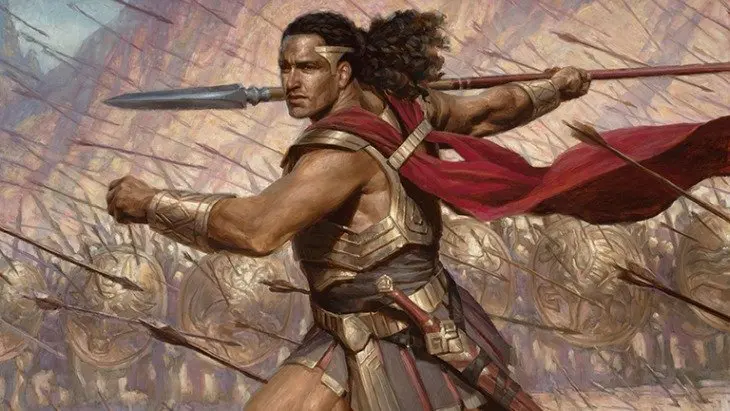

Haktos will always have protection from cards with converted mana costs of 0 and 1, as well as all converted mana costs from 5 upward. This includes permanents with a mana cost of X, as the value of X is always 0 unless the spell is on the stack.
The big question asked when people started to get their heads around Haktos was, "What happens if I copy it?"
The clause about choosing a random number is part of a replacement effect that changes how Haktos enters the battlefield. Because of this, it depends on what you're using to copy Haktos. For example,
If a card that's already on the battlefield becomes a copy of Haktos, however, the replacement effect never occurs because this copy didn't enter the battlefield. If you activate
Thassa, Deep-Dwelling

One of the monocolored Gods returning to the fray,

Pinched one of your opponent's creatures with a fancy enter-the-battlefield trigger? Congratulations! You can have it leave and re-enter the battlefield under your control as much as you like. What's more, if you steal a creature temporarily, perhaps with
Also note that Thassa exiles and returns the creature all in one go, leaving no window of opportunity for state-based actions. If you target
Polukranos, Unchained

Polukranos is back! Everyone's favorite Hydra returns from the underworld as a part-time Zombie with some familiar characteristics: counters, a fight ability, and some suitably cool art.

This time, the counters on Polukranos not only give it an intimidating body — particularly if you've cast it using escape — they also prevent damage. But watch out for everyone's actual favorite green 4-drop, the surprisingly verbose
Underworld Breach

There's an important difference between cards that have a mana cost of 0 and cards that do not have a mana cost.
Elspeth Conquers Death

Many people will be reasonably comfortable with how Sagas work after their introduction in Dominaria, but

In most situations putting a loyalty counter on a creature isn't going to do an awful lot. There are of course some creatures that can become planeswalkers, such as
There are some niche ways of keeping counters on a creature/planeswalker double-faced card during transformation. One example is
Heliod's Punishment

Heliod is facing retribution for sending Elspeth to the underworld, for four turns at least. Heliod's Punishment is also proving punishing for players who want to keep on-flavor and put this particular Aura on Heliod himself, or any other God. The devotion clause that dictates whether a God is a creature or not is an ability, and the Punishment removes all abilities. Does the Aura fall off if the devotion dips below the specified threshold?


As complicated interactions usually do, it comes down to layers. Layer 4 covers type-changing effects, which in this case determine whether a God is a creature or not. In layer 6, effects that add or remove a card's abilities are applied.
This means, the type-changing effect that dictates whether or not the God is a creature will apply before the ability-removing effect that takes away the type-changing ability. At the point Heliod's Punishment has removed the devotion ability, the devotion has already been checked. When everything shakes into place, the God will either be a creature without any abilities except for the one granted by the Punishment, if the devotion is high enough. Or it won't be a creature and the Aura will be put into the graveyard as a state-based action.
School's Out! Time to Play!
A good understanding of the rules is a key tool when brewing, as it can help you spot niche interactions. This is particularly true for formats outside of Standard where older cards and newer cards sometimes combine to work in unintuitive ways. The introduction of Pioneer to the roster of competitive formats has given players a whole new area to work in when it comes to card analysis. There are always a few interactions where everyone gets stuck, but hopefully you'll be able to avoid any nasty surprises when it comes to Theros Beyond Death now!
Opinions expressed in this article are those of the author and not necessarily Cardmarket.
If you're interested in picking up any of the new cards, check out our Theros Beyond Death page!
