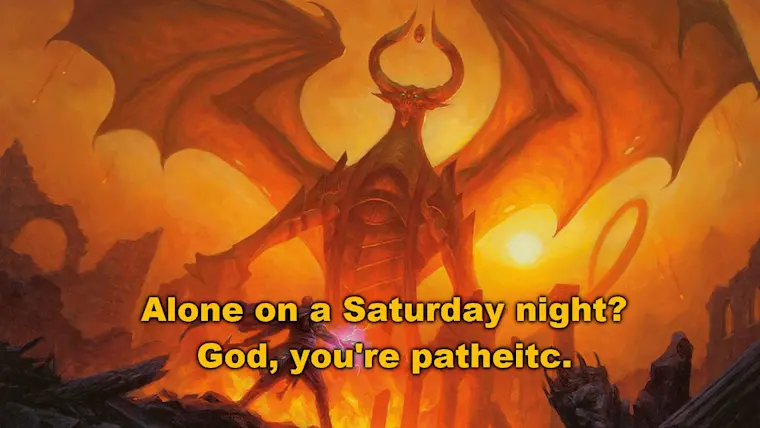
Verbosity in the Way of Animosity
We all know the trope about the triumphant Bond villain. They stand over the seemingly defeated hero and hold a long monologue about the brilliance of their plan, how the protagonist never stood a chance. Only, it is exactly this bombast that gives the hero the time to escape/foil the sinister scheme/destroy the villain after all. If only they'd gone for the kill rather than bask in their own glory and gloat.

"Your patheitc ideas lie in shambles— Wait, why are you laughing?"
"You said, 'patheitc.'"
"I meant pathteic."
"Still not a word."
"Patethic?"
"No."
"Phatetic then!"
"Again no."
"Ptahetic?"
"Sorry. Give up?"
"…"
"…"
"Yes."
Mixed Messages


I'm not invited? Are you saying you want to exclude me? And what do you mean, you don't have time for me right now? Is it okay if I try again next turn?
Speaking as a creature trying to fight through Invasion's duo of blue commons, one can't help but feel confused. Why do the words quoted not match the action performed? Why does the flavor text of one card fit the rules text and name of the other to a tee, and vice versa?
It's almost shocking to see how alike these cards are: same set, same rarity, same exact casting cost, similarly super strong, both cantrips, both concerned with "target creature," both bearing a name that's a two-syllable, seven-letter verb, with the same progression of the same three vowels, both ending on a silent e. It cannot be coincidence that
Selesyna Senescence
You know what's great about recycling flavor text? If it was correct the first time around, you don't need to spellcheck it again and can just copy and paste it onto another printing of the card.


Or, I guess, you can type it out again and accidentally turn Selesnya into "Selesyna." Yes, here's the gate to the famous Selesyna Cocnlave led by the drayd Torstani.
Fortunately, Wizards rediscovered copy-paste technology in time for the reprint of
That Middle Child
Wizards abandoned the Selesyna text after two failed attempts in favor of wholly new flavor when the Guildgate returned. Other stories conclude on a happier end. For


I like to imagine two dueling copy editors working on Tenth Edition. One declares the auxiliary verb unnecessary and changes the text to: "so that destiny takes its course." The other points out that it's a direct quote, to be preserved verbatim, and changes it back to: "so that destiny may take its course." This goes back and forth a couple of times until, eventually, "destiny may takes its course," which was of course destined to happen.
All (That) Is Lost

As someone who has written millions of words on Magic cards as a topic, I can sympathize with those who write all these words onto the cards themselves. Sometimes you just can't decide whether to go with "all I have" or "all that I have." It'll almost make you lose your mind.
Numbers?


If you have a Bible at home, chances are you won't be able to find the quote in chapter 40, verse 25 of the book of Job. In fact, chapter 40 won't even have a 25th verse. How embarrassing that it took Wizards five editions to fix the mistake, right?
Well, not so fast. Actually, the original flavor text never specified that it was quoting the Bible. The book of Job is of course older than god's own anthology, and Hebrew texts indeed count this as 40:25. Frankly, who would begin a new chapter with such a line anyway?
So between Fourth Edition and Fifth Edition
Why at least the first two Italian versions of the card attribute the quote to "Libro di Giobbe 40:20," however, is anyone's guess. All online resources suggest that this is just flat-out wrong.
Move on the Water
Please play the main power chord riff from Smoke on the Water here, if only in your mind's ear.


It's a fun exercise to try and parse the original flavor text as written. What do some naga initiates move? They move the suns' reflections. Where do they move them? On the water. How do they move them? As silently. As silently as what? No one knows, but perhaps as silently as
Alas, the reprint in Zendikar Rising Commander removed the mysterious quality, admitting the missing word. They don't move anything transitively. They intransitively move themselves, and they do so as silently as the suns' reflections on the water. First, though, Slither Blade's Mystery Booster reappearance repeated the mistake, probably even intentionally. (These cards are meant to be indistinguishable from the source material, copyright note and all, except for the little planeswalker pitchfork in the bottom left corner.)
Discretion Advised


Homophone fun! When you break a body apart, into discernable pieces, you could theoretically use the word "discrete." However, when you break a body apart by way of dissolving it, until no evidence remains, the word you're looking for is "discreet" and very emphatically not the other.
First the Answer, Then the Question
Assume you have two flavor texts, one posing a question and the other answering that very same question, in the exact same words. Let's further suppose the reply illustrates a counterspell, so it can act as a literal response to the other spell. Finally, let's entertain the idea that this counterspell comes with a significant bonus, an extra punch that only applies when it targets an artifact or a creature.
Wouldn't it be great if the question appeared on an artifact or creature?


We can still picture an awe-inspiring interaction at the Commander table: One player casts a lethal spell, another responds with an equally lethal
But just imagine how much better these two flavor texts would have fit together if the question had appeared on, dunno,
From Solid to Solidest

On many other worlds, the supernatural realm would find itself represented by ephemeral spirits. Meanwhile on Theros, the essence of Nyx condenses into enchantment creatures that aren't just solid. Some of them are solider.
Opinions expressed in this article are those of the author and not necessarily Cardmarket.