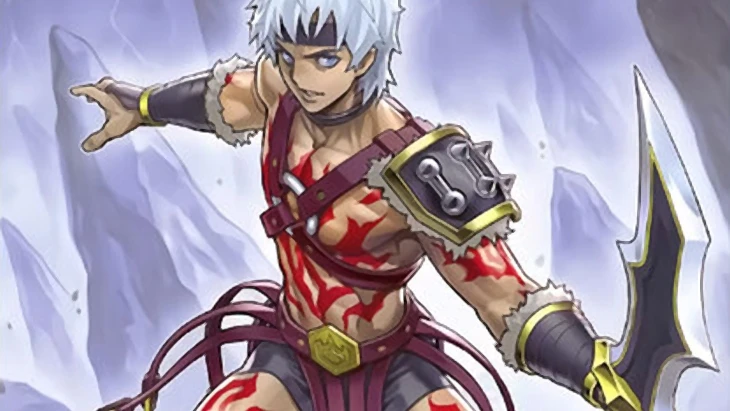
Let's get this out of the way first thing: War Rock is bad. However, what we'll be discussing in this article is not wether this archetype is meta relevant because it is obvious that it is not. Instead this article will make the case that the playstyle of War Rock is how this game was meant to be played.
 | This is one of the Easter eggs you can find in a selection of YGO Insight articles published in March 2021. Follow the instructions here and you may be among 10 lucky people who receive a little present for Easter! - Post a comment below that makes sense for this article and do so by March 24, 2021, at the latest.
- Sneakily build the code word "roll" somewhere into your comment—to show us you've found the egg; but don't spoil the egg!
- Have your account up to date with a valid shipping address.
- Only one comment per article per user counts, and it counts as one entry into our lottery. You can get multiple entries if you find more Easter eggs in other Insight articles (all of which require different code words). Happy hunting!
|
|
About War Rock
First, just a brief introduction to the War Rock archetype. It's a bunch of earth, warrior monsters, see for example and , that bump each other's attack by 200 and spam the field. They get various effects during the battle phase if an earth, warrior monster battled. And as if that was now slow enough, they have the text that every Yu-Gi-Oh! player does not want to read, the dreaded "by an opponent's card effect."
That part right there ought to tell you right away why the deck cannot ever be meta. I mean Konami could print a card that reads, "If this card is sent from the monster zone to the graveyard by an opponent's card effect: you win the game," and this deck would still not be meta. However, I don't want to go deep on the reasons why this archetype isn't and cannot be a big player in the metagame; those are pretty obvious. Rather I am interested in seeing it from a different perspective.
State of the Game
Why is that? Why is it that every single card or strategy that requires interaction is deemed as bad or outright unplayable? The answer to that is pretty simple: because too many overpowered strategies have already been printed. Back in the day, when Yu-Gi-Oh! was way slower than what it is now, there used to be this idea that every card has a weakness, and cards that did not have a weakness got on the ban list—for example , . However, time passed, and we saw the release of cards that either would allow players to turn those weaknesses into strengths or didn't have any weaknesses to begin with. That alone narrowed down the interaction between players, to bring it to a bare minimum, to the point where, when discussing pros and cons of removal, one of the cons of is the fact that it needs to be activated.
Let that sink in for a bit, we have gotten to the point where actually "playing" a card is deemed as a weakness. Then we got these crazy omni-negate boards, with cards whose sole purpose is to stop the opponent from playing. Or we got an archetype like Virtual World. Do you realize how powerful a strategy had to be to compete with a deck like Virtual World in its prime? It was able to put out not one but two copies of on the first turn, which essentially nine times out of ten stopped the opponent from playing the game. Similar to that we had the numeron engine, which unlike Virtual World actually stopped the opponent from playing every card.
After reading so far, some of you may be asking the question everyone is thinking: What about hand traps, aren't they a form of interaction? Well if you consider the state of the game the last few years, I think you will come to agree with me that hand traps act as a band-aid. They treat the symptom but not the cause.
Combo decks got so crazy that Konami had to print a card like . And what did players do? Exactly, they figured out a way to play around Nibiru—either by having plays after it resolves or by setting up a negation before the fifth summon. No matter what type of hand traps get printed, they will always be just another band-aid for the state of the game. I say that because, in order to keep up with the latest trends, even more powerful archetypes will show up. See the pattern? You could have the Nibiru effect with four summons instead of five and that still would not have made a difference.
At their core, hand traps try to do exactly what the overpowered omni-negate boards already do: stop the opponent from playing. And we got to the point where we have decks that lose to either a single hand trap, or to a specific hand trap. That makes luck a huge factor, meaning that, if you do not open that specific hand trap, you already lost the game. That right there shows, unfortunately, how a strong starting hand and winning the die roll constitute insane advantage nowadays. In order to win, you have to stop the opponent from playing altogether.
In Conclusion
Decks like War Rock remind us of how the game used to be, and arguably how it should be. We keep seeing crazy card after crazy card get printed, but how far is that going to go? Now we are getting another removal without activation in a card like the , or insane cards like . No card should be abusable like that, and no strategy should degenerate to the point where one player is playing solitaire. Interaction is crucial to keep the game fun, competitive, and also healthy. Yu-Gi-Oh! is a game of resources, and decks that generate resources at a rate that isn't normal are usually the decks we refer to as "meta." At almost every single event, we say the name of the deck that topped, rarely mentioning the player who piloted it. That goes to show that in current Yu-Gi-Oh! the car has become more important than the driver.
Opinions expressed in this article are those of the author and not necessarily Cardmarket.