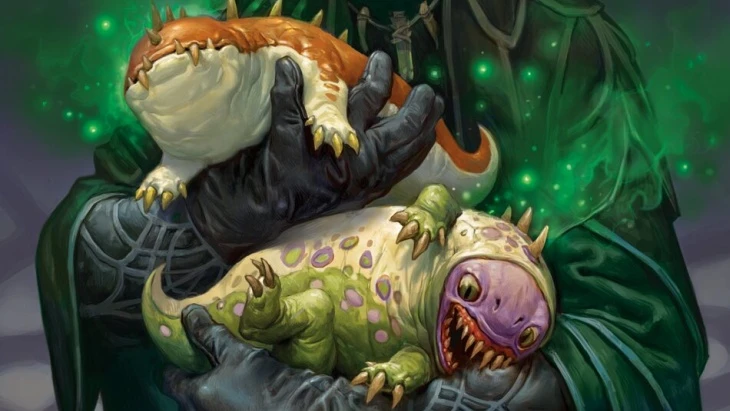
Once upon a time (or last year) there was Rakdos Sacrifice with its grindy death by a thousand cooked Cats. Enter the Witherbloom College of Strixhaven, and now the archetype in Standard has become all about setting up and performing a big sacrifice ritual that might well sent the opponent packing in one single feast.
The Guide on How to Sacrifice Your Pest
Sacrifice synergies have existed in Magic for a long time, particularly in black. But it wasn't before Throne of Eldraine printed and that this strategy became a fixture of Standard, to the point of showing up as a World Championship contender in 2020. Winning the game via Cat triggers alone was possible, if exhausting, as such approach had strong built-in resilience against control and a surefire way to slow down nontrampling aggro creatures, stalling the board until the eventual death by a thousand bakes would be accomplished.
But all that ruckus is firmly in Standard's past now. Cauldron Familiar was banned last summer, and then its main partner in crime, , rotated out with the whole of War of the Spark. A new iteration of the Sacrifice archetype has now resurfaced, taking a very different, yet somewhat familiar form. Strixhaven: School of Mages introduced us to the Pest tokens, adorable little suckers created in a variety of black-green ways. We should of course call that pairing Witherbloom, after the college of Strixhaven, not Golgari, after the guild of Ravnica. The whole point of the existence of the Pests is being sacrificed in order to gain life and activate all kinds of value plays.
The most notable Pest-related interaction is the one between 's magecraft triggers and 's self-copying capability. The moment we cast a Plumb and sacrifice any number of tokens or other expendables—the more the better, of course—the spell will copy itself for each of its victims, and every individual instance that we place on the stack will trigger the Witch separately, thus immediately replacing all of our lost Pests with the same number plus one, and also turning any different fodder into a Pest as well. In the process, we draw toward more sacrifice effects to repeat the ritual all over again. Once we add to this routine, we essentially obtain the old "Cat in the Oven" deal, triggering an occurrence of life drain for every 1/1 that went to the graveyard and then "came back." Except, this time, it's less of a turn-by-turn grind and more of a big mass suicide that could easily kill the opponent in one fell swoop, or two.
Is this game plan competitive at all? You bet it is. It's a matter of setting up the combo fast enough, but most of the deck is aimed squarely at that goal. Plumb the Forbidden can't really be countered except with specific tools like , and while we wait to pull the trigger, our many incidental tokens make it hard for aggro decks to endanger our life total. After all, Cat/Oven was treated as just a meme in the beginning, and Plumb/Witch already feels way more serious than that. It's not just about a kitchen appliance now; the Witch herself has come out to play!
Witching & Twiching
Let's have a look at a typical Witherbloom Sacrifice list. And if you want to see the deck in action, Luca Van Deun was running a similar build here.
Standard Witherbloom Sacrifice, Best of One
Main Deck
Sideboard
4
2
10
8
4
4
4
2
2
4
4
4
4
2
2
4
2
1
First, the token makers. is the card that can quickly produce a truly degenerate board state. It's also a 3-powered creature with menace, fully capable of dealing some damage on its own, and the additional life loss from the ward ability is just gravy. It's definitely our most valuable player, and we should never trade it away for anything, if at all possible.
Our secondary, but still very effective way to create tokens is , which can fetch from the sideboard, for a grand total of three Pests out of a single card. Hunt is actually our ideal play on turn two, but of course its value increases if we save it to be cast with one or more active Witches on the battlefield. is another way to get our hands on the Summoning as well as a solid turn-one play that can deal some damage in the air before being happily sacrificed along with the rest of our fodder.
Speaking of the sacrifice outlets, the principal one is, clearly, the powerful . But the already established does an important job of digging toward any missing piece of our combo setup, at a minimal mana investment. To cast an Eyetwitch and immediately feed it to Village Rites is not a wrong way to spend turn two, especially if we need to make sure to hit our land drop for turn three, when we'll be guaranteed to have Pest Summoning available.
, which also incidentally provides us with yet another token, is our killing engine of choice. It's followed at a distance by , which only really kicks into overdrive in tandem with the Bastion. The cool Dryad Druid is one of the few green cards in the list and could theoretically be replaced with , if we wanted to keep the whole business under the monoblack banner. Two elements favor Dina, though. First, the card is one mana cheaper than Vito, which is critical in a deck that already features eight crucial three-drops with the Witch and the Bastion. Second, it doubles as a sacrifice outlet and in that role can also become more of a threat than the Vampire, for instance by sacrificing a that was blocked or unable to attack. Besides, the deck has no way to exploit the larger scope of Vito's ability, since all of our life gain happens in increments of 1, which means Dina and Vito have the same exact effect. They're also both legendary and both 1/3 bodies.
With the mentioned , we enter the flex slots. It's another green presence that could be replaced, for instance with . But the Beast fits the list by giving us a turn-one play, by triggering magecraft, and by guarding our life total with its superior body. Similarly, has many synergies in a list that never lacks sacrificial fodder and is likely to have excess lands in hand to discard after a big Plumb.
The same goes for our removal of choice, , which is bound to cost only two mana in a deck filled to the brim with life gain. The removal suite is complemented by and as Lessons to learn from the sideboard. The former once again interacts winningly with the random tokens we'll have lying around, making it usually much better than its colorless alternative, . Breach offers us a nice way to have access to artifact and enchantment hate in game one or best of one. We're not in a and metagame anymore, but and are still around, as are other Equipment and Sagas with which we occasionally want to deal before they reach the last chapter.
Another card that many lists include is . However, I didn't find it particularly impressive. It basically only does something when we cast a big Plumb and it's a glorified the rest of the time.
Overall, Witherbloom Sacrifice is a much more entertaining deck to play and face than any iteration of the Cat/Oven combo ever was. It's too early to tell if it'll repeat the success of its culinary predecessor. In the meantime, it has better Pests to fry.
Opinions expressed in this article are those of the author and not necessarily Cardmarket.