After the painful hiatus caused by the coronavirus pandemic, the Magic World Championship has finally returned. It's been eighteen long months since the 2019 edition was held in Honolulu in February 2020, when the world was still blissfully unaware of the nightmare that was right around the corner. Standard went through two subsequent rotations since then, so all the sets that were legal at that point in time have now left the format.
It's a new beginning in more ways than one, but it also still bears the scars of the recent past. This time the proceedings took place entirely on MTG Arena, both the Limited portion and the Constructed portion. It's a direction we were probably already headed for, if only for the sake of better Twitch spectacle. But the top players of the 2020–2021 season that gave battle for the year's top honor between October 8 and October 10 were also doing so from their homes. This decision had clearly been finalized before the health emergency subsided enough to restart even the FNM program. However, that threshold was crossed months ago (the suspension of in-store play was lifted in the US on May 28) so it's hard to think there was no time left for a change of plans. Particularly when the entire event involves such a small attendance, if coming from as many as seven different countries subjected to a variety of local laws.
The issue here is not just about the unprofessional image that a webcam view is evoking, with the celebrated heroes of Magic: The Gathering caught on camera surrounded by such mundane objects as scattered clothes and empty cardboard boxes. Allowing the players to compete from home makes it impossible to safeguard against cheating (in the form of third-party tips or software aids), even with the broadcast delayed long enough to at least prevent sniping the opponent's hand. Let's just hope we won't have to deal with this kind of situation ever again.
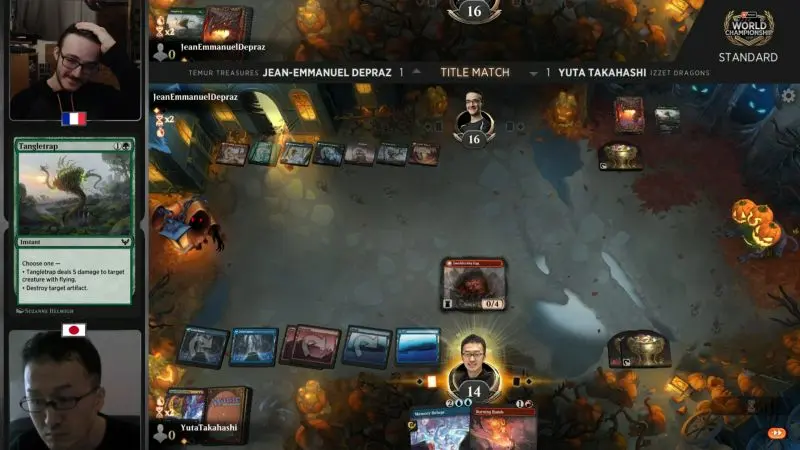
The sixteen qualified players hailed almost equally from the MPL and the Rivals League, encompassing the top four seasonal placements of each entity, plus the top two and the winner of their Gauntlet tournament, respectively. The roster was completed by the top four of the Challenger Gauntlet. Paulo Vitor Damo da Rosa was awarded automatic entry as reigning World Champion, but he also qualified separately with his second place in the MLP season.
In an unprecedented and slightly controversial move, each player received a $50,000 participation bonus, leaving only $250,000 to be awarded proportionally to the final standings. (And Wizards only added this bonus after much outrage; initially they had simply reduced the supposed one-millon payout to $250,000.) This means the monetary gap between players ending in the 13th–16th positions and the champion was a mere $65,000. In the previous edition, this disparity amounted to $287,500. Maybe Wizards of the Coast are trying to build a healthier pro environment where the "wealth" is more equally distributed? At the same time, it comes on the heels of the announcement that the MPL will be disbanded following the 2021–2022 season. There are clearly some mixed signals here that will need to be better parsed going forward.
The Year of the Dragon
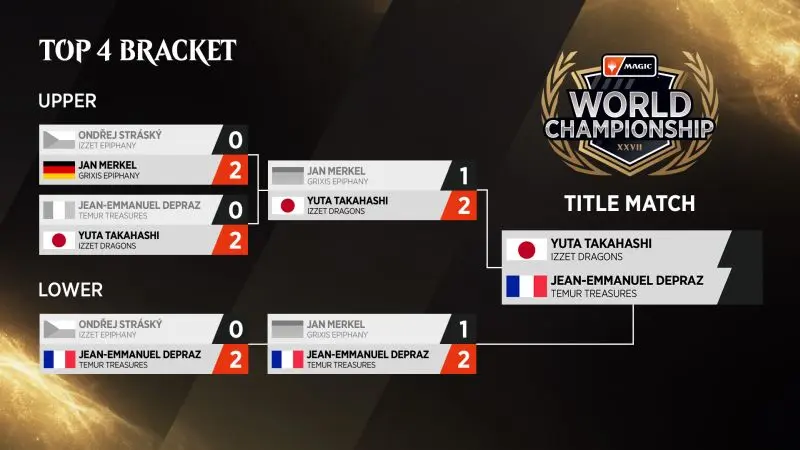
After three rounds of Midnight Hunt draft and seven rounds of Standard Swiss pairings across two days, the surviving four players got access to the Sunday finals. In order of standings, they were: Ondřej Stráský, who had never lost a single match in the event up until that point; Yūta Takahashi, who went from a 0-3 result in Limited to be undefeated in Constructed; Jean-Emmanuel Depraz, who was only in the event because Damo da Rosa's double qualification opened a third spot to the MPL Gauntlet; and Jan Merkel, who had staged an amazing comeback this year, fifteen years after his first place at Pro Tour Kobe 2006. Depraz and Merkel had defeated Matt Sperling and Sam Pardee in the playoff between the four six-win players with better tiebreakers at the end of Day 2.
The overall players breakdown by nationality was as follows.
- Japan: five (Yoshihiko Ikawa, Noriyuki Mori, Keisuke Sato, Rei Sato, Yūta Takahashi)
- USA: three (Seth Manfield, Sam Pardee, Matt Sperling)
- Czech Republic: two (Stanislav Cífka, Ondřej Stráský)
- France: two (Jean-Emmanuel Depraz, Gabriel Nassif)
- Germany: two (Arne Huschenbeth, Jan Merkel)
- Brazil: one (Paulo Vitor Damo da Rosa)
- Lebanon: one (Eli Kassis)
Among the players missing from the previous World Championship were the runner-up Márcio Carvalho (Portugal) and the 2018 World Champion Javier Domínguez (Spain).
The tournament's Standard meta covered seven archetypes, divided this way.
- Four Grixis Epiphany (Eli Kassis, Jan Merkel, Gabriel Nassif, Matt Sperling)
- Four Izzet Epiphany (Stanislav Cífka, Arne Huschenbeth, Keisuke Sato, Ondřej Stráský)
- Three Monogreen Aggro (Paulo Vitor Damo da Rosa, Seth Manfield, Sam Pardee)
- Two Monowhite Aggro (Yoshihiko Ikawa, Rei Sato)
- One Azorius Tempo (Noriyuki Mori)
- One Izzet Dragons (Yūta Takahashi)
- One Temur Treasures (Jean-Emmanuel Depraz)
You can view the full decklists here. This picture is actually less diverse than it looks, since it could be further broken down into three main components: decks built around


Blue was the most played color, appearing in eleven lists (five Izzet, four Grixis, one Azorius, one Temur) followed by red at ten (five Izzet, four Grixis, one Temur). And while green and white both had the distinction of monocolored decks to their name, black was only featured as a minimal splash in the Grixis builds: just two main-deck copies of
Decks that have otherwise a significant presence in the current Standard meta, like Monoblack Control and Orzhov Midrange, were disregarded completely by the Worlds competitors. One reason more to take all of this with a grain of salt when returning to Arena queues or Magic Online leagues. The World Championship metagame, as influential as it's inevitably going to be, is the fruit of a very restricted field made of a handful of well-known pro players who were trying to guess each other's choices. Black has certainly more tools in Standard than the World Championship gives it credit for.


The Selesnya Midrange lists with
The three monogreen decks only won six matches altogether in the Standard portion (three for Pardee, two for Damo da Rosa, and one for Manfield who got a bye in Round 10)—the most disastrous result of all the archetypes. Damo da Rosa had banked hard on green being able to go over the top of control builds but eventually lost his gambit, as did Seth Manfield. The white players from the Japanese expedition (Mori's Azorius list was essentially a white deck splashing blue for better interaction) underperformed as well, totaling just eight wins between the three of them, some of them against each other.


All this said, the loudest statement the World Championship seemed to make before its final day was about the overwhelming strength of
The Birds

Izzet decks were already a known quantity before the World Championship. Lists leveraging the insane card selection power of
| Izzet Epiphany by Ondřej Stráský, 4th place | ||
|---|---|---|
| Main Deck | Sideboard | |
|
|
|
In these builds, getting to a turn in which an Epiphany gets copied by Galvanic Iteration has become the entire plan. Such maneuver requires an amount of mana that ranges from a minimum of eight (with a foretold Epiphany) to a maximum of ten (hardcast Epiphany, flashed back Iteration). It ends up creating four Bird tokens, which is the same damage output as a Goldspan Dragon. The little fliers swing during the first of the two extra turns, when the deck's card-drawing engines get a chance to find yet another Epiphany to copy next, thus never giving the opponent the chance of taking another turn.


Clearly, this type of game plan requires a more control-oriented strategy. The deck can count on
Stráský, who was coming off a triumphal season that ended with his first place in the MPL, piloted the deck impeccably during Day 1 and 2, scoring an impressive undefeated result in both the Limited and Constructed portions of the event. Many were calling him a favorite for the title, but his imperious march came to a sudden halt on Day 3, when he lost to Jan Merkel in the upper bracket, then to Jean-Emmanuel Depraz in the lower bracket, exiting the event in fourth place. The first of his nemeses was using a slightly different variant of his Epiphany list.
| Grixis Epiphany by Jan Merkel, 3rd place | ||
|---|---|---|
| Main Deck | Sideboard | |
|
|
|
The more immediately conspicuous difference with the Izzet version is the black splash, which supplies hand disruption and targeted removal of higher quality. But the real game changer here are the three copies of


Another key difference is the presence of
The sideboard plan of Izzet Epiphany contains a possible transformation into Izzet Dragons by adding multiple copies of
All in all, the Grixis remix of Epiphany Control ended up performing better than the Izzet recipe, with three of its four representatives (all sharing the same composition) ending in the Top 8 of the tournament, one in the Top 4. Meanwhile, one finds all the Izzet players who weren't Takahashi or Stráský near the bottom of the final standings. It's not an unexpected outcome, given that the Grixis version was expressly conceived to prey upon the original, while also trying to stop Monogreen. After all, Duress is equally effective against Epiphany and its paraphernalia as it is against
Chariots of Fire

Stompy lists were having one of the greatest moments in their history before rotation, when cards like
| Monogreen Aggro by Paulo Vitor Damo da Rosa | ||
|---|---|---|
| Main Deck | Sideboard | |
|
|
|
Monogreen's solid core resides in the amount of power placed on the board by curving out


The deck is just chock-full with high-quality devices.
The available alternatives are also numerous. Sam Pardee brought the same list as Damo da Rosa, but Seth Manfield changed quite a few elements, picking


The amount of early acceleration in these lists (all of them also devote two slots to
On the other hand, one Chariot deck achieved an outstanding result, very close to the ceiling … But it had red as backup.
| Temur Treasures/"Wet" Gruul Dragons by Jean-Emmanuel Depraz, 2nd place | ||
|---|---|---|
| Main Deck | Sideboard | |
|
|
|
Giving Depraz's list the "Temur" label might be technically correct, but it's a real stretch. There are only two blue cards in the main deck, plus another two in the sideboard, mostly replacing the former in the matchups where


This Treasure-making shell is a natural fit for Dragons, since they are friends with Magda; specifically for


It's a well-balanced list that embodies the best of both worlds, as the Dragons side of Izzet merges with the usual green suspects of this era, namely
Depraz played some of the best Magic of his career on Day 3, defeating both Epiphany variants and such opponents as Ondřej Stráský and Jan Merkel. Unfortunately, a never-ending streak of second places keeps haunting the French player, who ultimately couldn't overcome the tournament's eventual winner. Ironically, it all boiled down to a distorted mirror match between flying lizards.
The Way of the Dragon
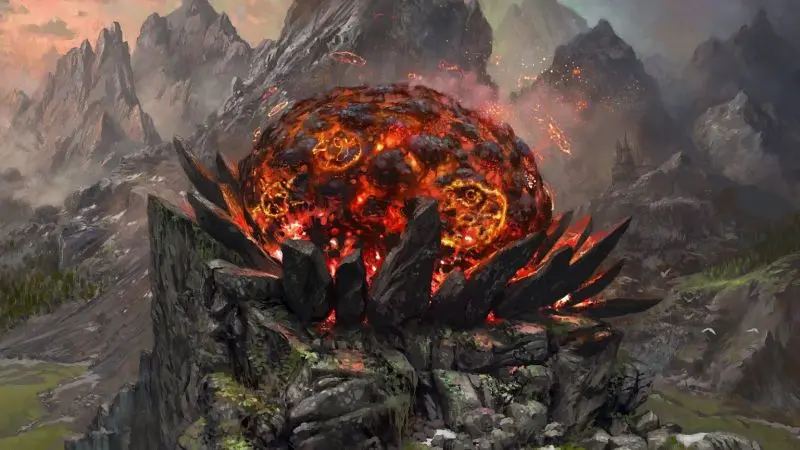
Here's an unquestionable truth about World Championship XXVII: Yūta Takahashi could not be beaten in Standard for the entire duration. He ended up with a perfect run of 10-0, losing very few games along the road. In the past, his passion and success with
| Izzet Dragons by Yūta Takahashi, 1st place | ||
|---|---|---|
| Main Deck | Sideboard | |
|
|
|
It's kind of funny how Takahashi's deck was hailed as a "rogue list" because the meta had given the impression that Izzet builds featuring Alrund's Epiphany should prioritize the combo aspect over the more direct route of "beat them with Dragons." But this very archetype has had an extensive history of success before the World Championship. Replacing


Takahashi's post-sideboard move was often to lose the Epiphany plan entirely and turn the deck into Aggro Dragons, something Izzet Epiphany could also do, if less efficiently. If Gruul Dragons has proven capable of routinely crushing its closest cousin, Monogreen Aggro (Depraz won against Pardee three times on Day 2), Izzet Dragons has done the same against Izzet Epiphany. It sure was a profitable weekend for what's become the most relevant creature type in Standard right now.
The World Championship field might have captured only a partial picture of the real environment, but some of the best cards in Standard were heavily featured, between
Opinions expressed in this article are those of the author and not necessarily Cardmarket.