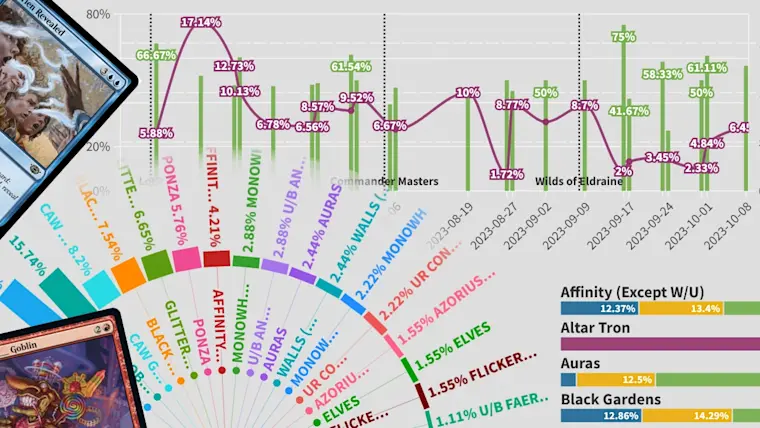
The Challenge Project
Each weekend at least two major tournaments happen in every format on Magic Online. Due to the entry fees and the prize pool, these events attract the best players and highlight the best decks and give the best indication of what is and what isn't working in the meta.
Wizards publish the results each Monday but unfortunately only the Top 32 lists, and they aren't grouped by archetypes. It isn't immediately obvious how much each deck won, and worse, we miss information on all decks that did poorly. In response, some people got together to start the Challenge Project, which notes every deck and player to generate the full data for the event. This takes quite some work and doesn't always happen or succeed. It isn't a perfect situation, but if I want to analyze the meta, I have to choose: Either I have all events but not the decks that did poorly or deal with full data but missing days. The latter arguably builds a better picture of the format.
If you followed my past work analyzing the Magic Online Leagues, you'll see that I'm using different naming conventions for this article. The Challenge Project applies a less granular categorization, and I stuck with it with only small adaptations.
Acknowledgements
I want to say thanks to PProteus, the manager of the Challenge Project, and all the players that contributed to the data collection: A_AdeptoTerra, Diego_Brando, Gn42, HeWhoIsInTheWater, Kirblinxy, and Walker735.
Metadata
| Set Name | Release Date | Challenges | /with Full Data |
|---|---|---|---|
| Tales of Middle-earth | 2023-06-23 | 12 | 9 (75%) |
| Commander Masters | 2023-08-04 | 10 | 6 (60%) |
| Wilds of Eldraine | 2023-09-08 | 10 | 8 (80%) |
Tales of Middle-earth


Tales of Middle-earth was extremely impactful with the printing of the land cyclers, especially
By far the most relevant was the blue spell as it helped nontempo blue decks match the card advantage of
Check out this article for more information on U/B Terror.
| U/B Angler-Terror by xfile, 2nd at Pauper Challenge, July 30 | ||
|---|---|---|
| Main Deck | Sideboard | |
|
|
|
The second most relevant card of this cycle was Generous Ent. Although it only slotted into one deck, Ponza, it was powerful enough to give the deck the bronze medal for popularity during that period. An issue with any land destruction build is that it easily runs out of gas. Ideally you want start on
Check out this article for more information on Ponza.
| Ponza by Make_it_Right, 5th at Pauper Challenge, July 7 | ||
|---|---|---|
| Main Deck | Sideboard | |
|
|
|
Lastly, some builds of Goblin Class Combo (also known as Moggwarts), started running the Troll of Khazad-dûm (and sometimes even
Check out this article for more information on Moggwarts.
| Goblin Class Combo (Moggwarts) by Hamuda, 5th at Pauper Challenge, July 9 | ||
|---|---|---|
| Main Deck | Sideboard | |
|
|
|
Commander Masters


When the set was fully previewed, there was so much excitement. Some downshifts would help fringe builds, for example Petal Festival gaining
The most popular decks of that era were still the same and in the same order: Burn, U/B Angler-Terror, Ponza, and the usual midrange Affinity, but the meta underwent changes. The Terror deck got the Cryptic Serpent upgrade and All That Glitters eventually slotted into Affinity.
Slowly a Monoblue Terror list started to arise, posting great results and even winning an event in the hands of the player discoverN. But for the rest of the month U/B and Monoblue Terror were both frequently played. Only by Wilds of Eldraine did we see the monocolored build being favored. This version is particularly good in a fast-paced environment: It doesn't have tapped lands and can deploy an early
Check out this article for more information on Monoblue Terror.
| Monoblue Terror by discoverN, 1st at Challenge, August 19 | ||
|---|---|---|
| Main Deck | Sideboard | |
|
|
|
It wasn't all that obvious in which direction to take Affinity. Some builds remained Grixis, others went to Esper or Jeskai. It was only after August 12, when Mogged found an amazing white-blue-based based configuration and placed second in the Challenge, that folks started to drift this way. Sadly we don't have the full data for that Challenge.
The deck won the Challenges of August 20 and August 27. It was also the most popular deck on September 3 and put three out of six pilots into the Top 8. Glitter Affinity proved an extremely fast-paced menace running cheap spells like
Check out this article for more information on Glitter Affinity.
| Glitter Affinity by Mogged, 2nd at Challenge, August 12 | ||
|---|---|---|
| Main Deck | Sideboard | |
|
|
|
Unfortunately we don't full data for four events, so we can't truly pinpoint the meta share impact of All That Glitters. In the events missing we can see that there were multiple copies of the deck among the Top 32. Again, either we have all days but without win rates and underperforming decks, or we have the full data but without a few days. Nonetheless I made the chart with the breakdown for the Swiss placements. The most interesting thing is how Boros Synthesizer got popular and snagged the most Top 8s and Top 16s proportionally.
Even though Boros Synthesizer converted 30.43% of its starts to Top 8 finishes, it also left 43.48% below Top 32, which is in line with the sort of play patterns this deck incentivizes. You can have aggressive starts with
- Check out this article for more information on Boros Synthesizer. It dates from an older meta, but some insights are still relevant.
| Boros Synthesizer by Nulyan, 1st at Pauper Challenge, August 5 | ||
|---|---|---|
| Main Deck | Sideboard | |
|
|
|
Wilds of Eldraine


The set brought
Despite already being legal for tabletop play, the Goblin wasn't widely tested. With its online implementation we saw an uptick in builds shifting back to
Check out this article for more information on Kuldotha Sticker.
| Kuldotha Sticker by beicodegeia, 1st at Pauper Challenge, October 30 | ||
|---|---|---|
| Main Deck | Sideboard | |
|
|
|
In other news, Caw Gates returned to the spotlight! It featured among the most played and enjoyed an amazing Top 8 conversion, putting more than a third of its players there. This deck is a machine but needs a competent pilot and a lot of finetuning to deal with the meta. The
Check out this article for more information on Caw Gates.
| Caw Gates by Gn42, 2nd at Pauper Challenge, October 1 | ||
|---|---|---|
| Main Deck | Sideboard | |
|
|
|
Monowhite Aggro was the surprise of this period. It kept good conversions for the Top 8, Top 16, and Top 32, but it wasn't a widely played deck. Does this mean players should pay more attention to it? I don't think so. White go-wide decks are a staple of Pauper, not for their power level, but because they creep through the cracks of the format and wipe the floor until the meta adjusts and shoves the deck away again. The combination of fliers in
Check out this article for more information on Monowhite Aggro.
| Monowhite Aggro (White Weenie) by BurnMann, 1st at Pauper Challenge, October 1 | ||
|---|---|---|
| Main Deck | Sideboard | |
|
|
|
One important observation concerns the atrocious results from Black Gardens. It was the fifth most played deck during that period but had the worst Top 32 rate of any deck, staggeringly! This is not to say there weren't good results, after all 11.76% of its pilots got a Top 8, and the deck won events like on September 16. However, playing it will most likely yield awful results.
Check out this article for more information on Black Gardens.
| Black Gardens by Purgatory_01, 1st at Pauper Challenge, September 16 | ||
|---|---|---|
| Main Deck | Sideboard | |
|
|
|
Aggregate Charts
The following charts join together all the data discussed in the last sections. They are shown here as a way for the reader to navigate through all the time periods and their respective metagames, a way to explore and get more insight on strategies that weren't discussed in detail.
Final Considerations
The most popular and arguably best decks of the format (Burn, Affinity, and both Terror versions) all have cheap threats, cheap ways to go through the deck, and cheap pieces of interaction. It seems a deck has to be good on all three fronts lest the handicap be too much to bear. Look at Black Gardens and how it frequently stays below Top 32. It has decent draws and answers, but it lacks early threats.
Even Caw Gates follows that formula, in a way. It doesn't draw as much as Dispute decks but has the typical card selection from blue and better interaction. As far as threats go, it solves the issue decks like Black Gardens experience with
Interestingly Ponza ticks these boxes but only if it curves well.
In short, decks that aren't hyperefficient won't have an easy time in the current format. Between threats that cost zero (
Opinions expressed in this article are those of the author, not of Cardmarket.