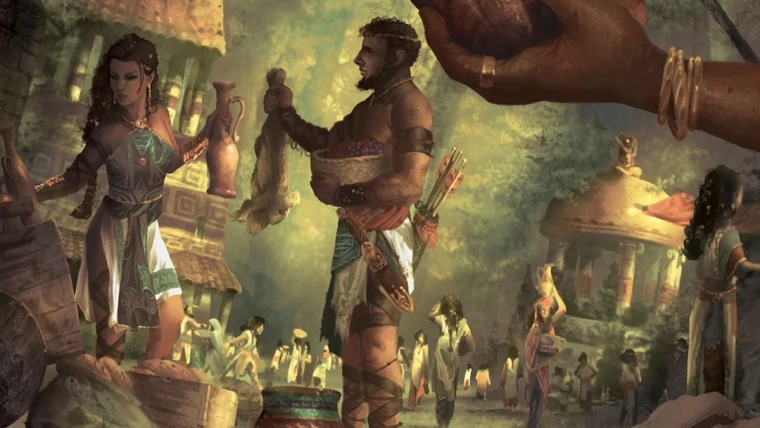
One might think that the people who acquire Magic cards are predominantly Magic players who intend to use the cards as game pieces to participate in tournaments. After all, I am a player, you're probably a player as well, and we both spend the majority of our Magic time among other like-minded magicians. However, there are four big groups of people interested in Magic cards: players, collectors, vendors, and speculators.
Players
The players' need to buy or otherwise acquire cards comes from the simple requirement of having cards to compete and to play the game as intended. They should be considered the driving force behind the prices as they create the main market demand. Players are the ones who discover which cards are playable, powerful, competitive, and thus popular. Their presence and participation in the market are crucial in the price creation process. Even though they themselves don't purposefully set the prices, they still contribute the driving factor. Not only do they acquire cards via the officially released products but also from other players—which is the essence of Magic's secondary market.

To illustrate the idea, if one player does exceptionally well at a tournament playing a card that was previously thought to be bad, the opinion about the card will change. In the current Magic sphere one content creator has a particularly strong influence on players' confidence, and that's Aspiringspike. His streams and brews always take the online metagame by storm. When he brews a deck around a niche card, it often seems to increase in price, if ever so slightly. Other times, there will be a big tournament, online or offline, and it might be won by a complete brew or include a rare that nobody had seen coming. Other players will pick up on this revelation and will also want to play the same deck as the champion, which includes this previously-bad-now-good card.
Naturally, all these players want to acquire this card, and the demand increases. There is a positive correlation between a card's success at tournament levels and its price.
Collectors
What differentiates a player from a collector is basically the purpose of the card acquisition. While players buy them in order to use them as game pieces, collectors buy them with the primary reason of owning them. It can be thought of as a form of alternative investment. There is a whole spectrum of dedication to collecting: Some just want the cards they personally like the look of or have a sentimental connection to, while others acquire cards that are very rare, expensive, and luxurious, and they collect them for the sake of possessing premium highly sought-after products.

Collectors may not intend to sell their cards ever again. Again the focus here is on possession, owning rather than selling. The role of collectors is sometimes frowned upon in the player base since they are thought to be hoarding cards which would otherwise be played with. Additionally, due to collectors taking the cards off the market, they increase the prices, sometimes ever so slightly and sometimes more substantially, a burden players have to bear in order to play the game.
The question whether cards are only meant to be played or also to be collected sparks controversy in the community. However, even people who believe cards should be played have to concede the point that, if one owns 100 cards but only plays 75, which is the standard deck size, then one in a way collects and hoards the other 25 that are not played. And if the counterpoint is that it's all about the scale, then we're getting into a very muddy territory of drawing a line at a particular value or quantity of cards owned. Whatever your position is, most Magic players own way more cards than they are physically able to play with.
Vendors
Vendors includes local game stores to a lesser extent and big online stores to a large extent. While players buy cards to play with them and collectors to own them, vendors buy them to actively trade with them. Turnover is the whole point.
Big stores often acquire cards through so-called buy lists. A buy list is a list of cards that a vendor is willing to purchase at a certain price, which most often is around 70–80% of market value. Later, they sell the cards at market value with some margin. Let me illustrate the process with an old entry from the former list of one such online shop.

The way it's presented shows, starting from the left, a visual image of
Professional vendors make money this way but also offer an invaluable service to the community with their superior inventory management. This includes selling cards that are too cheap for ordinary players to bother putting up for trade. The power of this strategy lies in the economies of scale. When such a shop sells hundreds of these otherwise difficult-to-trade-away cards for $0.50 each, profits start to pile up. Examples are basic lands, commons, and uncommons. While most players have basic lands, sometimes you'll want that specific art from a set five years ago, and then you'll fork out five euros on lands that are probably rotting away in somebody's bulk box. The same way someone might want the basics that you've got in a box in the basement.
Speculators
Speculators share their goal with vendors as they intend to liquidize the cards they acquire. However, they tend to focus on cards with uncertain prices and high potential. It's sometimes expressed in the form of preordering a large number of cards that have not been released yet, expecting them to increase in price after release. Sometimes it's investing in older cards with a known collectible value that is believed to go up further.
In extreme cases, speculators even attempt to buy out a certain card in order to create false scarcity and decrease its presence on the market. Below you can find two past examples of thousand-fold increases that are hard to explain without such market manipulation.

To execute this strategy, properly, would-be manipulators need to look at the listings on the biggest platforms and buy up every copy of a certain card from all of them. It is a high-risk gambit, only feasible at all for old and already scarce cards, and requires a considerable investment. Whether the people who bought all these
As we can see, there are four main groups of people interested in Magic—players, collectors, vendors, and speculators. Each group has a different approach and different needs, but they are all a part of the economic ecosystem of Magic. As always, remember to hold my hand and pass the turn together. Cheers!
Opinions expressed in this article are those of the author, not of Cardmarket.