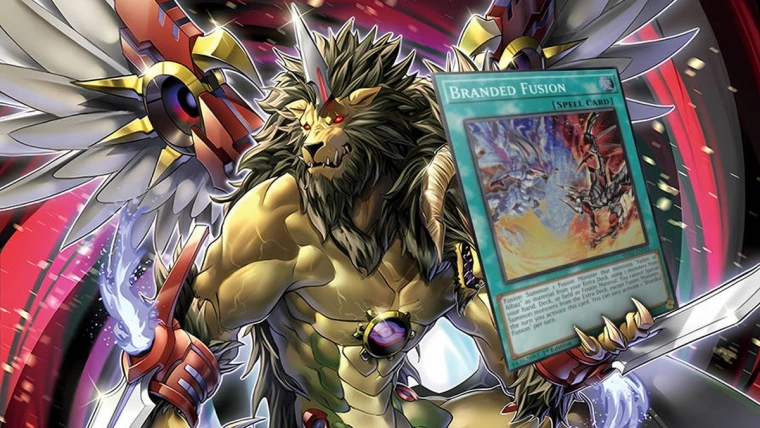
Branded Chimera is one of the best decks in this format, and it leaves a lot of room to incorporate nonengine or additional engine cards. Let us explore some of the tech and discuss the various options' advantages as well as their disadvantages. Just beware of the vicious Chimera!
While this deck might seem linear to some extent, it heavily relies on the extra deck as a toolbox to outplay opponents. Its ability to generate massive hand advantage during either player's turn translates into big fusion monsters and a lot of interruptions. The purpose of this article is to look into some supportive cards and engines, and decide how good they fit into the deck. I specifically want to focus on three remarkable tech ideas.
1. Pot of Prosperity
Everyone can agree that is one of the most incredible draw cards ever printed. Of course, digging into your deck to find either a or , or even one of your missing Chimera cards, is absolutely amazing. It adds a lot of consistency to the deck while baiting hand traps such as , which could potentially hurt your plays. On the other hand, there are some glaring issues that make the card seem unfit for the deck.
The first issue lies in the heavy dependence on the extra deck. Taking away three or six cards means you have less options to go for. Your main deck monsters cannot win you the duel on their own as they do almost nothing, maybe except for the Illusion monsters that you can stall with—but that’s about it, really. The truth, however, is that you do not need your entire extra deck. There are some cards which never get summoned. Therefore, it is okay to use Prosperity as long as you know which cards you won’t need in your current matchup, and which cards you rarely, if ever, summon.
The second issue is that going second, Pot of Prosperity hinders your ability to finish off your opponent since they only take half the damage. , which is your main way to one-shot your opponent, suddenly ends up not so useful anymore. Also, Prosperity doesn't allow you to draw cards for the rest of the turn, which conflicts with the effect of that lets you destroy cards and draw. Since all the main issues with Prosperity conflict with going second, the card can be sided out in favor of more useful tech that can help you break or prevent boards instead.
Overall, it is an amazing card that should be experimented with.
2. The Aluber Engine
The deck depends on two cards, and . You have many ways to search the latter; however, if you want to search Branded Fusion, the only way will be to include a small engine of and . Branded Opening helps you play around since you can activate it in the draw or standby phase. It also is a bait for in case you already have your Branded Fusion in hand. Lastly, Branded Opening can protect one of your fusion monsters from being destroyed by card effects if you happen to have it in your graveyard.
The problem with this engine is drawing the Aluber. As you already want to use your normal summon for , Aluber ends up being a dead card in your hand while any copies of Branded Opening you draw will be useless, especially now that the trend is to play two copies of Opening and one copy of Aluber.
In my opinion, it is sort of a necessary evil in this deck. Getting to Branded Fusion is a top priority. You can definitely play only with the Chimera portion of the deck along with some non-engine cards. However, Branded Fusion gives you access to some very powerful plays and can even send to the graveyard to get your Chimera portion of the deck going.
3. Frightfur Patchwork Engine
The engine consists of two , two , and two . It accomplishes a few different things: First of all, it adds a fiend monster to you hand, which the deck somewhat lacks since you generally only play two copies of . This allows you to make even though you cannot access your Berfomet. Another advantage is that Polymerization helps you fusion summon anything as long as you have the material in your hand or on the field, allowing you to play through unusual hands or after certain interruptions. Lastly, having Polymerization in the graveyard allows to be untargetable, which is a huge thing for 3,300 beater.
There are a few problems with this engine, the first one being that it is not that small. Six cards take the space of possibly two sets of hand traps, for example. You have to decide if you value hand advantage and playability options over interruptions. The second problem is that the deck could possibly be stopped by . So unless you have the necessary cards in hand after you get hit by Droll, your turn sadly ends.
The engine itself is good. Unfortunately, it does not start your plays, but rather enhances them in some ways. You can get away with playing only one Polymerization as it is recyclable with if you have concerns about space in your deck. Overall, it could be worth a shot, depending on whether or not you are satisfied with the amount of interruption and consistency of your deck.
It’s a strong deck, and one list even topped YCS Dortmund using and . In any case, it will evolve even further in less than a month when Age of Overlord is released and will provide new support. Let’s wait and see see how the deck will develop in near future.
Opinions expressed in this article are those of the author, not of Cardmarket.