Long-time readers may recall a piece from 2021, titled Everything You Should Know About the Arena Economy. The claim was more conviction than hyperbole, and it remains a fine article to this day. There's but one problem: Some of the things that made up "everything" back then are no longer true in 2023. Now you should know some different things instead. However, this is not just about updates. We can also use the opportunity to look deeper into the MTG Arena economy and its internal logic.
You don't have to go and read up on the past ~4,000 words. The coming ~6,000 words recap all major points as far as they continue to be relevant. Most of them still are. Most salient, the program still is a bottomless pit designed to suck in your time and dime. If you aren't a world-class player, you should not count on ever getting money out of the system. So you better put in as little of it as possible and count the time, the hours of gameplay, along with the lessons learned this way, as a net gain itself. The information below helps with the first part.
1. How Much Things Are Worth
If you've ever taken your trade binder to a larger Magic: The Gathering gathering, you may already be familiar with the heuristic: To figure out what an item is worth to someone, don't ask for how much they're selling but for how much they're buying. MTG Arena operates on a comparable double standard.
When you feel like getting a pack from the store, Arena will proclaim one pack to be worth 200 gems. But when you have a superfluous pack from a set you've collected in full, all of a sudden Arena will admit that, in truth, a pack is worth 20 to 40 gems plus a fraction of some wildcards. Insofar as they help you complete another set, these wildcards are worth some gems too. In fact, everything translates back into a gem value, albeit hidden well out of view of the ordinary user.
The Value of Cards, Wild and Otherwise
Every common and uncommon you acquire equals a certain amount of progress: first toward the completion of a set, then vault progress. Reaching any particular milestone doesn't affect the value of said progress. Whether you collect the first of 404 commons needed to complete a set or tick up the vault from 99.9% to 100% feels very different, but the size of each step is the same. Whether one acquires a random uncommon or an uncommon wildcard likewise makes a lot of difference to the user, but either marks progress of equal value.
One can apply the same logic to rares and mythics. If you were to receive a rare of which you already own four copies, you get 20 gems instead. So every rare and rare wildcard brings you one step closer to 20 gems, meaning 20 gems worth of progress. Every mythic rare and mythic wildcard means progress worth 40 gems.
Collecting one thousand surplus commons takes the vault to 100%. Every surplus uncommon advances the vault by 0.3%. At 100% the vault spits out one mythic and two rare wildcards, a value of 80 gems, plus three uncommon wildcards. The latter three create a bit of recursive problem, at least in principle: Three uncommon wildcards, once redeemed, bring you closer to another vault opening by 0.9%, another vault opening adds three more uncommon wildcards, which again bring you closer to another vault opening, and so on. But in practice the uncommons' impact drops so far down the digits, after just a few iterations, we merely need a bit of rounding to arrive at the following values.
- Each common is worth ~0.08073 gems.
- Each uncommon is worth ~0.24218 gems.
- Each rare is worth 20 gems.
- Each mythic rare is worth 40 gems.
(For a more principled approach, we can alternatively assume that the vault only spills 80 gems but already fills on 991 commons or 330.3 uncommons or some combination thereof. After all, it immediately returns three uncommons equal to nine commons. Down the line to infinity the differences cancel out and either calculation yields the same results.)
The Value of a Pack
We can determine the average value of a pack by applying the numbers above to what we know will be in it at what rate. Alas, nowadays we often don't get to know what's in a pack anymore, not in the age of special slots reserved for double-faced cards and Retro Artifacts and Multiverse Legends. Exact drop rates simply aren't public and presumably differ. There is added value in Enchanting Tales replacing Wilds of Eldraine commons, to be sure, but the effort of analysis exceeds its utility from both ends: The herculean task turns sisyphean as the gain proves pygmean. The main problem is that the subset's rares, which are far rarer than ordinary rares, account for most of the increase, which consequently is far harder to realize. Here, the theory that equates progress toward value with actual value finds its practical limit.
Therefore the following numbers all presuppose a regular set like Dominaria United, where the sole variation is that one in seven packs has a mythic in the rare slot. Regular sets released before Forgotten Realms feature a lower mythic frequency of 15/121. For them you got to subtract ~0.3778 gems from each pack value.
- The average regular, current draft pack is worth ~24.39094 gems.
- A regular, current sealed deck is worth ~146.34568 gems on average.
For a draft it depends not just on what you pick but also on what the others pick. If you only draft commons, the value of your card pool will amount to ~3.39051 gems. By contrast, if your fellow drafters always picked cards of the lowest rarity and you always picked cards of the highest, you'd have ~552.93066 gems in expected value. But actually expect such behavior you obviously cannot. Overall, the price and prize structures disincentivize aggressive raredrafting. As an edge case, with the cheapest entry option at 750 gems, it is literally impossible to make a profit off draft picks alone. Even within reason and realism, sacrificing deck quality for card rarity rarely makes good tradeoffs. Just one more match win is worth between 2.5 and 37.5 extra rares in best-of-one drafts and can be worth over 80 extra rares in best-of-three drafts!
Prize packs contain eight cards: one rare/mythic, two uncommons, and five commons for regular sets like Dominaria United, with wildcards of the corresponding rarity replacing some of them at irregular intervals. Replacements don't add value, but the wildcard reward track does. For every six such packs opened, it adds one uncommon wildcard and one rare wildcard, the latter upgraded to mythic once every 30 packs. This makes a prize pack more valuable than a draft pack despite its smaller size.
- The average regular, current prize pack is worth ~27.7855 gems.
Purchasing ten prize packs from the Arena store, at 1,000 gold or 200 gems apiece, incurs additional rewards, a "golden pack" worth ~156.54036 gems on average. So you can instantaneously turn a value of 10,000 gold or 2,000 gems into cards with an expected value of ~434.39534 gems.
The Value of Gold
As you can see above, the store operates on the assumption that 100 gold is worth 20 gems. But, as you can also see above, the store is a terrible place to buy things, funny as that may sound. It is indeed the worst place, clearly by design, because, even more than money, the system needs active players. Otherwise it wouldn't be worth anything to anyone at all. So between all its predatory pricing Arena effectively imposes a kind of tax on the ownership class and another lower kind of tax on the working class. If you want to own stuff right away, you're subjected to a hefty markup. For example, charging 2,000 gems for product worth ~434.39534 means selling goods at ~460% of their value.

If you're willing to work for stuff, however, you benefit from an economic policy best summarized as "More playing, less paying." The easiest example to calculate is a three-round Dominaria United draft. For every eight players that join, the program hands out 24 draft packs worth ~585.38273 gems, nineteen prize packs worth ~527.92446 gems, plus 6,350 gems in additional prizes, a total value of ~7,463.30719 gems. Entry fees for eight drafters add up to 12,000 gems, which means selling goods at ~161% of their value. One player also receives two "Play-In Points" not counted here for the primary reason that they are the topic of the next section and the secondary reason that their value varies.
To be fair, a five-round Constructed event is only harder to calculate insofar as it requires us to figure out the average prize distribution for 32 players. Assuming regular, current prize packs, their winnings add up to a total worth ~14,689.34439 gems, not counting four Play-In Points, while their entry fees add up to 24,000 gems. This means selling goods at ~163% of their value.
Aside on the News
Some of this is new, by the way, for instance the golden pack bonus at the store. Before, the store used to sell packs at >719% of their value. Events looked different in 2021 too, in particular the Constructed options. They became pricier to a degree but prizier to a higher degree, much more valuable overall. Putting Constructed and Limited players on largely equal footing stands as the main achievement of the economy's overhaul.
What does any of this have to do with the value of gold? Each event permanently on the roster charges a fixed multiple of either 100 gold or 15 gems. If you care about value, you'll mainly rely on these events and avoid the store, making this the relevant rate of equivalence. If you don't care, there's no point in assigning value to anything, making this the only relevant rate.
- 100 gold is worth 15 gems.
Every rule knows an exception. Every few weeks a one-time offer from the store will allow you to buy an amount of gems or gold for a lesser amount, essentially a gift. This free value is why you should still check the daily deals daily. But the store insists on 100 to 20 even here. Special events like Arena Opens likewise cost a multiple of either 100 gold or 20 gems to enter. Pay in gold for all such deals and events you're interested in.
This means, when it comes to regular events that do not make a difference between 100 gold or 15 gems, you spend gems first. An additional factor in support, there's no upper bound on the number of gems you can make, whereas the usual play rewards limit you to a maximum intake of 1,500 gold per day.
One last exception: As long as you're reasonably active on Arena, the simple mastery pass for every set is worth more than it costs but accepts no gold payment. Save at least 3,400 gems for it.
The Value of Play-In Points
Play-In Points are a recent invention as well, part of a revamped qualification system that increasingly resembles a baby carrot dangling from the end of a mighty tree branch. Nowadays the average user has to enter a qualifier that qualifies for another qualifier, whose first day qualifies for a second day, which then qualifies for the Arena Championship. It would be unwise to base any decision on the prospect of earning an invite to the big show.
What still attracts even realists are gem prizes at every step of the way and the lack of decision points in the face of Play-In Points. The first step, the Play-In event, costs either 20,000 gold, 4,000 gems, or twenty Play-In Points. Spending gold is a bad investment unless you can guarantee a positive record. Spending gems is 33.3% worse because of the exchange rate. But Play-In Points serve no other purpose, accumulate without expiration date, and are included as a prize with lots of play modes. You get twenty of them if you finish a monthly season ranked one of Arena's Top 251–1,200 players. Regular unranked drafts award two points if you go 3-0. Regular Constructed events award four points at 5-0 or one point at seven wins, respectively for the best-of-three and best-of-one options.
Determining how much value the average Play-In Point adds from a macroeconomic perspective borders on impossible without insider information on user number and user behavior. But the microeconomic discussion, how much value a point adds to one player's personal budget, is open to everyone. The minimum prize for spending twenty points, joining the Play-In event, and not winning a single game is 500 gems.
- Each Play-In Point is worth at least 25 gems.
The maximum is absurd but entertaining to calculate. A player who invests twenty points once, never loses a game, but never leaves their house to attend the Pro Tour or Worlds will make 31,000 gems on their way to the Arena Championship and $30,000 at the Arena Championship itself. If they were to spend all this money to buy more gems, each of their Play-In Points would be worth ~301,580 gems!
I spent 180 points last quarter and won 36,500 gems in prizes, an average of ~202 gems per point. Your mileage is bound to differ, and so is my future mileage. If you only enter Play-In events when the format suits you and you feel confident in your ability to reach a positive record, averaging 150 gems per point seems like a realistic goal. Calculations below nonetheless use the baseline of 25 gems.
2. How to Pick Your Battles
Arena broadly offers seven different play options open to anyone anytime. All of them require some investment. Either you need to bring your own deck or pay an entry fee or both.
- Unranked Constructed play for free
- Ranked Constructed play for free
- Ranked best-of-one bot draft for 750 gems or 5,000 gold
- Ranked best-of-one player draft for 1,500 gems or 10,000 gold
- Unranked best-of-three player draft for 1,500 gems or 10,000 gold
- Unranked best-of-one Constructed event for 375 gems or 2,500 gold
- Unranked best-of-three Constructed event for 750 gems or 5,000 gold
The Value of Wins, Any
There are good reasons why someone might choose not to compete for prizes or rank. Maybe they want to get acquainted with a new deck. Maybe they just want to collect their benefits within the shortest time and have the easiest time doing so.
- The first four wins per day award a total of 550 gold worth 82.5 gems.
- The next eleven wins add a total of 200 gold worth 30 gems.
- They also add six card rewards, each worth an average of ~2.4659 gems.
- In sum, these free daily win rewards are worth an average of ~127.29537 gems.
- More win rewards from the free side of the mastery track can be worth ~1,000.27793 gems per set.
Or maybe someone wants to maximize returns on the daily quests: Try to exchange all small quests for big quests, finish the latter, and ideally leave some of the former unfinished to improve the odds for multiple big quests the next day. Completing/not completing quests can variously mean playing many/few lands, casting many/few spells of certain colors, or killing many/few creatures. Picking a deck accordingly works best when win rate is a secondary concern.
- Completing a small quest awards 500 gold worth 75 gems.
- Completing a big quest awards 750 gold worth 112.5 gems.
The Value of Ranked Wins, in Addition
Ranking up incurs additional rewards, awarded on a monthly basis. The following are cumulative in two ways: Each rank comes with all rewards from all the previous, and ranks in draft and Constructed count separately. Pack values are the average for regular, recent sets like Dominaria United.
- Playing a game at bronze awards one pack worth ~27.7855 gems.
- Making it to silver adds 500 gold worth 75 gems.
- Making it to gold adds another 500 gold and another pack.
- Making it to platinum adds another pack.
- Making it to diamond adds another pack.
- Making it to mythic adds another pack.
- This sums up to a total of 1,000 gold and five packs, a combined value of ~288.92749 gems.
The following rewards are not cumulative. Only the highest rank counts, not within draft or Constructed but across both. Making it past any milestone doesn't count either. One has to be at a certain rank in the exact moment the monthly season ends.
- A Top 251–1,200 finish awards twenty Play-In Points worth at least 500 gems.
- A Top 250 finish instead allows a player to bypass the Play-In event, a bonus of unclear value, and to advance straight to the next Qualifier Weekend where prizes go up fast but again start at 500 gems.
There's a correct place for everyone in this system, whether that's bronze or rather platinum. But there are also places at the top where barely anyone should spend their time.
Whether something is worthwhile depends on the worth it gives and on the while it takes. Climbing through bronze, silver, and gold in Constructed is worth very little but comparatively quick and easy to do. It's not just the level of competition. It's also that best-of-one play at these ranks counts every win as two steps forward and not every loss as one step back. Intermittent winning streaks will eventually get even a Constructed player with an overall win rate of 33% to platinum. It'll take forever, figuratively, but there is, literally, nothing else one can do at this win rate that generates as much value for the time invested. All other play options merely convert value into lesser value.
The curious flip side of this is that it's correct for players who do better on the ladder to spend less time on it. They have alternatives that net more value per hour. Of course, if none of the good players competed for the top ranks, it would take so little effort and time to snatch one of the associated rewards as to be worthwhile again. However, at current participation levels, the skill and hours required to maintain a Top 1,200 rank are more rationally invested elsewhere.
The Event Horizon: From Free to Fee
All drafts and Constructed events take in more in entry fees than they give out in prizes. They eat value. For every player turning a profit, another turns an even greater loss. Or two others lose more combined than one gains. Events mean competing in a negative-sum game. Still there are compelling reasons to join some anyway.
The first reason is the free gold everyone can collect each day. This gold has to go somewhere, and it may as well go into events. After all, there's only one alternative.
The second reason is that the only alternative, the Arena store, eats even more value. If you spend 10,000 gold at the store, you get cards worth an average of ~434.39534 gems. If you spend 10,000 gold on bot drafts instead, only pick your fair share of rares, and only win 24% of your games, the expected return on your investment is already higher, ~441.33593 gems! Note also that bot drafts, unlike player drafts, allow every human drafter to walk away with more than their fair share of rares.
The third reason is that it's impossible to maintain a win rate as low as 24% in bot drafts by mere incompetence. These are ranked, which means the matchmaking algorithm will try to pair players based on their current record in the event, their publicly displayed rank, and most crucially a second hidden rank that reflects their overall performance in ranked drafts. While the details remain opaque and imperfect, the system can draw from a vast number of people, and sooner or later it will give anyone opponents as bad as they are, at least predominantly and roughly. The resulting games, at this level and in Limited especially, will be closer to coin flips. A bot draft win rate that ultimately settles in at 31% yields an expected return worth ~521.17666 gems per 10,000 gold, better than the store by one fifth!
You cross the magical threshold for best-of-one Constructed events at a game win rate of ~33.5% and for best-of-three Constructed events at a match win rate of ~28%. At these rates you can expect them to yield greater value than the store. But be careful. Without the benefits of rank-based matchmaking, here it is possible to maintain win rates this low and lower. If you're determined to play only Constructed but only win a third of your games against the general population, you really only have the store as a rational receptacle for your in-game currency.
Ranked Drafts ("Quick" and "Premier")
The win rates discussed above all translate into negative expected value, merely less negative than what the store sells. Determining the win rates at which ranked drafts net profits is possible, too, but sort of pointless. For reference, if you were able to maintain a win rate of ~67.9%, you could keep drafting forever, amass infinite gems, and have all the cards for free.
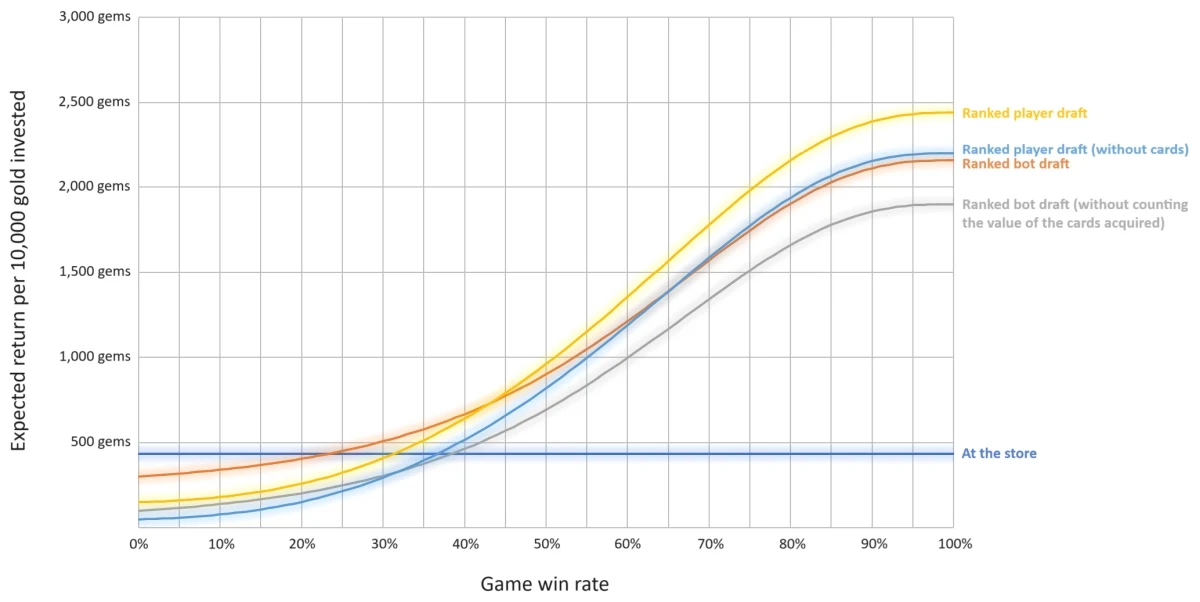
- Bot drafts offer greater value than the store at any maintainable win rate.
- Bot drafts offer greater value than player drafts at win rates below ~43%.
- At ~63.5%: expect ranked player drafts to net value but still to cost gems.
- At ~67.9%: expect ranked player drafts to net gems and go infinite.
- At ~68.1%: expect bot drafts to net value but still to cost gems.
- At ~74.7%: expect bot drafts to net gems and go infinite.
You probably cannot maintain a win rate of ~67.9%, not in ranked drafts. Here, our old friend, rank-based matchmaking, comes into action again, and this time it comes as an enemy. As you climb the ranks, it will successively select stronger and stronger opponents for you until you face opposition against whom you can be happy to win half the time. Of course, actually winning half the time gives you a lower rank, which in turn gives you easier opponents you beat more often, which starts the whole process anew. Some state of equilibrium presumably exists, somewhere beyond the scope of this article. Just know that wherever your win rate against random opponents may stand or sit, whether high or low, rank-based matchmaking will always pull it closer to 50%.
It's not just that the opponents themselves get stronger. What causes a drafter's ranking to spike is unlikely to be a sudden rise in the quality of their gameplay. More likely it's an unusually successful draft that ended in an unusually powerful deck, which started an unusual winning streak that, as usual, rank-based matchmaking now seeks to end. What makes everything worse is that stinker decks are removed from the population at 0-3, earlier if a player drops, whereas monster decks aren't even halfway through their winning streak at 3-0. So the top of the Arena ladder makes you face overly overpowered decks from different draft pods all the time and by design.
Unranked ("Traditional") Drafts
This option combines all the most promising premises to reward high win rates. Rank-based matchmaking? No. Top-heavy payout? Yes. 3-0 drafters take home ~39% of the total prize purse. Best of three, where high game win rates translate into even higher match win rates? Oh yes! For example, winning two thirds of your games means you win almost three quarters of your matches.
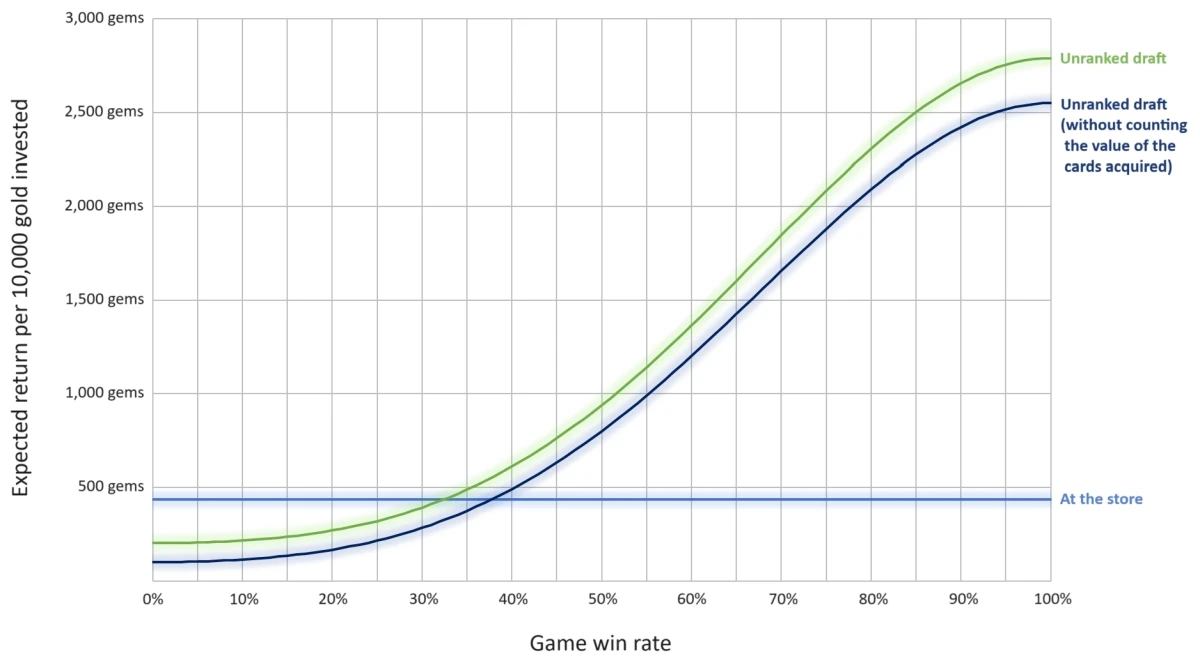
At a game win rate of ~32.4% (match win rate of ~24.7%): expect unranked drafts to yield greater value than the store.
At game win rates above ~57.5% (match win rates above ~61.2%): expect unranked drafts to yield greater value than ranked drafts played at the same win rate.
At a game win rate of ~62.9% (match win rate of ~68.9%): expect unranked drafts to net some profit, a combined value of cards, Play-In Points, and gem prizes that is higher than the entry fee.
At a game win rate of ~66.7% (match win rate of ~74.1%): expect unranked drafts to net gems and go infinite.
Here you have the reason why the top drafters should not chase the top ranks forever. At any game win rate that could clinch a Top 1,200 finish, one can expect more from every draft if it is unranked, maybe even a profit instead of a loss. Comparing a once-per-month bonus to a once-per-draft bonus is tricky, but one of the two adds up. If a strong drafter wants to invest a lot of hours, unranked is almost assuredly where they should end up.
However, it isn't where they should start. Until a rank catches up to a high skill level, ranked drafts are easier to win than unranked drafts. A rational if slightly risk-averse economist, thus, would try both, monitor the returns and the progress toward a top rank, and abandon the latter once it reduces the former. Some estimates can fill in for data in practice, especially with experience.
This approach will leave even many decent drafters well outside of mythic. It also leaves the majority of all with an incentive to go "slumming" on purpose: Drop down to whatever rank is "too easy" every month, wait a week for those crabs as can to make it out of this bucket, then shoot some of the remaining for free value. It won't make you a better drafter, or person, but will make you a better capitalist!
Constructed Events
Comparing ranked with unranked play is complicated because virtually everybody's win rate will differ between the two. Comparing Limited with Constructed is the same, for the same reason, but worse. One cannot recommend one over the other by plugging one universal and uniform win rate into any one formula.
The one exception concerns a new player who's winning extremely little. They better put excess currency into bot drafts for a while, as much for the lower required win rate as for the cards required to construct a competitive deck. But once this hurdle is cleared, we can easily compare unranked best-of-one with unranked best-of-three Constructed events based on game win rates.
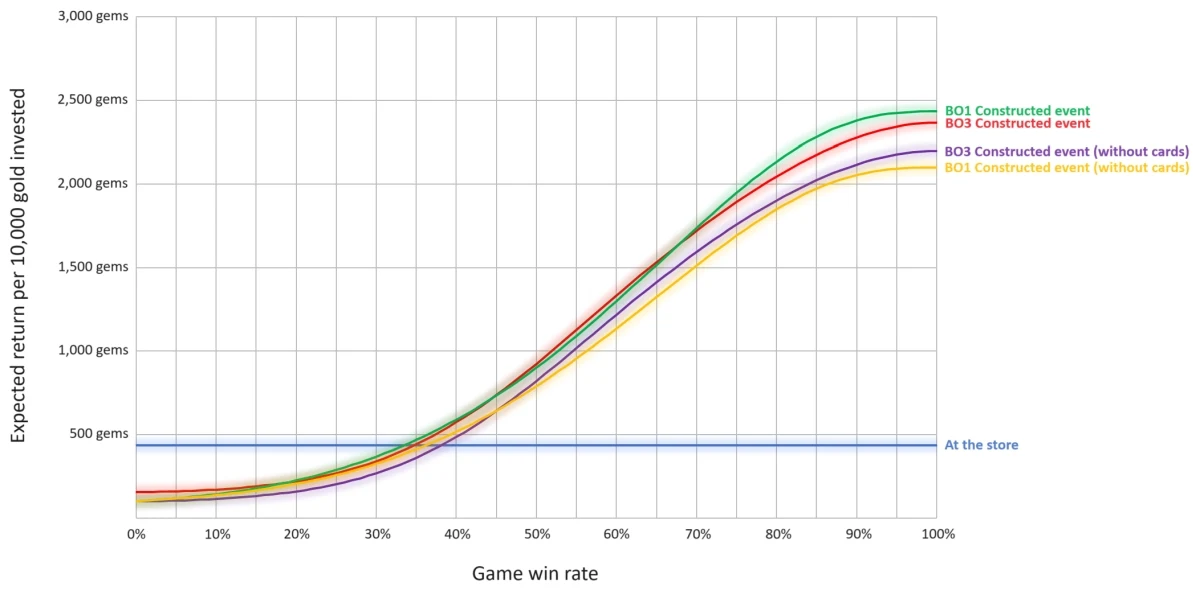
At game win rates between ~18.5 and ~44.2% (match win rates between ~9% and ~41.3%): expect best-of-one events to yield greater value than best-of-three events.
At a game win rate of ~33.5%: expect best-of-one events to yield greater value than the store.
At a game win rate of ~34.9% (match win rate of ~28%): expect best-of-three events to yield greater value than the store.
At a game win rate of ~64.2% (match win rate of ~70.7%): expect best-of-three events to net some profit, a combined value of cards, Play-In Points, and gem prizes that is higher than the entry fee.
At a game win rate of ~64.7%: expect best-of-one events to net some profit.
At a game win rate of ~67.4% (match win rate of ~75%): expect best-of-three events to net gems and go infinite.
At game win rates above ~67.6% (match win rates above ~75.3%): expect best-of-one events to yield greater value than best-of-three events.
At a game win rate of ~69.7%: expect best-of-one events to net gems and go infinite.
Whoever designed these did an amazing job. It makes sense not to compete with ranked events for players at low win rates, because unranked events can't ever succeed here anyway. It makes sense that the rates required for profits match up so well to those in unranked drafts. It even makes sense that they are a little higher, because Constructed is easier. It's beautiful to behold the egalitarian prize payout in best of three, where the top ~3% of players claim a mere ~8% of the purse. It is weird how playing best of one first yields worse returns than best of three, then better, then worse, then better as you climb up the win rates. But it does make sense for the two to rival one another throughout, because there's no compelling reason to put either at an advantage at any rate.
This is not mere theory either but empirical truth. The initial observation predates the calculations by months. What provided the impetus to look into the numbers at all were successfully sustained experiments.
To wit, between mid-May and mid-October, I played 376 best-of-one Explorer events. (It is not madness to do the same thing over and over if you don't expect different results!) I won 1,970 of my 2,795 games, ~70.5%, and averaged ~5.24 wins per event. I spent a total of 141,000 gems in entry fees. Here's what I got in return.
- 141,300 gems in direct prizes,
- 175 Play-In Points worth at least 4,375 gems,
- and 776 prize packs with a minimum value of ~21,268 gems. 776 packs and the corresponding vault openings also yield more Pioneer cards than the game of Magic releases in five months, though maybe not enough to keep up with this strange spinoff game inexplicably crowding the same platform, Alchemy.
- ~259 common wildcards plus ~3,621 random commons
- ~308 uncommon wildcards plus ~1,397 random uncommons
- ~149 rare wildcards plus ~653 random rares
- ~55 mythic wildcards plus ~71 random mythics
It all sums up to a total net profit of ~25,943 gems, ~69 gems per event. This is the reality of what it means to go infinite on Arena. If I counted the 250+ hours of play time as a cost, it'd be better to work minimum wage elsewhere and to buy gems with the money. (Maybe it can be madness to do the same thing over and over after all, even if you don't expect different results.) But we never count play time as work. Anyone who does has picked the wrong game in MTG Arena and MTG period, or they have to be a successful content creator, in which case one could argue they've still picked the wrong game. If and how the program can be free to play for Constructed grinders, without drafting or upkeep costs, was the only sensible point to investigate and QED.
How realistic it is for someone reading this to match such win rates is hard to say. At least I have found it much easier than winning 66.7% of draft games. I initially worried about facing not a sample of the general population but rather a group of people who self-select based on the expectation they'd do well in Constructed. However, to whatever degree the competition in these events is above average, it proved quite beatable overall. Most players bring a deck that wouldn't look out of place in a Pioneer Top 8, make worthy sparring partners, and teach lessons that apply outside of Explorer too. But enough don't bring an optimized deck and/or don't bring their A game. One time, at a record of 5-2, I met a player who ended their second turn with
If you keep up with new releases and the latest technology, you might as well achieve better win rates. I used a deck not updated since Neon Dynasty, chosen to prove another point back before it was clear how many points this article would have. Except twice I misclicked and registered old Standard decks instead.
| White-Blue Control, 1,958-820 in Best-of-One Explorer Events | ||
|---|---|---|
| Main Deck | Sideboard | |
|
|
|
3. How to Trade Stuff for More Useful Stuff
As far as actionable advice goes, this final part explores what to do with too many wildcards. But it also turns the theory of counting commons as ~0.08073 gems and uncommons as ~0.24218 gems into practical reality.
Take a look at how my account's inventory developed since the previous article on this topic. If you've also seen the tweet X post that exposed it a while ago, you may notice I had to adjust the scale for the gems, again, because >80,000 didn't fit anymore. At least, any change on either of the two dotted lines now represents an equal change of value.
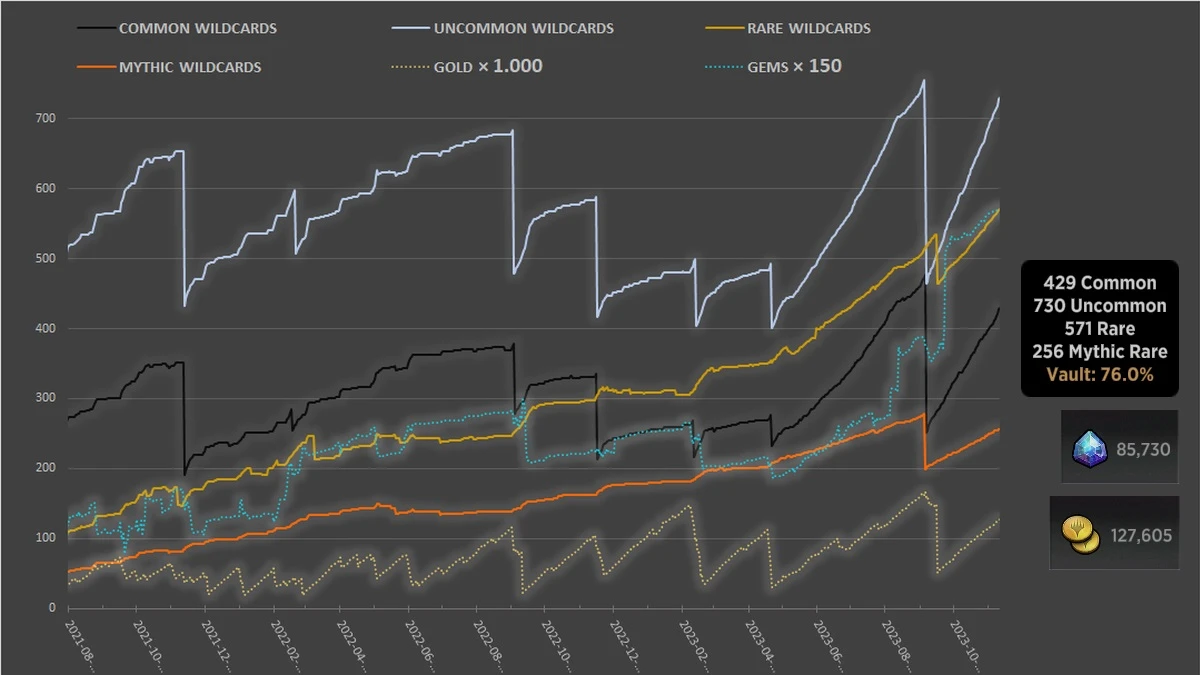
If you read this far, you know of course that the sharpest gold decreases mark Arena Opens, whereas Qualifier Play-Ins are what causes the steepest gem increases. The rise in wildcards used to mirror the life cycle of Limited formats: a ton early on, then petering out as everyone figured out the ins and outs of the draft environment. This changed drastically in May when I mainly moved to Constructed events. Ever since it's been a constant climb.
I want to draw your attention to the drop in wildcards coinciding with most set releases. For example, I tried out Wilds of Eldraine Limited, liked it well enough, and decided to add all the missing mythics, uncommons, and commons to my collection. Then, a few days later, I decided to get all the remaining rares as well. In total I spent 79 mythic wildcards, 73, rare wildcards, 300 uncommon wildcards, and 227 common wildcards. It was not that I needed the cards, see decklist above, but specifically that I didn't. The main reason to unwild all of these wildcards was that I played enough Limited that I would have got all of these cards regardless.
So instead of getting these rares and mythics from pools and prize packs, I got 73×20+79×40=4,260 gems. Instead of getting these commons and uncommons, I got 227×0.1+300×0.3=112.7% of vault progress, which will turn into another ~90.9788 gems when I invest the attendant wildcards in the same manner in the future. It's not a great exchange rate, but it's the best one available, and the exchange works. In the very, very long run, it'd even work if I didn't play any Limited at all. The Explorer events have already given me so many Rivals of Ixalan packs that now 20 gems replace their rares.
Ultimately, it doesn't make a difference to the value whether one stores it in wildcards or gems. If I planned to take a sabbatical from Arena, I'd keep more wildcards because one can only turn so many gems into new cards within a given time frame outside of using the prohibitively expensive store. But at current rates the inverse is a bigger factor to me, namely that one can only trade in so many wildcards per set release. I'm not alone in this. Just look at Deathsie's inventory!
I'm crying too when I see this. If Deathsie had used all of these wildcards and the ones in his vault in the way described, he'd have ~25,538.8498 gems more on his account. Worse, if he wanted to start using them now, it'd take him nine Standard releases, more than two years, to unlock their value. I mean, being able to leave this much food on the table is an impressive flex, sure, but a weird one. It'd be all the more impressive if he weren't, like, a dozen or so failed drafts away from running out of gems. To stay with the eating analogy, it's the equivalent of an impossibly skinny mukbang creator sitting down to a meal they can't possibly finish. That, too, is a form of entertainment, but, damn, there are kids in bronze who go to bed hungry for more Magic but with no gems at all, so better eat up!
At least, that's what the frugally inclined old person in me wants to shout. You know, the one perched atop the window sill, overlooking my imaginary but immaculately manicured front lawn.
Anyway, I hope this article has given you some food for thought when it comes to maximizing value on Arena. For a more fun-focused approach to the program and tips on drafting, go and watch Deathsie stream. Just keep in mind that drafting is no longer the optimal thing to do, now, inside the new Arena economy.
Opinions expressed in this article are those of the author, not of Cardmarket.