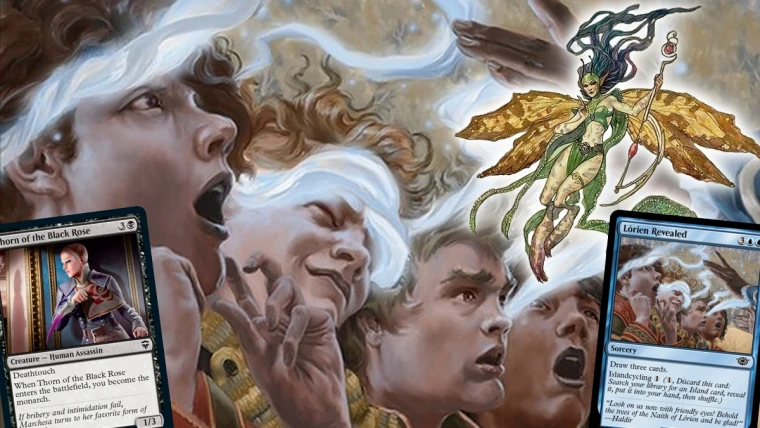
Every Wednesday Insight is taking a quick look at one of the top-performing, most peculiar, or simply sweetest Pauper decks among recent results. Winning two main events on the same weekend, piloted by a player who already won five out of the eight previous Challenges, is this the return of the Faeries?
Before we talk about the deck, I want to point out the insane run of the Brazilian player Carlos Roger, beicodegeia on Magic Online. He won seven out of ten Challenges while piloting four different decks! The last choice was Blue-Black Faeries, which he used to win the two events on October 21 and 22. He evidently has incredible reads on the format and what is working, which should be reason enough by itself to try out the deck.
The main core of Blue-Black Faeries is the interaction between and . The first is perfect to counter on curve and the second works both as a draw engine and as way to extract more value from the creatures with enter-the-battlefield effects, like the Sprite or . Midgame the deck pivots to more of a midrange plan with and , backed by to help hold the crown.
Effectively this creates a mix of tempo and midrange, and this flexibility allows it to adapt to all kinds of matchups and situations. I already wrote about the deck in early June. The core of the deck remains more or less the same, and the article is broad enough that it warrants a rereading. This time I want to explore only what changed since then.
was printed in Tales of Middle-earth and changed how any blue deck plays. A high-cost spell that can be used during the first turns for landcycling proved crucial for blue decks to remain competitive. The current format is all about fast plays and hyperefficient spells. You can lose, or be put into a losing position, as early as turn three. It also doesn't help that the fast decks have sturdy draw engines and can keep up steam for several turns, potentially outdrawing the slower decks. Lórien is perfect to even the field. Draw it too early? Turn it into a land. Don't need lands or draw it late? Cast it to get back into the game after you've traded resources. With this addition the deck increases the density of spells and matches the power required to compete in this new Pauper era.
The removal suite is very fractured because of how diverse Pauper's threats are. needs to be answered with an or a rightly timed . The sacrifice effect is also relevant against Auras to deal with a , and in rare cases you may even target yourself to gain life off to beat Burn. Spells like and are important against and niche decks like Elves. The rest of the removal slots go to the broadest answers, and .
Postboard you have things like and for attrition wars, such as to expect from blue mirrors and against midrange decks, for example Black Gardens. Extra copies of and complete the picture alongside the usual blue blasts.
We don't have the full data for any of the Challenges. However, as far as Top 32 positions go, Carlos was the only Blue-Black Faeries player on Saturday. By Sunday three others joined him, two with the same list finishing in eleventh (cicciogire) and fifteenth (thebuttermerchant) place, and another in nineteenth place (Brivenix) with one different main-deck card in . This is an intriguing card choice and can help against Black Gardens or Terror variants. Due to the deck's game plan flexibility, there's definitely space to be explored. Keep that in mind when you build it and adapt it to your meta.
| Blue-Black Faeries by beicodegeia, 1st at Pauper Challenge, October 21 and 22
|
|---|
| Main Deck | Sideboard |
|---|
| | |
Opinions expressed in this article are those of the author, not of Cardmarket.