
Let me start by reiterating what I already wrote in my first article on the topic: "This survey is part of our assessment but won't bring any game to Cardmarket by itself."
Your voice matters a great deal to us. That is why we ran the survey in the first place and why we're very grateful that so many of you responded. But please note that the survey results are just one factor to consider. Here are some others.
Opportunity costs: We kept the survey quite simple on purpose. We only asked whether you're interested in those new games or not. We didn't ask how big your interest is and didn't ask if it's bigger than your interest in, say, the addition of extra features to Cardmarket or the improvement of existing ones. A data analyst colleague of mine voiced the concern that respondents might be tempted to answer, effectively, "Sure, why not?" for every possible game. After all, having more games and thus more options available is clearly better—in a vacuum. Of course, we on our end don't operate in a vacuum. We have to weigh the obvious advantages of adding games against the costs, for example the workload on our teams and our servers. Costs doesn't even mean money here, not primarily, but rather that doing X means not doing Y. Again, "The declared goal in all of this is to make the largest number of current and potential future users happy," and: "It is possible that the resources we'd put into a new game are more likely to make more people happier if we spent them on other kinds of improvements instead."
Actual interest in current games: Our analysts also look at the behavior of our current users to determine how many are interested in the games we already support. It's obvious one can't compare the real activity on an established game one to one to the self-reported interest in another game from a survey. Nonetheless, this analysis at least yields some benchmarks. To give one example of a possible useful finding: If the absolute number of survey participants who noted interest in one new game is higher than the absolute number of users who actively pursue one old game, that would be quite relevant insight.
Business insider information: That so many regular TCG players use our marketplace has always been what defines Cardmarket. We ran this survey specifically because we wanted to hear from the base and the masses. However, we also happen to hear a lot from actors that operate on a different level within the TCG ecosystem. Many of our biggest sellers sell games outside of Cardmarket too, especially those games that are not on Cardmarket. Many operate physical stores, and they tell us what's popular there. We also hear from distributors. We'd be remiss if we didn't consider all of this information in our assessment as well.
Talks with publishers: Related to the previous point, Cardmarket has even been in contact with a few of the companies that publish the games mentioned in our survey. Learning more about their current business, their plans for the future, and their strategies for growth helps us determine what game may be a good fit for Cardmarket too. Of course we don't base any decision on their information alone, just like we don't act solely on the data from distributors, or the feedback from stores, or indeed the results of the survey.
Survey Results, Part 1: The Bones
As you may have seen elsewhere, almost every survey starts on a couple of basic demographic questions. Not to Jedi handwave anything away, but I suspect these aren't necessarily the results you're looking for here as a reader, so I'm trying to keep this section short.
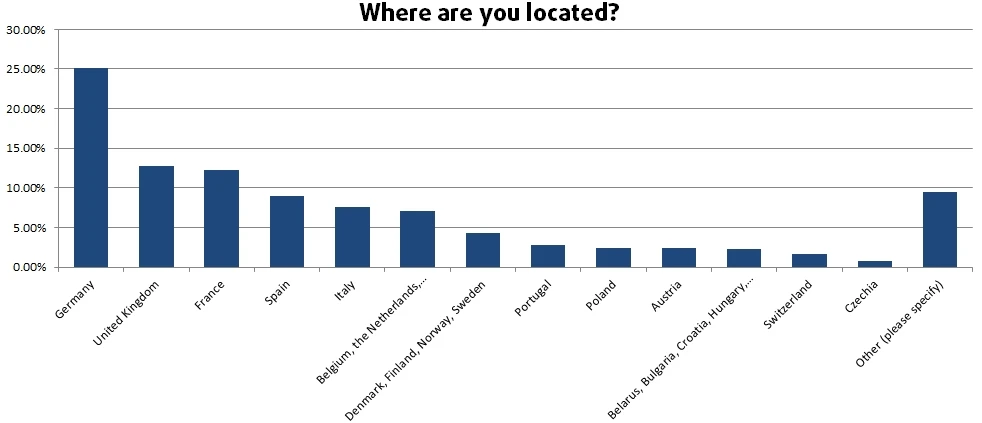
However, these questions do serve a theoretical purpose. One can cross-reference these answers with other answers and glean potentially useful information this way. For example, among respondents based in France, the new game that scored best, on both awareness and interest, was the Altered TCG. So if we somehow decided that we wanted to grow Cardmarket specifically in France, we might be more inclined to add this game. But I literally just picked this example because it was so easy to anticipate and to confirm. There are no such plans.
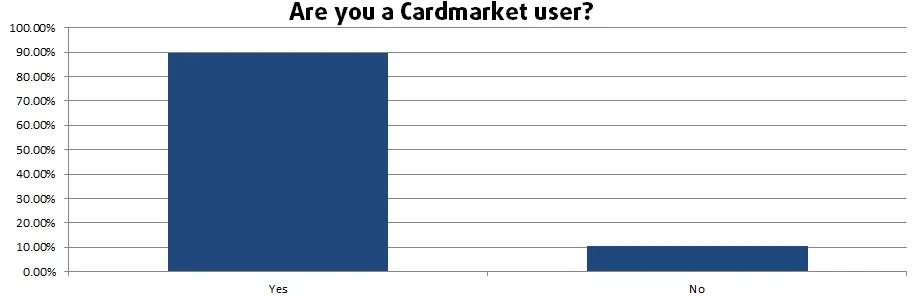
Another question from the early part of the survey illustrates this point even better. I don't know which, if any, is more likely and/or more worthwhile: that a Cardmarket user expands their use to another of their games when we add it or that a gamer first joins Cardmarket when we add their game? This could influence the relative importance one assigns to the answers given by the 10.5% of respondents who aren't on Cardmarket yet, one way or the other, or not at all.
Likewise it is interesting to note how many respondents are currently playing more than one of the games that are on Cardmarket. The percentages in the following chart, excluding those for "None of the above," add up to 172.4%. And this doesn't even account for people who'd have multiple entries in the "Other" category here, which comprises Cardfight!! Vanguard, Weiß Schwarz, Battle Spirits Saga, Final Fantasy TCG, and Force of Will.
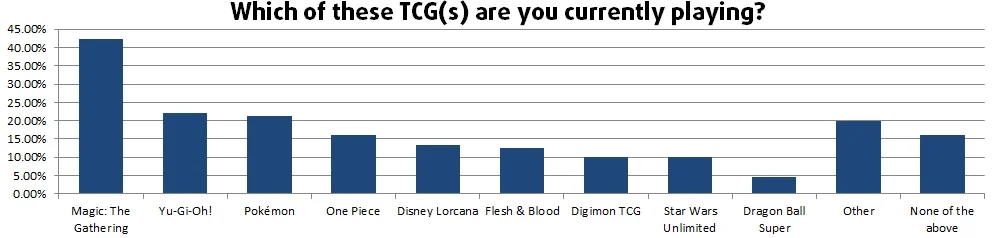
Look at the entries per respondent, combine that with the previous question, and you may find a subset of people who are most likely to use Cardmarket for another game. Or do any number of cross-references, maybe even draw comparisons to data on real user behavior, and there's no telling what useful information might come out of it. The possible permutations aren't technically endless, but they are legion.
My point here is, again, that Cardmarket has much to analyze and to consider, which goes far beyond the scope of this article. To my colleagues whose full-time job is to analyze data, I must say: I'm happy for you, or sorry that happened, but I ain't reading all that.
This means, at this point, you don't get to read any more mad data scientist ramblings anymore either. Without advanced multidimensional data visualization technology, I can't illustrate most of it anyway. Plus, full disclosure: We do have to keep some information to ourselves. Most importantly, however, I expect you have come here mainly to find out which new games scored highest on our survey, so let's move on to the main course.
Survey Results, Part 2: The Meat
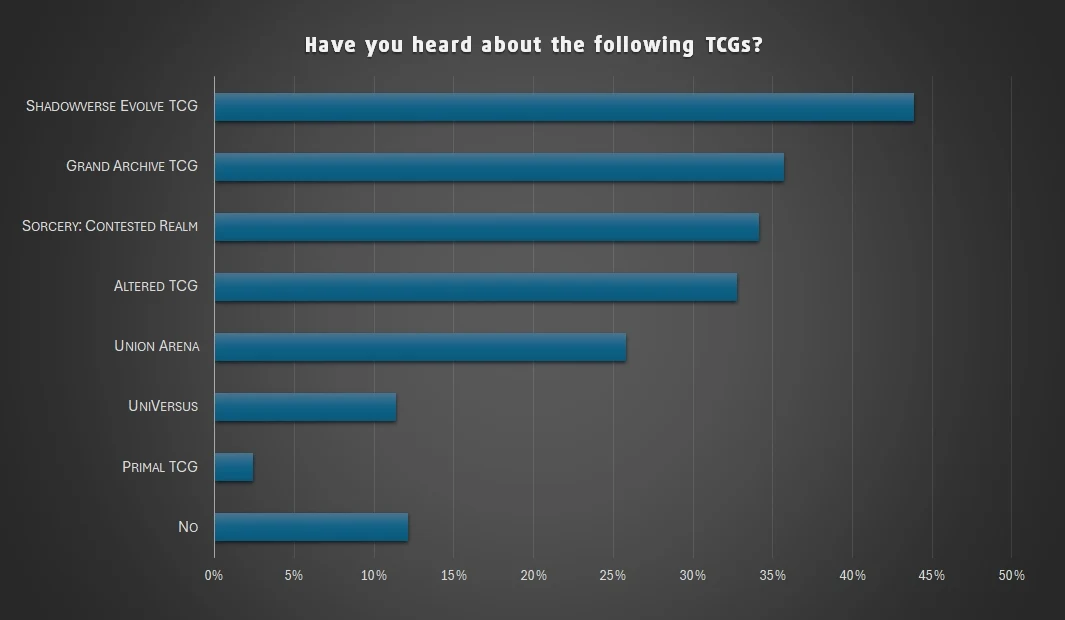
When I saw these aggregate numbers, I immediately had questions. First of all, I was curious to learn how many survey participants had to select multiple games for these percentages to add up to 198.2%.
Among respondents who answered positive for any of these games, 45.6% had heard of one, 24.4% had heard of two, 14.4% had heard of three, 8.4% had heard of four, and 7.2% had heard of five or more. Among those who selected exactly one game here, Sorcery: Contested Realm narrowly surpassed Shadowverse Evolve with 30.0% over 29.4%, and Altered TCG pulled ahead of Grand Archive with 14.0% over 12.6%. Only two respondents in total listed Primal TCG as the only game of the seven they had heard about.
I can't say whether or not this added context is in any way likely to impact Cardmarket's final assessment. But those are additional data points to consider, and there are plenty more whence they came.
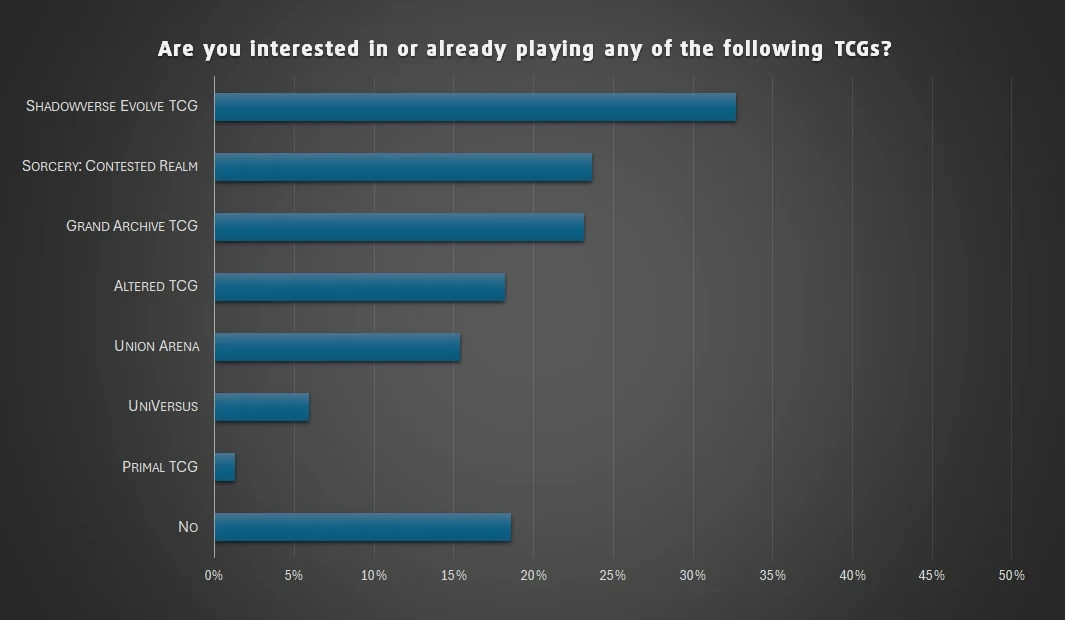
One of course expects to see the percentage for every single game go down from the previous chart to this one. Of course only some of those who have heard about a TCG actually play or have an interest in it. In fact, one would expect to see a sharper dropoff—if one interviewed a truly random population sample, that is. For example, a whopping 74.5% of respondents who selected Shadowverse on the previous question also selected Shadowverse here. The corresponding percentage for Sorcery: Contested Realm was 69.3%, whereas Grand Archive's only came to 64.9%. That's why the latter two traded places in the ranking. Altered's was 55.6% and Union Arena's 59.5%.
So about three quarters of our survey participants who have heard of Shadowverse Evolve are interested in or already playing Shadowverse Evolve too. We indeed see a correlation above 50% between awareness and interest on every game. This probably suggests that our survey attracted disproportionately many active players who wanted to vote their game(s) onto Cardmarket, which by itself is neither good nor bad, nor a surprise, honestly. After all, they have the most vested interest, and invested players make for reliable constituents. But it is yet another factor to consider, especially relative to the absolute numbers that hide behind these percentages.
Survey Results, Part 3: The Write-In Winners
If someone makes it all the way to the very end of a survey and takes the time to type in an answer all by themselves, their voice deserves special attention. So I'm happy to report I have good news for all the people who used this opportunity to tell us we should finally add Flesh and Blood, the Final Fantasy TCG, Battle Spirits Saga, or Force of Will to Cardmarket.
Unfortunately, I have bad news too. Almost 70% of the participants who had responded to the previous prompts skipped the question, "Are there any other TCGs of interest to you or that you are currently playing?" entirely. Among the rest, the most common response was no/nope/none. The second most common response was to reiterate and stress how big of an interest there is in one of the seven games listed in the charts above.
All of this left little room for people to bring up additional games, and they didn't agree on many either. 3.0% of everyone who had responded to the previous prompts mentioned the Rise TCG here, 2.4% Wixoss, 1.4% Vampire: The Eternal Struggle, 0.8% Duel Masters and Warlord, 0.6% Neverrift and Naruto Kayou, and 0.5% Alpha Clash. Every other game was listed fewer times than that.
Thanks for Your Help—and Your Understanding
I hope this article has given you a better idea of how many factors affect the decision to add a new game to Cardmarket. Maybe you can understand why we do not have a decision to share with you at this time. We will of course inform you once we do. Thank you.