First of All: Intended?
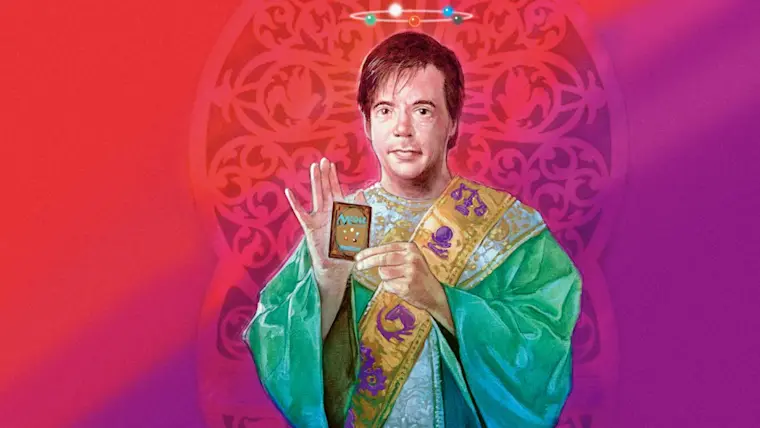
Language is a magical thing, not just for its ability to communicate ideas clearly but as much for its proficiency at ambiguity. The phrase "Magic as Garfield intended" is a beautiful example. It entered the online discourse a while ago, often used in irony to refer to various aberrations. But it also allows us to make 100% true statements that are nevertheless totally misleading. ("It doesn't stop being magic just because you know how it's done.")
To wit: When he first created Magic, Richard Garfield never intended for it to become a worldwide phenomenon, with cards published in eighteen languages, even multiple dead and two fictional. He never intended for it to be his biggest contribution to civilization, providing countless people with their favorite pastime and so many with a job. He never intended for tournaments to be attended by thousands looking for glory and prize money and a qualification to further events with more glory and more prize money on the line. He never intended for anyone to spend as much time as a chess master to master Magic, to write millions of words on Magic strategy, to publish treatises on calculating mana bases, to prove Magic is Turing complete, or to devise a Magic combo that can find the new largest prime number known to humanity.
What he intended to create was a game cheap enough for his publisher to produce, primarily because the then fledgling startup couldn't afford his RoboRally boardgame yet. Funny how these things play out.
So what Garfield had in mind for Magic and what Magic had in store for the world differed. But the delta between intended outcome and actual outcome doesn't tell us Garfield didn't appreciate all of the above. I picked a few examples that I thought a mathematician and game designer might be fond of. If anything, it may tell us he wasn't as big of a dreamer as he was a problem solver. ("Restrictions breed creativity.") So yes, it is sleight of hand to play loose with the term "intended" like this. However, it's no slight to point out that the initial vision for the game impacted its initial design.
Magic Story/Flavor (as Garfield Intended)
The initial idea was that players would use the cards to tell their own story. That's why the cards were so heavy on basic fantasy tropes that should be familiar to everyone. It's why much of early flavor text was lifted straight from literature, quoting well-known writers like
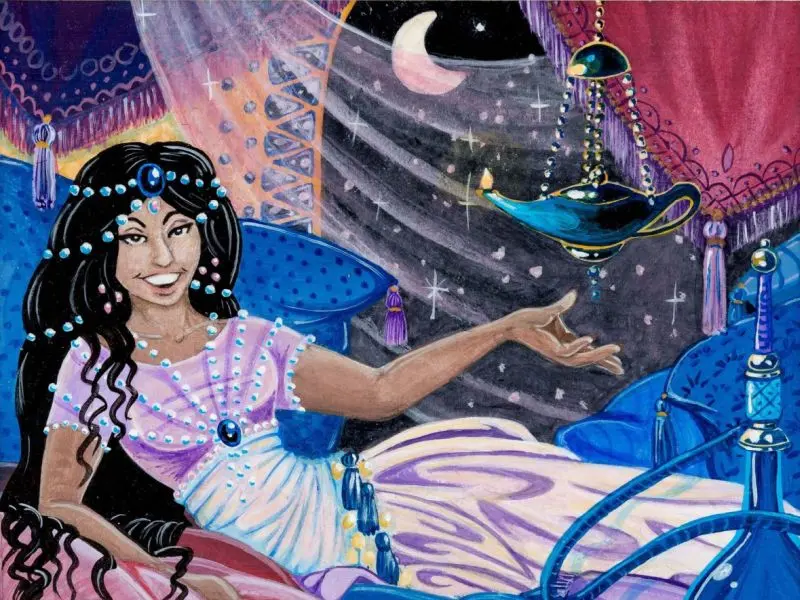
The medium of trading cards, which fall into the hands of people in a random order, doesn't lend itself to linear storytelling anyway. Early releases like Antiquities, The Dark, Ice Age, and Fallen Empires instead engaged in nonlinear worldbuilding. Like an archaeologist piecing together a history from fragments of folklore, texts, and artifacts, the cards told of halcyon days long past, of an ancient civilization, far advanced in magical technology, crumbled in an all-out war whose fallout altered both the physical and the political climate for centuries, forced practicioners of magic into hiding during the dark ages, toppled empires, and left survivors to struggle with the aftermath. It was peak flavor, but it was not a coherent narrative one was supposed to follow on a set timeline. Little of it was set in any kind of present.
If you enjoy Magic for its flavor, so far every shift in direction here has had its downsides and its upsides. This was true when we first boarded the Weatherlight. It was true when planeswalkers lost most of their power, some lost their spark, and some their life. It was true when we got a new cast of planeswalkers whom we could cast ourselves. And it was true when they formed their little league of justice to fight evil. Recall the peak story moment when Liliana Vess decided to defy Nicol Bolas. In the end, it did matter.
Now half of all sets going forward will cover an outside work of fiction such as Final Fantasy or Spider-Man. If you enjoy Magic for its flavor, this shift has its downsides and its downsides as well. However, while
You may hate this new direction, but in many ways it's rather an old direction. In any case you may find solace in the fact that 50% of Magic in 2025 still leaves three sets (an estimated 800+ cards) to advance the game's own storyline. For perspective, telling Magic's story in 2010 (including minor plot points like, oh, the awakening of the Eldrazi and Phyrexians starting their takeover on Mirrodin) took all of three sets (a total of 642 cards).
Magic Card Power (as Garfield Intended)
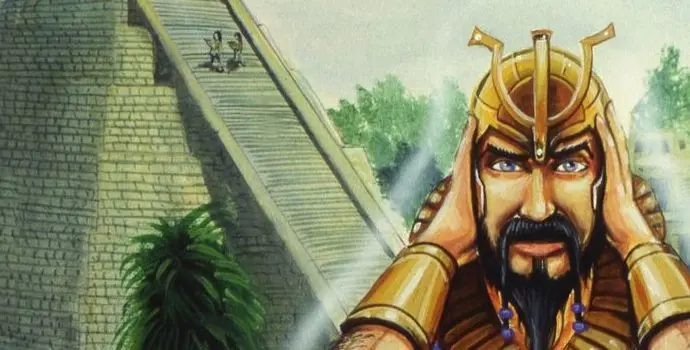
I sometimes still hear that cards like
In fact, another central feature of Magic has always been that it challenges its players to break the rules. It literally says so in the earliest rulebook ever printed. The very first sentence under the "About the Rules" heading there reads: "If a card contradicts the rules, the card takes precedence." This rulebook claims that players alternate taking turns, can only play one land per turn, and untap all of them every turn, but
One thing that was not a central feature of Magic in the beginning, however, is the four-of card limit. A deck running more than four
| Turn One Deck-Kill Deck, 1993 |
|---|
|
(The first rulebook mentions a minimum deck size of 40; no sideboard; no mulligans either, but the first commonly established mulligan convention allowed you to redraw your opening hand if it contained all lands or no lands.)
One could argue the earliest developers were concerned too little with capping the power ceiling whereas the most recent developers are concerned too little with capping the power ceiling. For example, last year I participated in my ninth Pro Tour Top 8. (Who is counting and has two thumbs?) Like the previous time, my task at Pro Tour Modern Horizons 3 was to record exactly what cards one player had in their hand at any given moment. This time, however, Modern Horizons 3 meant
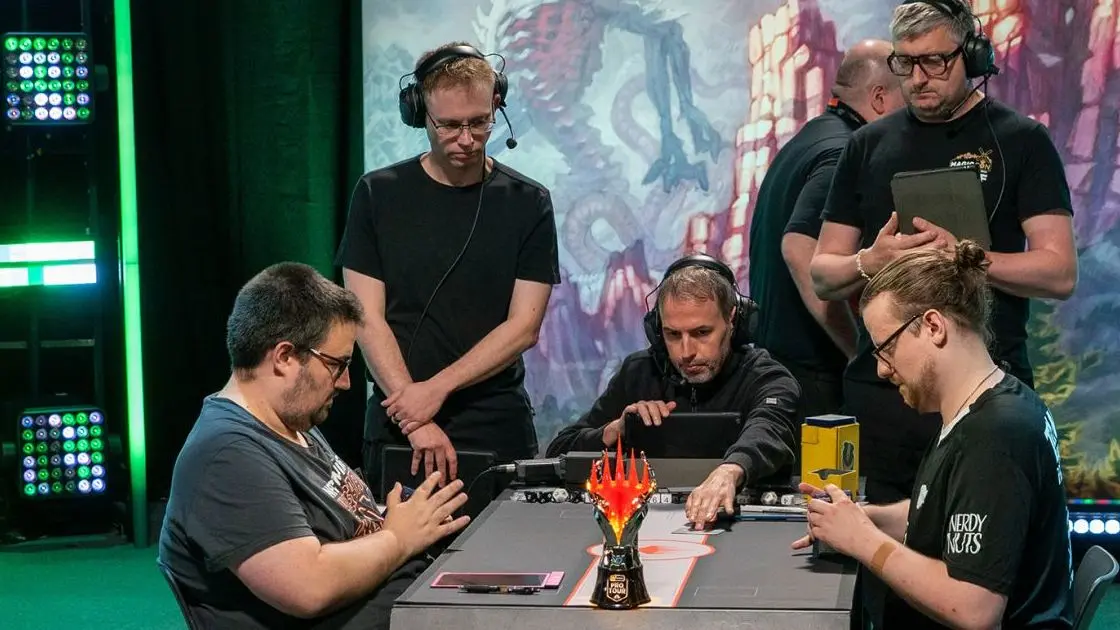
This stupid/wise Bird enabled players to move all nonland cards in their library to their hand (and all lands to the battlefield) as early as turn three, which certainly made things interesting for me. Now I can't complain. It was a fun challenge to keep up with the stream of cards. Nadu also reveals each card one at a time before putting it into the player's hand, so noting them down wasn't that hard. And it wasn't like everyone at the top tables ran Nadu. (Except from the semifinals on, when all four players did.) Sometimes I also stood next to Javier Dominguez and watched as he drew four cards with
But covering Nadu is not something I'd like to do every weekend. It seems that all of these decades later the designers still haven't quite got the hang of balancing one-shot and repeatable effects. More accurately, they rely on their power to add more power to make the most exciting cards, just as Garfield and his developers did. Indeed, it lately looks like the ones in charge are willing to take greater risks again. The F.I.R.E. design strategy ("fun, inviting, replayable, exciting") keeps burning (players, collectors, trees) for its implicit mission (good numbers for the business quarter) but a mere quarter of its stated mission. (Cards requiring a ban are dubious fun, hardly inviting, and most glaringly, by definition, not replayable.)


So thanks for keeping Magic exciting! I do mean that. But personally, I'd prefer to live in times that are maybe, if that's possible, a little less exciting, for a change. Pretty please, hugs and kisses?
Magic Competition (as Garfield Intended)
The original vision for Magic players to compete against one another didn't involve regular tournaments. It didn't involve external prizes. People were supposed to play each other for fun. And for the ante.
Ante meant: At the beginning of every game or match, as agreed between them, both players would set aside one random card from their deck, and at the end the winner would take ownership of the loser's card as a prize. It was a beautiful concept in theory, so flavorful. Imagine a dungeon-crawler type of game, where you face opponents of varying power levels, and if you defeat them, they drop loot that's added to your inventory. Some are harder to overcome, but they leave you with items that are on average more useful when you do. If you really can't beat one, you may have to try easier opponents and "level up" first.
In this way ante introduced some balance too. Players whose decks were more powerful were more likely to win, but they risked more powerful cards. A few cards also allowed to modify the ante. For example
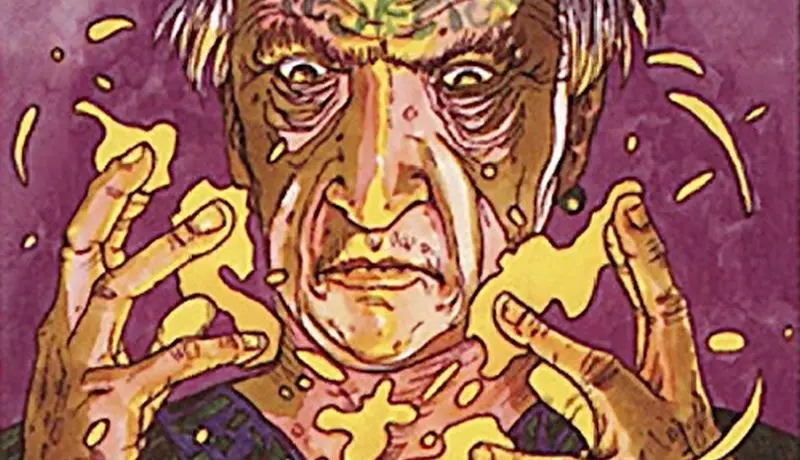
Like other flavorful concepts, ante ran afoul of people's interest in owning (and keeping) Magic cards, which had been severely underestimated ahead of Magic's release. (More on that below.) Ante technically remained part of the game until October 1995. But at that point its main contribution was to give trivia buffs the answer to the cute question which Homelands card is the only one ever to be hit with a ban.
Indeed, the first official tournament rules had already outlawed all ante shenanigans in January 1994. So tournaments existed. They offered prizes outside of people's decks. And they didn't mesh well with ante. They also didn't work well with the out-of-bounds power of Magic's first set and first set of rules. Instead, these new rules limited most cards to four copies and restricted all the mana-producing zero-cost artifacts to one copy, along with
Tournaments and their rules grew in number, scope, and quality. In 1994 Magic crowned its first world champion. In 1995 Magic introduced different formats, held its first national championships, and crowned the first team world champions. In 1996 we got the Pro Tour, followed by Pro Tour Qualifiers, and Magic crowned its first Player of the Year. The Grand Prix circuit started in 1997 and the Masters series in 2000. The APAC championship first took place in 1997, followed by the European championship in 1998 and the LATAM championship in 2000. Beginning in 2005 players were inducted into the Pro Tour Hall of Fame, and people got to compete for levels in the Pro Players Club, which may have marked the first time actual pro players could say "pro" without air quotes.

Throughout all this, tournaments, policies, and qualification paths were continuously refined and restructured. Formats were added, abandoned, and rebalanced. Opportunities to compete increased well into the 2010s. What had started with nine Grand Prix events in 1997, for example, peaked at 59 GPs in 2018. Opportunities to follow online what competitive Magic happened offline increased even more. We had tournament live streams of players competing with each other in person almost every weekend, sometimes all around the clock, sometimes even different streams of different players competing with each other competing with each other. We had a full archive of official event coverage.
Alas, all good things must come to an end. (Most likely because of the heat death of the universe or human hubris, depending on project scope and time frame.) The reigning European champion still remains Nicolai Herzog, who earned his title in 2003. Autumn Burchett has been England's last national champion since September 2018. In December 2018 Jean-Emmanuel Depraz, Arnaud Hocquemiller, and Timothée Jammot became the last team world champions to date. The Pro Players Club was disemboweled over time starting in 2016 and discontinued in 2019, the same year Reid Duke was the last inductee into the Hall of Fame. The final Grand Prix season was cut short by the pandemic in 2020, and all attempts at a revival since then have been lacking in luster and support, not just for promotion and prizes but also for the judge program.
Richard Garfield envisioned a world where people mostly played Magic in private, among friends, without external motivators like fame and fortune. There's nothing wrong with doing that either, mind. As far as we know, it's how most Magic is and has always been played. But we also know that the Magic of kitchen tables and living room tables and the Magic of high-stakes tournament tables can coexist. We saw them coexist, and taking the official coverage archive offline does not actually change anything, no matter what the memory hole at the ministry may say about who controls the past.

Three years ago I wrote a warning against the dangers of letting Magic retreat from shared public spaces into secluded private ones. It all boils down to the question why anyone should want to spend several ten thousand times as much to own a proper
It's a genuine question, too, because the honest answer is: We don't know. We know that casual and competitive Magic can coexist and flourish because we saw them do it. What we don't know is if Magic at home will continue to flourish if Magic at tournaments continues to falter. We've never been there, it's too complex of a system to simulate, and it isn't an experiment one can rerun with different inputs. There is no control group.

You know what isn't, objectively, the worst part? One could argue that Garfield wasn't "greedy" enough in his dreams to imagine Magic growing so far beyond private gaming whereas it's "corporate greed" that is now making it move back home. After all, Magic rakes in several times as much money as it did ten and twenty years ago. But this isn't the worst part, at least not objectively. There's a kind of "wrong" that's hard to pin down and up for debate, but there's another kind of "wrongdoing" that is just objectively wrong, which is when your actions conflict with your own objective. (Funny how these words line up, huh?) We call that "a mistake."
The worst part is how short-term business interests (make as much money as possible in a given period) can doom overall business interests (make as much money as possible, period) here. A lack of investment may hurt the investors it is supposed to benefit. The discard pile of history is littered with examples, while most success stories remain studies in survivorship bias.
It is possible that management ran a risk factor analysis and luckily nailed what support is necessary to keep the Magic ecosystem in balance, and we're just here to witness the fallout. It is possible market research correctly identified that an aging player base is less interested in in-person competition. It is granted that I'm myself a dinosaur who rarely flies anymore. (At peak performance I took more than 50 flights in a year to cover big Magic events and would regularly run into colleagues and Pro Tour champions at airports, joking that we saw each other more often than our own mothers. Which was funny because it was true.) It is possible analysts have accurately determined an inescapable expiration date for Magic. It is possible a cabal of CEOs has seen the looming ecological collapse of the planet and decided it's time to slaughter all available cash cows in the hopes of securing a golden ticket to a space ship that some thinly veiled Peter Isherwell caricature got built in real life.
Any of the above are possible. However, it's also possible that someone makes a well-rationalized decision to cut funding but ends up making a mistake. I can understand greed, but I'd hate to see Magic shrink and shrivel because of an avoidable misplay. I'm such a positive person too that I believe the latter to be more likely. ("Never ascribe to malice that which is adequately explained by incompetence.")
Magic Card Rarity (as Garfield Intended)
You know what did not rely on one piece of cardboard to be considered ten thousand times as valuable as another? The game Garfield intended to create.
The expectation was that Magic players would not buy more than a couple of starters and a handful of booster packs from a set. And then they would trade, primarily within their peer group, to make some improvements to their collection. They'd trade cards for cards, mind you, not trade cards for money. It's a trading card game, after all, not a collectible card game or credit card game.

This is how the developers expected to get away with
Indeed, every rare card like Black Lotus appeared on average no more than once per 117 booster packs (twice per 117 starter packs). The number may seem droll today, but it worked to keep the power level in check, essentially by accident, because supply also could not keep up with demand back then. You couldn't just go to a store and buy as many packs as you wanted because they sold out everywhere immediately. According to Magic's Official Encyclopedia all sets that contained a proper Black Lotus accounted for only 44.9 million cards in total and rares only accounted for two out of 60 cards in starters and one out of fifteen cards in boosters. This suggests that only 15,000–20,000 copies of each such rare card ever made it into circulation.


They eventually solved the problem of overpowered cards more summarily with rules that limited which cards and how many players could use. To their credit, once they realized that people's eagerness to buy cards unraveled their original plan of keeping power in check via rarity, they also used the first opportunity, the very first revision of Magic's card pool, to stop printing more copies of Black Lotus and its friends. They failed to adjust some channels in their rebalancing, like
The parallel to the present, meanwhile, should be obvious. A card that shows up once every 117 packs was initially imagined as a phenomenally, almost mythically rare thing. However, when Magic introduced mythic rares fifteen years later, each one showed up once per 121 packs. At one point each mythic started to appear roughly once every 140 packs (not counting foils). Only this time, rather than being so rare that no one is supposed to own many, people who want to play a certain deck or win tournaments are expected to acquire four copies of mythics all the time, plural, often of several. It's the rarity Garfield intended, albeit with unintended consequences.
To be fair, with the increased chance to pull multiple from a booster now, mythics may have become somewhat less rare again. Alas, we can find more than a little poison mixed in with this medicine. What we cannot find is exact information, the next and final topic to cover.
Magic Card Knowledge (as Garfield Intended)
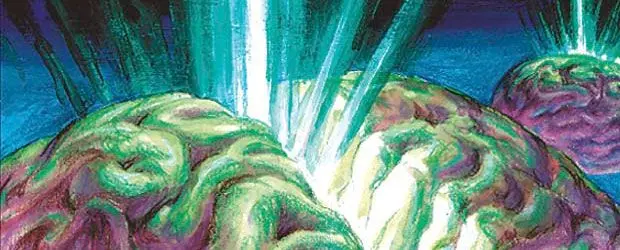
It wasn't merely that players weren't supposed to own hundreds of rares. They weren't even supposed to know what rare pieces of magic were out there or how rare any card was, including their own. Magic was supposed to be a game of discovery, where every pack you opened and every new deck you faced offered the opportunity to encounter a card you'd never seen or heard of before. It was another one of those flavorful ideas, like ante, that ran counter to people's urges to have as many cards (in their mind and in their possession) as possible.
That nature will find a way doesn't just apply to genetically modified dinosaurs. It also applies when you fight human nature. But here Magic did put up a fight. Unlike ante, which was abandoned quickly, Magic held on to its secrecy for years. It took forever before we got official card lists. I'm old enough to remember refreshing TheDojo while reports from prereleases came in and the community tried to piece together what cards were in the new set, often making mistakes early on and taking days to track down (and identify as such) the last missing rares. (Picture every card typed up in plain monospaced text, no pictures.) Up to 1998 cards themselves gave no indication whether they were common, uncommon, or rare or how many were in a set in total. The Gatherer, Magic's official searchable online card database, only launched in 2004.
Somehow we still knew all the cards. Nature found a way. We entertained ourselves on long car rides with a game called Twenty Questions, where one person would think of any card and the other(s) would have to guess it through a series of yes-or-no questions. ("Is the card exactly one color?" … "Is it a permanent?" … "Does it cost three mana or less?" … "Is it
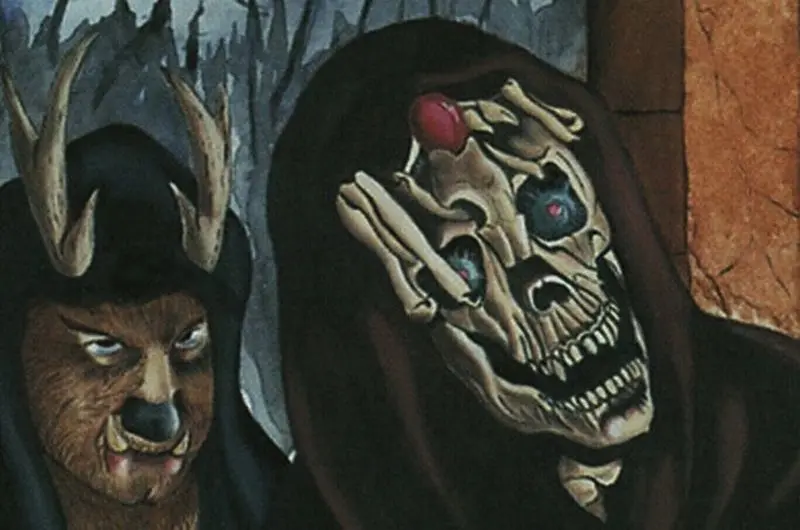
Eventually Magic got over itself, and we got close to perfect information. We even got to know the odds of pulling a card from a pack because we learned how print sheets worked. One of these sheets was eleven cards wide and eleven cards long and contained all of a set's 53 rares twice and all of its fifteen mythics once. I once knew the numbers before mythics existed as well, but this brain has long ago overwritten the old data with the newer data. The latter didn't get overwritten with another update because since then "Project Booster Fun" has added too many tiny variables, changed them too often, and never graced the community with exact information to begin with. Magic picked up the fight for secrecy again.
It may very well be more fun, too, not knowing what to expect when you crack a pack, the same way a gambler who doesn't know the odds probably has more fun at the roulette table. It's not necessarily a comforting thought, but it isn't objectively wrong either.
Nowadays I can sit down at a random Commander table and will likely encounter a card I have never seen or heard of before. I can find an unexpected gem (off The List, some Special Guest, or similar) in a booster. I can look at its black/silver/gold/orange set symbol, and will nevertheless have no clue how rare this card is compared to other cards from the same pack whose set symbols bear the same color. I can look at a recent card's collector number and will see a whopping four digits, maybe followed by a letter, but no more total. I cannot find a bunch of regular Standard-legal cards in regular boosters and may never have some tournament-legal cards if I don't visit secretlair.wizards.com (or, I guess, thank you, cardmarket.com). No one can play Twenty Questions anymore, not because the mere passage of time has accumulated too many cards, not even because the rate of accumulation has increased, but because new cards fly by so fast now that no brain has the time to develop any emotional attachment to them.
And so, after all these years, they have finally succeeded at creating a world where a Magic player's knowledge of Magic matches what Garfield intended. Thanks, I hate it.
Opinions expressed in this article are those of the author. Cardmarket may not agree.