Some of you who watch my stream might know this already, but the whole endeavor around my master's thesis took and still takes a bit longer than I had planned. Fortunately for you this means I get to write this article about a point where my studies and my passion intertwine. Not only do you get an explanation about the thesis and what it is I'm trying to find out, but you can also actually participate in the study!
How to Help Me
Before you start reading this article's main part, I would appreciate your help on my thesis. This might not work for everyone reading this, as the following link takes you to a survey that takes around 45 minutes to complete. But if some of you were to help me out, that would be great!
You'll have to make an account to log in, but you won't be bothered with any kind of confirmation or other mail. Because it is hosted on a German website, you may find some documents written in German, for example the privacy notice, but the survey itself is fully in English.
Context
Before we hop into the topic of the thesis itself, I'd like to give you some context regarding the course of studies I'm attending. I'm currently pursuing a master's degree in what is called "Lehramt an Gymnasien," which roughly translates to highschool teacher, but I'm aware that school systems in different countries work quite differently. The subjects I would teach would be maths and philosophy, although philosophy courses in German schools often go by different names, which makes this a bit more confusing.
Over the course of my studies I have to attend a plethora of different courses. Maths and philosophy courses are fairly obvious, but I also have or had to take didactics classes for both subjects as well as classes on psychology and educational sciences.
How I Got to the Topic of My Thesis
I wrote my bachelor's thesis on mathematical didactics but wasn't very happy with the supervisors and their process. I figured it might make sense to write my master's thesis on a psychological topic instead. Note that I was able to choose my subject from the full range of the types of courses I had to take.
I had enjoyed one class about intelligence in particular, where the instructor seemed invested enough, so I thought I might as well ask him to be the supervisor for my master's thesis. He agreed, although I didn't quite have a topic in mind yet. Through multiple meetings we got to the idea that then became the topic of interest for my thesis.
What My Thesis Is About
Experts and novices in memory tasks regarding "Magic: The Gathering"—that's what the title roughly translates to.
There already exist similar studies concerning chess instead of Magic. Chase & Simon as well as De Groot and a few others have produced a bunch of material on this rather specific topic but also gone somewhat wider. The parallel studies in chess look at broadly speaking four different cases:
| chess game position/ expertise of the participant | random situation | regular situation |
|---|---|---|
| novice | ||
| expert |
What they tried to find out is how the grid above is supposed to be filled out. When it comes to memorizing game states that are typical for games of chess, experts perform better than novices. The interesting question, however, is: to what extend do they retain that edge over novices if the game states are not ones that occur in regular games of chess?
There are a bunch of different ways of constructing these random situations, starting with just cutting two regular situations in half and adding them back together to letting computers construct truly random situations. The gist of the results is that experts retain some lead, but depending on the type of random situation used for the study, the retained edge reaches from not even statistically significant to fairly reasonable.
Now my thesis is about literally the same thing, but in Magic. This means that I too have to find both experts and novices who try to memorize Magic board states and to reconstruct them. Then I'll try to find out whether my results are similar to the ones in chess or not and to find explanations for one or the other.
How It Is Structured
To reach that goal of finding out whether there is a difference or not between random and regular board states I set up an online survey that will hopefully give me a reasonable sample size. Actually, a friend of mine helped me program the whole mess that is the web application that incorporates this survey. Getting a questionnaire online would've been fairly easy, but it wasn't trivial to combine that with a bunch of memory tasks that include a matrix or grid in which to display the cards that people are supposed to memorize.
Below you can see the two example tasks that participants are shown to make sure they understand how the tasks work.
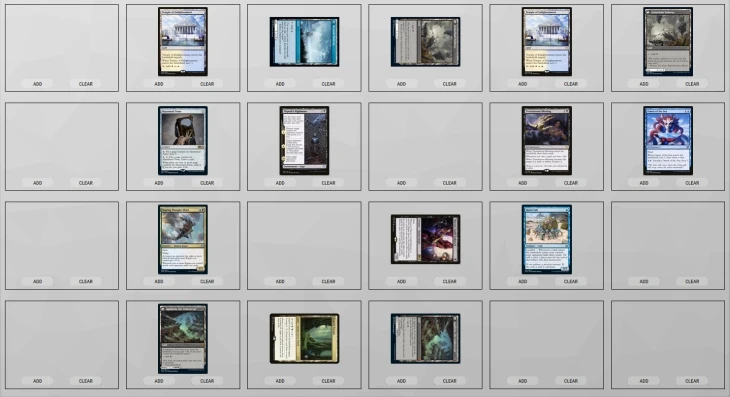
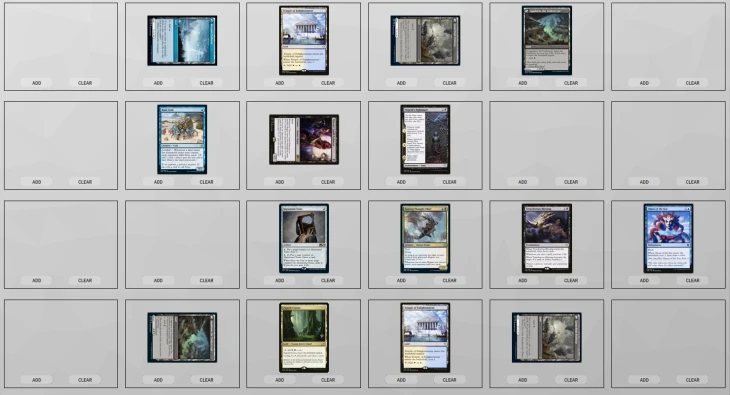
The survey also asks for some demographic data like age and gender, then some questions to help categorize participants as experts, novices, or something in between (more on this later). Afterward there are a bunch of those memory tasks.
The memory tasks' specifics I tried to extrapolate from the analogous experiments in chess. In addition I conducted some small pre-studies in which I tried to figure out how big I'm supposed to make the board states, because I need to get people to make mistakes but at the same time not to get everything wrong. If the board states were too easy or too difficult to memorize, my data set would likely lack enough variance, and I needed to circumvent that. I chose size, number of cards, and different cards, and so on based on these heuristics.
My job is to try to derive useful information from all the data that I will hopefully get. Comparing the answers on the questionnaire part and the performance in the memory tasks will ideally yield significant results.
One possible issue is that not all participants may sort neatly into one of the two main classes of experts and novices. I'll see whether there are some gradual differences and look for interesting categories in between. This means to check the data for correlating sets of information.
Finish Line
Depending on how well this article is received and how well my master's thesis goes, I might be back eventually to report my study's findings. Until then we'll be talking regular Magic content again soon. Thanks for the read and thanks for your help!
Opinions expressed in this article are those of the author and not necessarily Cardmarket.