
Explain it to Me Like I'm a Magic Player

The term "fungible token" originated in the field of economics. If something is fungible, its individual units are, in all relevant ways, equivalent to, indistinguishable from, and thus interchangeable with one another. The token example is money. A "non-fungible token" then is simply anything where the aforementioned is not true.
Imagine you lend a friend a
In today's usage, the term NFT is inextricably chained to the blockchain, so we got to look at that next. According to Wikipedia, "A blockchain is a growing list of records, called blocks, that are securely linked together using cryptography." One main appeal is that, "Blockchains are typically managed by a peer-to-peer network […], where nodes collectively adhere to a protocol to communicate and validate new blocks."
Imagine playing this memory game where each player, when it's their turn, needs to recall all items previously listed, in the order they were first listed, and then adds another item to the list. (In Germany this game goes by the name of "Ich packe meinen Koffer und nehme mit …" while at least some parts of the English-speaking world seem to know it as "Mother went shopping and bought …") Let's say one player starts with
The analogy isn't perfect, because none ever are, but it can serve as a simple, real-world example of a "publicly distributed ledger." It's in the collective self-interest of the peers here to reject illegitimate additions, and to eject bad players, and everyone can check their own memory to verify legitimacy. The game also demonstrates another central feature of decentralized record keeping. Storing a copy of the data in five people's heads instead of writing it down on one piece of paper is horribly inefficient, but the inefficiency is essential to the game.
It's also prone to errors, which is where the analogy admittedly breaks down. On a larger scale you instead see a tradeoff. Storing data across a vast computer network is far more secure than using a central database which could become compromised. But it is still quite inefficient, and it is so by design. The more redundancy you build into a system, the more secure it becomes. The inefficiency remains essential to the game.
Taking the Fun out of Fungible

Connecting the economist's idea of a non-fungible token and the technology of blockchain, we finally arrive at the modern definition of an NFT. Take it away, Wikipedia:
"A non-fungible token (NFT) is a financial security consisting of digital data stored in a blockchain, a form of distributed ledger. The ownership of an NFT is recorded in the blockchain, and can be transferred by the owner, allowing NFTs to be sold and traded. […] NFTs typically contain references to digital files such as photos, videos, and audio. Because NFTs are uniquely identifiable, they differ from cryptocurrencies, which are fungible. The market value of an NFT is associated with the digital file it references."
Note how much of it is arbitrary. The union of this economic concept and this specific technology is not a predestined romance but an arranged marriage. As we've seen, you can have a non-fungible token in the classical sense without involving the blockchain, or even the internet, or any computer at all, and you can use the blockchain to record any kind of data, not just transactions. Likewise wholly arbitrary, as well as arguably more astonishing, is the tie between a digital file and a unique certificate. One is by nature infinitely reproducable, the other tries to turn it into a rare commodity regardless.
The modern NFT is a Frankenstein's monster assembled from ill-fitting pieces, willed into existence at the stubborn insistence of its master. Granted, one can say the same for a whole lot of human designs, a lot abstract and arbitrary, some quite valuable. But many who aspire to mastery end up serfs.
Parallel Lines (Going Up)

So an NFT is rare without reason, limited not by dearth but by decree. More accurately it is rare for the sole and express purpose of creating a collectible for commerce.
Well, well, well, he says as he steeples his fingers, now doesn't that sound, somehow, eerily, familiar?
Well, it should. Because it's the business model of trading card games, including Magic, in a nutshell. Here as there, artificial scarcity is essential to the game. Wizards could print

Same with efficiency. In either case, the road to hell (on earth) is covered in large carbon footprints. Blockchain technology consumes more energy to process data than alternative, centralized solutions. In proof-of-work designs, such as bitcoin, inefficiency is not just no bug but the main security feature. These systems require computational effort for the primary sake of imposing costs. This doesn't stop attacks. It doesn't determine who is an attacker and who is a regular user. It just leaves thieves with an electricity bill more expensive than what they can hope to steal. It's not brilliant but sadly impractical; it's brilliant because it's impractical. You can clean up the energy balance, but then you throw out the incorruptible toddler you appointed chief of security along with the dirty bathwater.
Wastefulness is also essential to the game of Magic, where it is tied up with artificial scarcity. Estimates vary, but for every
The parallels, as you frankly would expect from their definition in Euclidean geometry, don't stop. NFTs and crypto assets in general catch a lot of bad press for accruing value exclusively through a chain of "greater fools." If you buy in with the goal of making a profit, you have to hope that someone else will buy in later at higher price. Once again, you could say the same for investing in Magic cards.
Another common, and related, critique leveled at crypto trading is that it starts out with a zero-sum proposition. For every euro anyone gets out, someone has to put one euro in. But it gets worse. Transaction fees and those energy bills eat up a chunk of that money, so for every euro put into the system, only cents come back out, meaning it's actually a negative-sum game. Well, if you sell cards on Europe's biggest marketplace, I am personally going to eat some of that money too. Not literally, maybe, but Cardmarket takes a small cut and uses it to pay its employees who use it to buy food. Thanks for that, and I'm sure the post office appreciates your business too.
Gamification
Of course, owning a Magic card provides utility beyond its resale value. You can use it to play Magic, whereas owning an NFT, by itself, doesn't do anything. It specifically does not confer copyright, or any kind of ownership, of the associated file.
But the token does not have to be an empty hull, devoid of all meaning. It is no coincidence that NFT proponents have in droves latched onto gaming as an avenue of filling them with value. Games assign relevance to simple, otherwise worthless objects all the time, namely to various game pieces.
By the same, haha, token, it's no coincidence that the CEO of Hasbro once wanted to embrace NFTs, saying, "We have our arms around this and see multiple opportunities on the NFT side."
One step further, it's no coincidence that gamers have largely remained skeptical, at times hostile. Gamers know a money-extraction scheme when they see it, especially one that's purposefully wasteful, based on artificial scarcity, and a negative-sum affair. The rejection may resound all the louder not because NFTs explore alien territory, but because they step on ground already covered and on toes shuffling around in self-aware embarrassment.
So it may be no coincidence either that Wizards didn't implement any NFT plans yet. So far the only opportunity they did seize was to send a cease-and-desist note when another party wanted to issue Magic NFTs. Said party argued fair use because NFTs don't involve copyright. Lawyers of the Coast disagreed.
While Magic has no modern NFTs of the digital variety at present, Wizards started experimenting with non-fungible cards in print last year. There appear to be 100 copies of a special
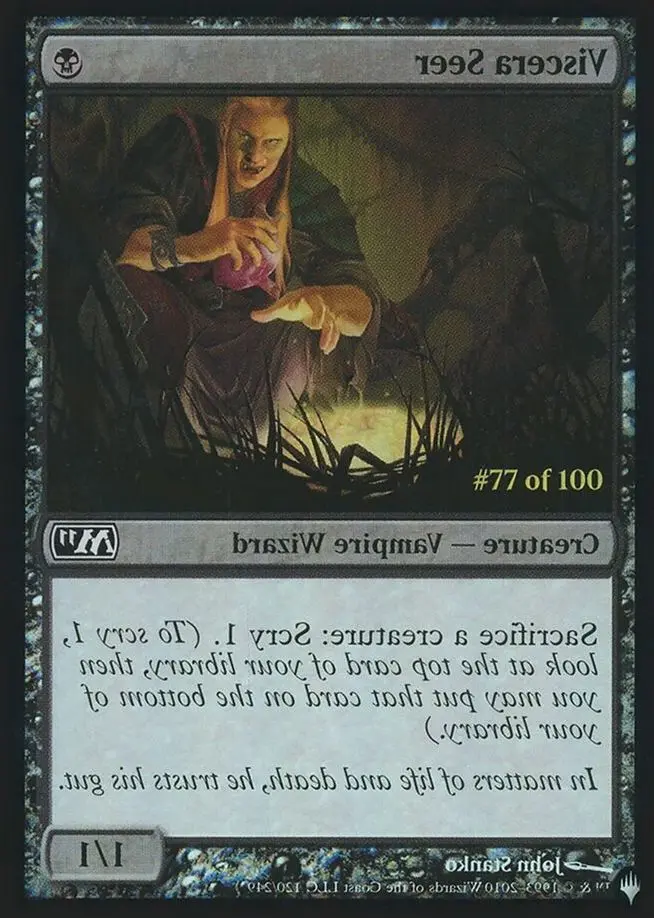
A person whose name may sound familiar to you,
Future Opportunities
But let's let go of the cynicism for a second. Let's engage the possible benefits for games, and gamers, in good faith. The crypto enthusiasts envision a future when players can mine some currency in one game, trade it for a rare item in another game, and use this item across several games. Encoding ownership of both the currency and the item on the blockchain has certain advantages over traditional alternatives, albeit with uncertain prospects.
A record that exists independently of any specific platform should be easier for various platforms to access. In this way it can facilitate sharing of assets across games. More generally and philosophically, if you "own" something that is tied to one specific account on one specific platform, possession ultimately lies with whoever controls the platform. Not least, a properly independent trading system ensures you will always be able to cash out, whereas proprietary systems exhibit a tendency to worry predominantly, or exclusively, about cashing in.
To be honest, a lot of this reads great. It also sounds exciting to have trading cards exist in this space. Cards with a limited number of copies in circulation can claim some of the middle ground between fungible currency and truly non-fungible singletons. Maybe the NFT people are onto something.
The problems reside partly in the nature of the technology, but mainly in human nature. People and, by extension, companies follow incentives. Corporations can, and sometimes do, join forces to reap positive-sum rewards. It is easy to imagine a scenario in which allowing players to share assets between multiple games grows the customer base of each. It is harder but possible to imagine such growth outweighing the costs. Because, although the argument is often presented as if, blockchain doesn't actually lift or ease the burden of reading and rendering a token in the fashion appropriate to a game. Finally and notably, it is tough to find examples of such endeavors in the wild.
More commonly, game companies engage in a zero-sum competition over limited resources: potential players' money and time. Interest in one's market share does not imply interest in sharing the market. And crypto enterprises are as guilty, if not more guilty, of playing zero-sum games. Many a project seems to exist primarily as a vehicle to get people to invest in the project's very own cryptocurrency. There are many black sheep whose white papers are mostly just that: white.
A cynic might argue that form follows function, and function follows form. Blockchains aren't good at handling transactions at scale, at speed, and this suits blockchain enterprises just fine. After all, history has shown a lot of them to rely on a majority of investors to believe they are "ngmi" unless they "hodl" with their "diamond hands," while a select few take the money and run. ("Not gonna make it" and "hold on for dear life" in case you don't know the lingo.)
In the end, people will be people, and technology will help them with that. So thanks for the opportunities. I hate them.
Opinions in this article are those of the author. Cardmarket isn't quite sure how to feel about any of this.