
Questions Concerning Companion
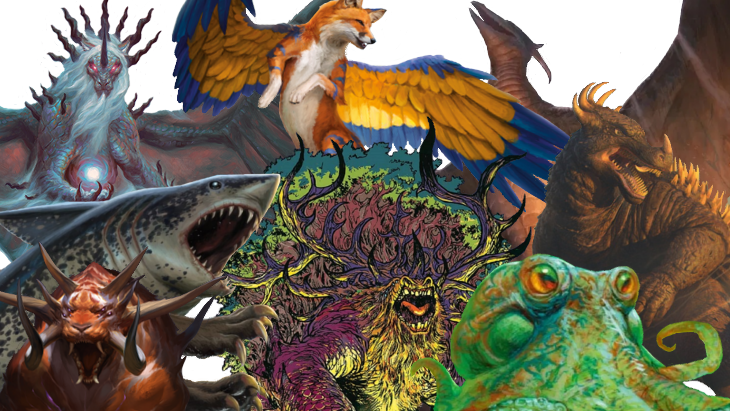
It bears repeating: if you have a companion, and you only can have one, you have to reveal it before the start of each game, thereby declaring your deck to match the stated restriction. No, even a player willing to cheat can't wait and choose to cast either their 2-drop or their
Also note that "starting deck" refers, clumsily, to the deck you present for each game. No, you can't board in
Companions are the first cards ever legal in Standard to reference "deck" at all, breaking a wall between in-game terminology where it's always "library" and the outside world. So yes, Wizards should have used even more tournament terminology here and just write "presented deck" instead. "Starting deck" needlessly confused many people, including the most notable of Magic experts such as, oh, our current World Champion.
Unrelated to Companion or Mutate
-
When you target an opposing
with , Narset remains on the battlefield until the Ultimatum has finished resolving. Only then do state-based actions put the loyalty 0 planeswalker into the grave. This means, you don't get to draw any cards. -
For
to generate extra mana, the permanent you tap for mana must have a mana ability featuring the tap symbol. Kinnan doesn't notice when taps an artifact and tapping for its own ability doesn't count either. -
's triggered ability allows you to select a creature from among the eight milled, regardless of whether the cards hit the graveyard or go to another public zone instead. While and stop this effect, and do not. When Rest is in play, Gyruda simply takes a creature from exile. In fact, when Rest is in play, Cage and Kunoros no longer work to prevent any of this and you could even mill, exile, and reanimate a you own. -
is a neat way for a deck accompanied by to spend more than two mana on a creature. But once Lurrus is in play and the X spell in your graveyard, the Cat Nightmare only allows you to recast a dead Serpent with X=2. Note the difference in wording and functionality to . Also note that Lurrus does allow you to cast from your graveyard for its spectacle cost.
Be aware that several of these interactions may not work correctly on digital platforms such as Magic Online.
Massive Mutant Merging
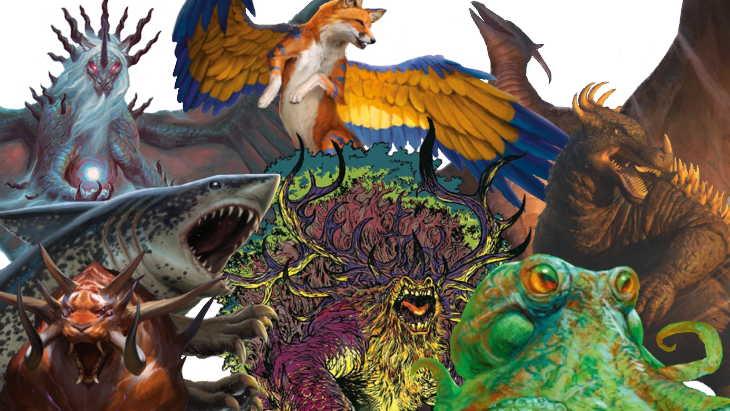
Casting
When you choose to cast a creature spell using mutate, some very interesting things happen. First, you need to select a target. The target has to be a non-Human creature and it has to be owned by the same player who also owns the mutating creature spell. The first limitation seems to be purely flavorful; Humans just don't mutate. The second, targeting a creature with the same owner, is important for how mutating cards behave on the battlefield, specifically for how they leave the battlefield. Note that the cards themselves remind you to pick a "non-Human creature you own," which isn't technically correct. If you cast your opponent's
Then, you're paying an alternative instead of the card's casting cost. Whenever you do so, you have to pick one of the alternatives available to you. This means,
So now you have a spell on the stack that is a creature spell and has a target. This is a first in Magic and creates a whole new spectrum of ways for players to interfere. Your spell is fair game for
But if your mutating spell resolves with its target still legal, then you have to "merge" the card with its target. How you merge is a decision you take upon resolution; you don't have to announce your intention or even make up your mind beforehand. It is also the topic of our next chapter.
Merging
You put the newly cast card either over or under its target. It doesn't matter if the target has merged with something else previously, as the exact position of a component in a three-way merger doesn't matter. The only thing relevant is which component is on top.
The top component gives the merged permanent all of its base characteristics: name, cost, color, card types including supertypes and subtypes, as well as power and toughness. It also determines whether the whole thing is considered a token or not. All the other pieces only add their abilities to the mix. Imagine copying the rules text from their text boxes. The one exception pertains to Commander. If a player's commander is part of a merged permanent, the whole thing is considered to be their commander.
The merged object is not a new object. Equipment, counters, and Auras remain in place, unless the new top card clashes with an Aura's enchant restriction. For example, a mutating
You may already know that when a creature's ability references its own name, it simply applies to itself. It doesn't matter whether you copy
Leaving
Merging allows a single object on the battlefield to consist of multiple cards, though it counts, acts, and moves as one. When it dies, all cards end up in its owner's graveyard. When an effect returns it to its owner's hand or puts it into its owner's library, all cards go there. This is why mutate restricts targeting to things owned by the same player.
As usual, when multiple cards go to the graveyard at the same time, the owner can determine in which order the cards lie. Now, the same is true for effects like that of
When a merged
If a merged
Abilities that trigger when an object moves from the battlefield to another public zone look back at the permanent as it existed in play. They have to, lest cards such as
Once again, the rules know one exception: if you use the Commander variant's built-in replacement effect to put your commander into the command zone instead of your graveyard/hand/library/exile, then any cards merged with it still go where the initial effect wanted them to go. They created this exception to avoid noncommanders moving to the command zone, where they'd be uselessly stuck forever. They didn't quite succeed, though, because
As we've seen, when a merged permanent leaves the battlefield, the cards don't necessarily lose all memory of having been connected. But they definitely lose all memory of how they were connected. If an effect puts such a permanent into exile and returns it to the battlefield, all permanent cards enter the battlefield as new and separate objects. The same applies to effects that return a dying creature from the graveyard: whether it's
When
Interacting
Except for the fact that it's a token if there's a token on top, a merged permanent is treated the same way as if it were one card. Imagine you had one card that had printed on it: all the text boxes from each component and all the rest taken from the top component. This is important for the interaction of continuous effects, all of which apply on top of the mutations regardless of what came first.
For example, when you
However, when you copy a permanent that has mutated, the copy hasn't mutated itself. The game tracks the number of times a permanent has mutated, relevant for cards like
Normally, when a permanent loses and gains abilities, the latest loss or gain will count. If your flier loses flying due to
Mutate always getting the first word in, never the last, isn't limited to outside interference. When you mutate
A
Unlike a basic Forest animated by Nissa,

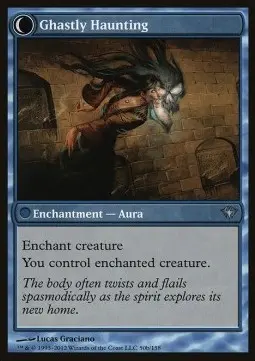
When Soul Seizer transforms while merged with another creature on top, nothing much happens, except that the permanent may lose flying. The rules forbid creatures from getting attached to creatures, and non-Auras don't have to worry about the state-based action that kills most permanents with "enchant creature" if they don't enchant a creature.
The vast majority of double-faced cards are Human on one side and non-Human on the other. Note though that any change in creature type, whether through transformation or
Mutate isn't the first time two cards combine to form a single object. Eldritch Moon already gave us meld. Thankfully, interaction between meld and mutate is minimal. You can put a mutating creature spell on top of or under


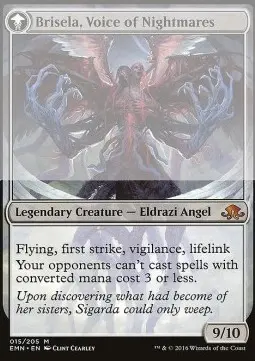
When it's time to meld, two permanents take a trip to exile, but only the melding cards have a return ticket. Other cards merged with them stay in exile. Mutating onto Brisela afterward should not require a judge. Maybe a
A face-down permanent is, by default, a colorless 2/2 creature without rules text. For a merged permanent, the top component determines whether it's face down or face up. You can only turn face-down permanents face up, and only if there's no
-
If you put a mutating creature spell under a face-down permanent, the merged permanent is still face down and, consequently, a colorless 2/2 creature without rules text. You can use
or to turn it face up, unless you merged with a instant or sorcery. Once face up, mutations apply to the merged permanent. -
If you put a mutating creature spell on top of a face-down permanent, the merged permanent is face up. It takes its abilities and characteristics from the newly cast card right away. The face-down component doesn't contribute anything and you can't turn it face up because the composite permanent already is face up.
However, it is also possible to turn a merged permanent face down, for example when it contains a face-up
Another interesting interaction concerns
When Sarkhan's effect ends, it becomes highly relevant whether you placed the creature or the planeswalker card on top. If the planeswalker card is on top, the permanent goes back to being a planeswalker. The planeswalker keeps the abilities gained in mutation. Many of the possibilities here, such as double or first strike, flying, menace, trample, vigilance, or "whenever this creature mutates," are useless until something turns the planeswalker back into a creature. Some others are useful. A Tamiyo merged with
If the creature card is on top, the permanent will remain a creature after Sarkhan's effect wears off. It has all the abilities from the creature card and all the abilities from the planeswalker card. It doesn't lose any of its loyalty counters when damaged and doesn't die when it loses its last loyalty counter. These rules only apply to a planeswalker, which the permanent is not. The creature can still activate loyalty abilities, one per turn, during its controller's main phase, while the stack is empty. This rule is not specific to planeswalkers.
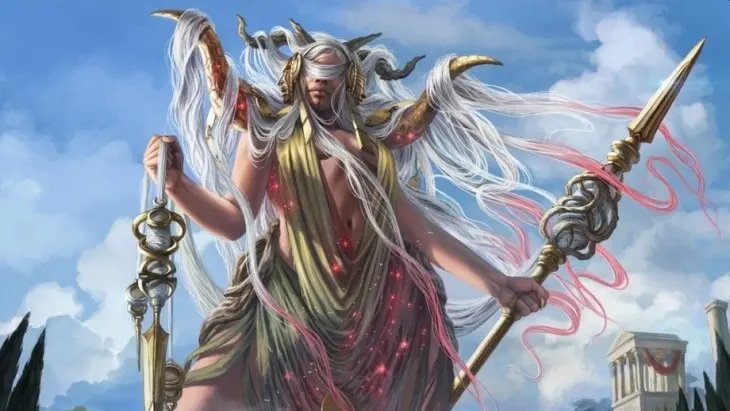
Our final destination for this article is
When we put Archipelagore on top, something most curious happens. At the base level, we now have a nonlegendary blue 7/7 Leviathan creature with a couple of triggered and two static abilities. However, at a higher level, one of the latter interferes. It makes the permanent not be a creature as long as our devotion to red and green is less than seven. As luck would have it, our devotion has just dropped from seven to five, because the permanent previously known as Klothys now goes by "Archipelagore" and has a mana cost without any red or green in it. So the permanent is not a creature. But it isn't an enchantment either, because a merged permanent takes its card type only from the top component. So what is it?
Well, once you eliminate the impossible, whatever remains, no matter how improbable, must be the truth: The permanent has no card type at all. It proceeds to sit on the battlefield until such a time our devotion to red and green reaches sufficient levels again. It's still indestructible, but a legal target for
Curtain Call
I wish to express my gratitude to Guy Baldwin, a very nonjudgmental judge who painstakingly proofread this article, patiently provided answers to all of my questions, and came up with questions I never thought of asking. He also endured frequent interjections of, "But what about
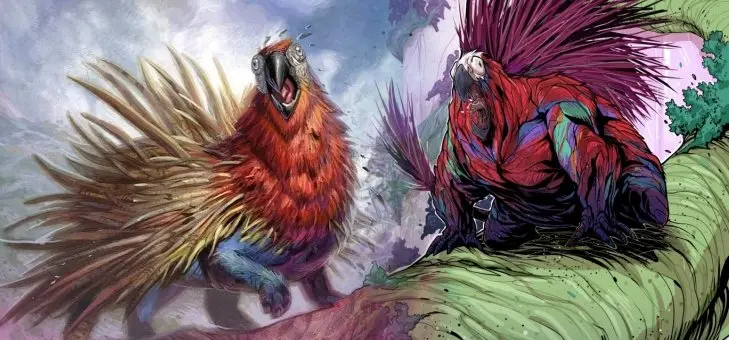
P.S.: If you were to replace Archipelagore in the Klothys scenario with Porcuparrot on top, the typeless permanent could also tap to deal 1 damage to any target.
Opinions expressed in this article are those of the author and not necessarily Cardmarket.