Modern has always been and continues to be a brewers' paradise. People's creativity is indomitable. This time is no different. Let's savor the moment and move quickly. Swoop in at high velocity, at least Mach 1. Then—lore and behold—we take all the turns, at least from now until the end of the game.
There is this popular notion of a deck-building paradox in Magic—the bigger the card pool, the fewer cards are playable. Why? Because the power level at the top increases so much that it leaves a huge chunk of legal cards effectively unplayable. In Legacy, even though 28 years worth of Magic cards are legal, most top decks come prebuilt using just the most efficient and deadly tools.
However, players are so eager to innovate that new decks still pop up regularly, especially in Modern. When you scour any 5-0 dump, you're likely to see at least one deck that you've never seen before. In this article, I want to talk about one such deck which has actually started making waves at the top tables in Challenges. A deck utilizing …
But first, let's do a little jump through time! Our story began in the year 2018 and took a few turns since then.
How We Took Turns
So-called "Taking Turns" has been a fringe mainstay in Modern for quite some time now. It was first popularized by Daniel Wong who became famous for quadruple-sleeving his deck almost as much as for taking extra turns. He racked up multiple strong Grand Prix finishes with the strategy.
| Sample Decklist from 2018 |
|---|
| Main Deck | Sideboard |
|---|
- 2
-
- 1
- 1
- 2
- 4
- 3
- 4
- 2
- 2
- 3
- 4
- 4
- 1
- 2
| - 2
-
- 3
- 1
- 2
- 6
- 1
- 1
- 1
- 1
- 3
- 2
- 1
- 1
| |
The fundamental goal of the deck is, predictably, to cast a lot of spells that grant an additional turn and to convert this into victory. These spells are , a miracle , and a similar-in-effect . Paired with additional card draw such as or to keep going, each additional turn generates more and more value. The kill condition is usually some beatdown or ultimate.
Fast forward to 2020. The deck started to incorporate and . Fires first allowed the deck to use , and Sanctuary almost guaranteed to hit Time Warp after Time Warp, especially in combination with . Other developments included , the ultimate allowing for sheer infinite recasting of Time Warp effects. Unfortunately Mystic Sanctuary ran afoul of the banhammer, and the concept lay dormant ever since. Until now.
How We Take Turns
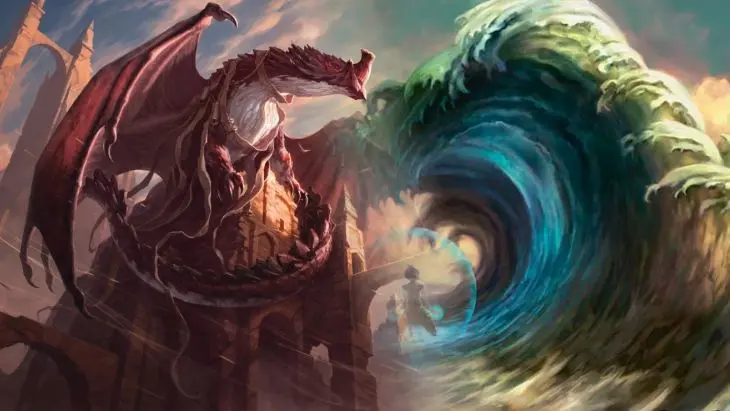
Strixhaven comes around and completely changes the archetype's architecture. Nobody is looking to prolong the game to hardcast anymore, or to double the cards drawn every turn via . Instead, let's take a look at . It's a powerful Dragon with a bunch of keywords and a wall of text. In short, upon attacking we can cast an instant or sorcery that costs up to five mana from among the top seven cards of our library. The problem? This Elder Dragon costs seven mana, so it won't see much play outside of EDH … or will it?
The Eldraine cycle of lands among which was clearly the best comes to the rescue again. This time it's . With our fourth land we get a 1/1 Dwarf. Still with me? Good.
The best way to abuse a free token is . It is far better than because it also works on a Treasure token from and because it can target two tokens as insurance against spot removal. With just two actual creatures in the deck, all of them Velomachus, Creativity destroying a Dwarf or Treasure means the Dragon is coming down. Ideally, this will all happen on turn four—fetch the Mine, cast Creativity, find Velomachus. The setup can potentially close the game on the spot.
When Velomachus attacks, we just need to find one of eight cards in the top seven of our library. Both and work here, because we don't even need to untap on our extra turn for our vigilant Dragon to attack again. This second trigger hopefully secures another turn, and so on. All of that is coupled with dealing damage in increments of 5 so four attacks is enough to finish off our opponent.
| Velomachus Turns by MrRaeb, 14th at Modern Challenge #12318579 |
|---|
| Main Deck | Sideboard |
|---|
| | |
Plan B
All the pieces mentioned above take up a mere half of the deck's spell slots, so what does the rest do? First, there are nine planeswalkers in the deck. All of them aid the combo: With it's easy to keep hitting lands, including the all-important fetch land on turn four for . protects the token with his passive ability, so that doesn't get dominated by a simple . puts Time Warps back into the library for Velomachus to find. But the planeswalkers do so much more.
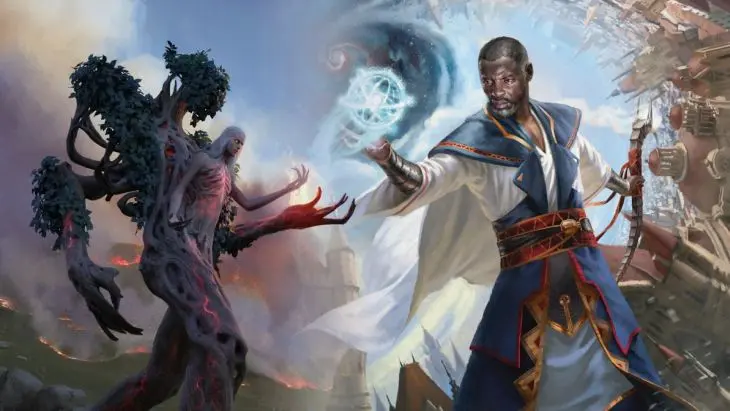
Thanks to them you can play a smooth control game. Wrenn on turn two punishes and . Teferi makes a killing in the control matchups and spells even more trouble for another pillar of the format: he does not allow cascaded spells to be cast, so good game, and . Jace serves as a totally fair win condition and card advantage engine in one.
The walker base is supported by a ton of removal. A playset of both and provide the early interaction that this creature-infested format requires. Bolt can also help close out the game in fewer than four swings—if the opponent at least shocked themselves, one Bolt cast from hand or by the Dragon's trigger can take the place of a third extra turn. Finally, has a ton of utility in the deck between killing artifacts, filtering through excess copies of walkers or combo parts, looking for combo parts, removing creatures from the battlefield, or creating a Treasure that can speed things up or be a target for Creativity.
Do you know what else supports planeswalkers, and does so in a major way? Taking extra turns! When walkers tick up, Wrenn in particular, the clock is ticking, and the odd extra turn can go a long way, especially if it only costs three mana. You don't even need to untap when you to use all your planeswalkers another time. Plan B? In a good chunk of games and matchups, playing a couple of planeswalkers, a bunch of removal, and taking a few additional turns will work as your first plan. Of course, you're still threatening a combo kill, and opponents will have to respect the possibility.
Oh, and how can I not mention the sideboard tech of two and one ? When Velomachus doesn't look promising, you can just slam your walkers every turn, topping it off with Nahiri. On her third turn in the game, summoning an attacking and annihilating Emrakul should do the job.
Conclusion
The deck knows what to beat. It combines a strong proactive plan A with a great plan B and tools that target all the pillars of Modern: Ragavan, , and . Ordinarily, Saga players would have the ideal artifact to stop a creature from being cheated into play in . However, this deck has sixteen ways to uncage the Elder Dragon, all already in the main. Can you count them all?
Prismari, Prismatic, Teferi … Yes, but more importantly, itself can just target Cage and Dwarf at the same time! All in all, this is a fun deck that's hard to attack—ideal for people who want to both interact and actually kill instead of durdling forever.
Leave a comment below and let us know what you think of the deck! As always, hold my hand and let's pass the turn together—pass it back to us, I mean. Cheers!
Opinions expressed in this article are those of the author and not necessarily Cardmarket.