
The classic example of a periodization system is human history by periods. Typical classifications distinguish between the Stone Age, the Bronze Age, and the Iron Age, or Antiquity, the Middle Ages, and modern times.
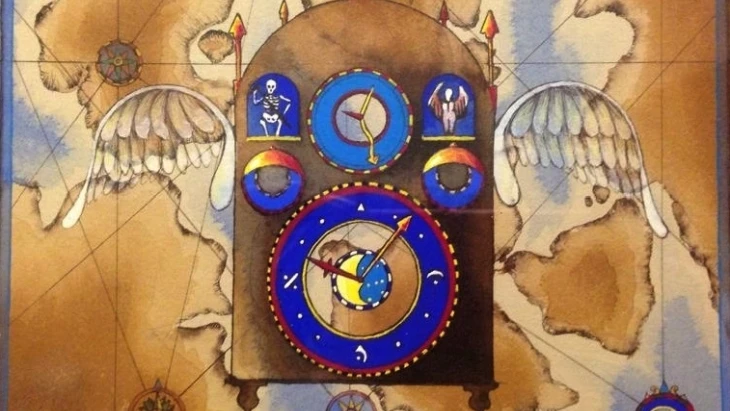
While determining different periods in Magic might be an absolutely subjective barber shop topic, I admit that thinking about it was a lot of fun. Furthermore it helps rearranging thoughts about times and sets from the past. The most important question I asked myself was this one: what actually makes an era an era in Magic? I decided to search for cutting incidents. A caesura. A break with the rules or habits! When were Magic players most angry? ("This does not look like a Magic card!!!")
Using the labels "gold, silver, bronze" (and "opal") I collected the most important key aspects, changes, and annoyances, but also the big caesuras, which ended the specific eras—in my personal opinion. The most notorious innovations and upsets of every era are summed up under "outrage" and "most notable." Since I am an art geek when it comes to Magic, I can already reveal that my choices are related to the aesthetics of the game.
The Golden Age of Magic
Alpha to Onslaught
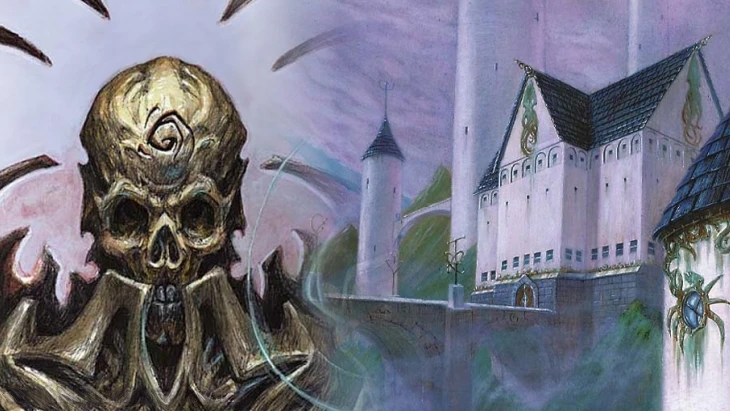
Determining the Golden Age was the most difficult part for me. Some of the most fundamental innovations were given birth around these first years of Magic: the dual lands, the first set symbol (Arabian Nights), then the colored set symbol in Exodus, and the foil card in Urza's Legacy. It was obvious to me that it had to start from the very beginning with Alpha and include every following set including Urza's block, but I was not exactly sure where to let it end. At first I felt that it ended right after Urza's block.
Then I recalled that Masques block, although noticeable weaker, was still very pretty above all. Especially the aristocratic theme of Mercadian Masques was cool and a real beauty in my eyes. While Invasion still felt special to me, the following blocks Odyssey and Onslaught were already lacking that special Magic feel and appeal to me. They delivered highly iconic and powerful Magic cards like
Ultimately I feel that the changed card frame in Eighth Edition was the biggest caesura until then. To me it was the
Outrage: The reprint set Chronicles caused a massive decrease in value of cards, which led to the creation of the Reserved List (a very controversial topic today, since ages, and probably forever). Urza's "Combo Winter" made players leave the game because of massive power level issues. Power level issues were also a thing (or not a thing) when it came to "Necro Summer" (
Most notable: legendary sets (Alpha/Beta/Unlimited/Revised, Arabian Nights, Antiquities, Legends, Ice Age, Mirage, the Tempest and Urza's blocks), the Power Nine, dual lands, fetch lands, the Reserved List, foils, color pie inconsistencies, introduction of colored set symbols in Exodus
Caesura: frame adjustment with Eighth Edition
The Silver Age
Eighth Edition/Mirrodin to Theros


I must admit that I was not entirely sure if this Silver Age wasn't the real—or another—Golden Age of Magic, at least part of it. I can relate to anyone arguing so. One could definitely make a case that this was or still was a Golden Age for Magic. The sets of this era were creative, the art was still gritty, the paper quality was still great, and the sets were relatively well balanced for the most part, with some exceptions in Affinity and phyrexian mana.
The most important innovation of this era was without a doubt the planeswalker card type launched in Lorwyn. It was one of the biggest game changers and a defining moment for Magic in general. If not overnight, planeswalkers became highly iconic. Just think of all the Lilianas, Jaces, and Nissas at games conventions nowadays. But as always, when things change drastically, players leave the game, because they cannot cope or don't want to deal with the change.
With Return to Ravnica Wizards also started their "print to demand" system and gave printers a hard time. Print runs went through the roof. What ended this era for me? Here we go again: I can't look over the fact that Magic lost appeal again because of a more functional, cleaned up, less aesthetic card frame with M15.
Outrage: all in all quite little, Affinity and Cawblade, phyrexian mana, M10 rules change, introduction of mythic rarity
Most notable: very consistent, creation of some of the most decisive sets ever (especially Mirrodin, Time Spiral, Lorwyn, Scars of Mirrodin, as well as the original Ravnica, Zendikar, and Innistrad), Dredge!, shock lands, enemy fetch lands, Masters sets, planeswalker invention
Caesura: frame adjustment with M15
The Bronze Age
M15/Khans of Tarkir to War of the Spark

This era brought the contemporary Magic card frame. While it definitely is functional and clean, I do not like it from an aesthetic perspective. Looking at it, I still get the feeling that something is missing on the lower end of the card. To me it looks like a test card. Unfinished. The uncontinous boarder still rings the aesthetic alarm bell in me. It was roughly around this time too that the illustrations became less gritty and less textured. I don't want to go into detail on the topic of Magic becoming more lighthearted, though, because Gianluca Aicardi already did.
The Bronze Age (Modern Horizons inclued) also delivered a still continuing stream of problematic cards. Many of them saw multi-format bannings. Others, like
Other points worth mentioning are the clearly tangible change of paper quality since M15 and
Outrage: Eldrazi Winter, failed Masters sets Iconic Masters and Masters 25 (turning out pretty strong later), quality issues (paper quality down), Amonkhet Invocations, power level and beginning of problematic cards being printed again (
Most notable: Dominaria and War of the Spark as standout sets, Eldrazi Winter, introduction of lottery cards in Battle for Zendikar
Caesura: introduction of box toppers and collector boosters
The Opal Era
Throne of Eldraine to Present

Because of it's colorful and shiny appearance I want to name this era "opal." This ongoing period was kind of initiated by the introduction of the Ultimate Masters box topper. It ushered in a new era in which every set has one or more very special chase cards. These are full-art editions for the most part. Adding Battle for Zendikar, Kaladesh, and Amonkhet to this era (because of the the Expeditions, Masterpieces, and Invocations) is defensible too.
This era also standardized the release of collector boosters for every set and introduced the Secret Lair Drops to the market, which later sparked the whole conversation about different eras in Magic by adding The Walking Dead to Magic. Technically, there were crossovers before. Just think of
You can like or dislike the fact that Wizards started to sell cards directly to players, but you can't deny the creativity behind some of the Secret Lair Drops like Party Hard, Shred Harder. As a metal head I was stunned the first time I saw these. I really like how they continuously test new waters with this. The most recent innovation of this era is the "etched" card from Commander Legends.


Outrage: problematic cards (
Most notable: Crossovers! Secret Lair Drops!

Conclusion
Use of the saying "everything is relative" might be inflated, but it is true nonetheless. I was shocked the first time I saw the new card frame in Eighth Edition and Mirrodin. Today Mirrodin is one of my favorite sets of all time. I was even more dismayed, maybe a little bit sick, when I saw the contemporary frame and I still would change it if I was able to, but I am aware that the frame might be modified again. Maybe, in a year from now, I am crying for the lost M15 frame.
We should not forget to appreciate the fact that Magic is still around and going strong after so many years. Maybe, while I'm writing these lines searching for the "Golden Age of Magic" I am currently living in one. Arthur Schopenhauer described this dilemma the best: You feel pain, but you do not feel painlessness. You don't realize when you are satisfied. You don't feel when you are healthy. But you do feel when you are ill. The negative aspects always surpass the positive. You might only see the golden years when they already lie in the past.
Iron Maiden refererenced this thought more poetically than I did in their wondeful song "Wasted Years":
So understand
Don't waste your time always searching for those wasted years
Face up, make your stand
And realize you're living in the golden years
Wizards tends to make weird market decisions from time to time and they may not manufacture products for everybody these days, but they always find a way to attract players. New and old. This shows specifically in the way they also address old-border fundamentalists like me by including old-framed cards in sets like Mystery Booster or on "The List." In my opinion the hottest take on this is Time Spiral Remastered. It delivers reprints of staples like
If Magic really continues to diversify its product line like this, most people who are interested in new cards should be happy in one way or another. Even if you dislike the idea of a crossover, I want to encourage everybody to look for the positive aspects, because you might find you're living in the golden years. Enjoy them!
Opinions expressed in this article are those of the author and not necessarily Cardmarket.