Disclaimer and General Project Info
You can find clarifications on the naming of archetypes in Appendix 1: Deck Dictionary at the end of the article. There I list the cards normally seen in each deck and discuss some of the naming conventions, things like why Boros instead of R/W.
This data set was crowdsourced via players in the Pauper Leagues of Magic Online from February 1 to February 28, similar to the famous Challenge Projects of Vintage, Legacy, and Pauper. I received everyone's data and was tasked with the merging, organization, and treatment of it. This means removing duplicate entries when both players send their results, dealing with naming conventions, et cetera. After everything was done, we had 1,195 matches to analyze.
This neither comes from nor has any affiliation with Wizards of the Coast, and it does not offer a full picture of the metagame. Despite our sample size, averaging almost 43 matches a day, it is still only part of what happened on Magic Online during this time. Nonetheless, we believe the data may help highlight overall trends in the world of Pauper.
There can be duplicate data points of a deck being piloted by the same player in the same League run, which shouldn't be treated as if it were separate entries of the deck. The player could have completed one run, thus five matches, on the same day or split them across several days. If said player matched with more than one of the folks tracking their data, we would have at least two data entries instead of one. However, the player may have instead completed two runs (ten matches) with the same deck in a row, and in this case it makes sense to have multiple data points. I couldn't find a good way to differentiate between these scenarios. Therefore all entries are treated the same, meaning that a deck can unfortunately have extra entries. As we track more matches, it is reasonable to assume the sheer volume deem these situations negligible. As for known players paired against each other, I made sure to remove all the duplicates when they happened: If player A faced player B and both sent me the data of that match, I registered it only once.
Changelog for February
New archetypes added:
- Proliferate Storm
- Jeskai Synthesizer
Metadata for February
| Starting date: | 2023-02-01 |
| Final date: | 2023-02-28 |
| Number of days: | 28 |
| Number of matches: | 1,195 |
| Unique archetypes: | 69 + Rogues |
| Archetypes >5% of the meta: | 6 |
| Archetypes >3% of the meta: | 9 |
| Entries Day 1 to Day 10: | 557 (46.61%) |
| Entries Day 11 to Day 20: | 408 (34.14%) |
| Entries Day 21 to Day 28: | 230 (19.25%) |
Introduction and Motivation
For a variety of reasons I decided to try to track the changes in the Pauper League metagame after the release of Double Masters 2022. As it was a successful endeavor, I decided to repeat it for subsequent months and will keep doing so until the amount of data sent my way is not enough to warrant an analysis. You can check all of the original motivations behind this project in the first article of this series.
February 10 saw the release of Phyrexia: All Will Be One on Magic Online. So far it seems to have been the least impactful set for Pauper from this last year and a half. Sure, it's been less than 30 days since the release, and players can still come up with new technologies for established decks. But the other sets had almost immediate impact. Their new technologies were widely adopted from the first day of release and, more importantly, forced the top decks of the format to adapt to the changes.
Although nothing earth shattering was discovered yet, some things still changed. One was the addition of a new game plan for control decks, which can now use cards such as


The most impactful change may have been the introduction of
Metagame Consolidation
I identified 69 unique decks, plus rogue designs, for February. A few of the decks submitted, twelve in total, were too hard to classify or looked too experimental and thus received the "rogue" label. To further justify the classification, these included Jund Reanimator as well as Mardu- and a Gruul-based tokens decks. These builds are not what we normally see in the format and don't yet warrant the creation of another deck label.
To track the changes over time, I split the data for the month into three periods of ten days each, the last shorter as February only has 28 days. I grouped the Top 18 archetypes for January and show them here:
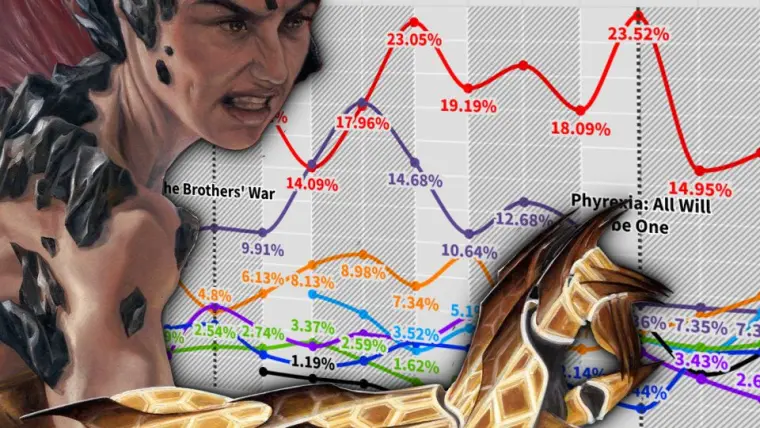
I created all the charts in this article with Flourish Studio. This includes the following, which shows metagame trends. It starts with the eight biggest archetypes at the beginning of the month of February, but you can select whichever decks interest you the most from the drop-down menu:
You can find the full table with all the decks as well as their meta share for each period at the end of this section. However, to make the analysis easier to follow, I want to highlight the Top 8 most played decks in each split here:
| Top 8 Most Registered Decks | ||||
|---|---|---|---|---|
| January 2023 | February 2023 | |||
| Rank | Days 21 to 31 | Days 1 to 10 | Days 11 to 20 | Days 21 to 28 |
| 1 | Synthesizer Burn 18.09% | Synthesizer Burn 23.52% | Synthesizer Burn 14.95% | Synthesizer Burn 16.09% |
| 2 | Grixis Affinity 11.28% | Grixis Affinity 7.36% | Grixis Affinity 7.35% | U/B Angler-Terror 8.26% |
| 3 | W/B Ephemerate 8.56% | W/B Ephemerate 6.46% | U/B Angler-Terror 6.86% | Grixis Affinity 7.39% |
| 4 | Auras 7.2% | U/B Angler-Terror 5.75% | Monoblue Faeries 5.15% | Walls (Combo) 7.39% |
| 5 | Walls (Combo) 6.23% | Monoblue Faeries 5.39% | Walls (Combo) 4.9% | Monoblue Faeries 5.65% |
| 6 | Monoblue Faeries 5.84% | Walls (Combo) 5.39% | Boros Synthesizer 4.66% | Boros Synthesizer 5.22% |
| 7 | U/B Angler-Terror 4.47% | Auras 4.67% | W/B Ephemerate 3.68% | W/B Ephemerate 5.22% |
| 8 | Boros Bully 3.31% | Tron (Flicker) 3.59% | Auras 3.43% | Caw Gates 4.35% |
W/B Ephemerate had been a constant presence in Leagues in the previous month, and it also had good results in Challenges during that period, which prompted AdeptoTerra to write an article about it. But it seems the meta quickly adjusted, and the deck kept losing numbers throughout February, settling in at the bottom of the Top 8.
U/B Angler-Terror kept rising in numbers throughout February and ended up the second most played by the end of the month, taking the spot usually reserved for Grixis Affinity. It also had great results in big events, winning the Challenges on February 19, 25, and 26!
There is something worth pointing out for February in relation to decks that use flying creatures. They experienced a noticeable uptick:
- Boros Synthesizer started to gain in popularity with
. - Monoblue Faeries kept roughly the same numbers since the end of January.
- Caw Gates gained significant meta share by the end of February.
I credit this movement to the multiple copies of
Interestingly enough, something similar already happened in a past meta. There was a time when people were trying to go above Affinity, and the deck started to be more Rakdos instead of Grixis, which solved some issues but opened players up to be more easily hated postboard. This ended up forcing Affinity to switch back to Grixis. There were even some metas in which decks like Boros Bully were having success because they had both threats, like


Of course we should not dismiss the raw strength of those three highlighted decks. They all have solid game plans against most of the format and can tune, sometimes even overtune, their sideboard to deal with the top decks. However, I wanted to highlight them because of the flying creatures and current lack of Cannonade. I think we are entering a phase with a lot of back and forth on slots in various builds! Many signs point this way: In the past two months I changed the naming of Kuldotha Burn to Synthesizer Burn because some builds started to drop
Will these pressure points on Synthesizer Burn and Grixis Affinity be enough to make the Leagues' meta more varied? It seems we are approaching that. Numbers are down for both decks, and in Challenges we see a wider spread.
| Gathered Meta February 2023 | |||||
|---|---|---|---|---|---|
| Rank | Deck | Days 1 to 10 | Days 11 to 20 | Days 21 to 28 | Total |
| 1 | Synthesizer Burn | 131 (23.52%) | 61 (14.95%) | 37 (16.09%) | 229 (19.16%) |
| 2 | Grixis Affinity | 41 (7.36%) | 30 (7.35%) | 17 (7.39%) | 88 (7.36%) |
| 3 | U/B Angler-Terror | 32 (5.75%) | 28 (6.86%) | 19 (8.26%) | 79 (6.61%) |
| 4 | Walls (Combo) | 30 (5.39%) | 20 (4.9%) | 17 (7.39%) | 67 (5.61%) |
| 5 | Monoblue Faeries | 30 (5.39%) | 21 (5.15%) | 13 (5.65%) | 64 (5.36%) |
| 6 | W/B Ephemerate | 36 (6.46%) | 15 (3.68%) | 12 (5.22%) | 63 (5.27%) |
| 7 | Auras | 26 (4.67%) | 14 (3.43%) | 6 (2.61%) | 46 (3.85%) |
| 8 | Boros Synthesizer | 8 (1.44%) | 19 (4.66%) | 12 (5.22%) | 39 (3.26%) |
| 9 | Tron (Flicker) | 20 (3.59%) | 14 (3.43%) | 4 (1.74%) | 38 (3.18%) |
| 10 | Ponza | 18 (3.23%) | 8 (1.96%) | 6 (2.61%) | 32 (2.68%) |
| 11 | Caw Gates | 7 (1.26%) | 9 (2.21%) | 10 (4.35%) | 26 (2.18%) |
| 12 | Monored Blitz | 12 (2.15%) | 11 (2.7%) | 3 (1.3%) | 26 (2.18%) |
| 13 | U/R Faeries | 11 (1.97%) | 7 (1.72%) | 7 (3.04%) | 25 (2.09%) |
| 14 | W/U Familiars | 13 (2.33%) | 9 (2.21%) | 3 (1.3%) | 25 (2.09%) |
| 15 | Naya Gates | 10 (1.8%) | 8 (1.96%) | 6 (2.61%) | 24 (2.01%) |
| 16 | Rakdos Burn | 11 (1.97%) | 4 (0.98%) | 7 (3.04%) | 22 (1.84%) |
| 17 | U/B Faeries | 11 (1.97%) | 8 (1.96%) | 1 (0.43%) | 20 (1.67%) |
| 18 | Tron (Altar) | 4 (0.72%) | 10 (2.45%) | 5 (2.17%) | 19 (1.59%) |
| 19 | Rogue Deck | 7 (1.26%) | 8 (1.96%) | 3 (1.3%) | 18 (1.51%) |
| 20 | Monowhite Heroic | 5 (0.9%) | 9 (2.21%) | 3 (1.3%) | 17 (1.42%) |
| 21 | Poison Storm | 3 (0.54%) | 12 (2.94%) | 2 (0.87%) | 17 (1.42%) |
| 22 | Boros Bully | 5 (0.9%) | 7 (1.72%) | 3 (1.3%) | 15 (1.26%) |
| 23 | Mardu Synthesizer | 6 (1.08%) | 7 (1.72%) | 2 (0.87%) | 15 (1.26%) |
| 24 | U/B Control | 7 (1.26%) | 5 (1.23%) | 3 (1.3%) | 15 (1.26%) |
| 25 | Moggwarts | 3 (0.54%) | 6 (1.47%) | 4 (1.74%) | 13 (1.09%) |
| 26 | Monored Burn (No Synth, Spell Based Burn) | 1 (0.18%) | 8 (1.96%) | 4 (1.74%) | 13 (1.09%) |
| 27 | Monowhite Aggro | 7 (1.26%) | 4 (0.98%) | 2 (0.87%) | 13 (1.09%) |
| 28 | G/U Turbo Fog | 6 (1.08%) | 4 (0.98%) | 0 (0%) | 10 (0.84%) |
| 29 | Jund Midrange | 7 (1.26%) | 1 (0.25%) | 0 (0%) | 8 (0.67%) |
| 30 | Monoblue Control (Terror) | 3 (0.54%) | 2 (0.49%) | 3 (1.3%) | 8 (0.67%) |
| 31 | Walls (Cascade or Initiative) | 5 (0.9%) | 3 (0.74%) | 0 (0%) | 8 (0.67%) |
| 32 | Esper Control | 4 (0.72%) | 1 (0.25%) | 1 (0.43%) | 6 (0.5%) |
| 33 | Gates Soup | 3 (0.54%) | 1 (0.25%) | 2 (0.87%) | 6 (0.5%) |
| 34 | Monoblack Control | 2 (0.36%) | 4 (0.98%) | 0 (0%) | 6 (0.5%) |
| 35 | Monoblack Khalni Dispute | 3 (0.54%) | 2 (0.49%) | 1 (0.43%) | 6 (0.5%) |
| 36 | Monogreen Stompy | 2 (0.36%) | 2 (0.49%) | 2 (0.87%) | 6 (0.5%) |
| 37 | Elves | 4 (0.72%) | 1 (0.25%) | 0 (0%) | 5 (0.42%) |
| 38 | Gx Ramp Pile | 0 (0%) | 3 (0.74%) | 2 (0.87%) | 5 (0.42%) |
| 39 | W/B Pestilence | 1 (0.18%) | 2 (0.49%) | 1 (0.43%) | 4 (0.33%) |
| 40 | Cycle Storm | 1 (0.18%) | 3 (0.74%) | 0 (0%) | 4 (0.33%) |
| 41 | Jeskai Wildfire | 1 (0.18%) | 2 (0.49%) | 1 (0.43%) | 4 (0.33%) |
| 42 | Naya Midrange | 2 (0.36%) | 1 (0.25%) | 0 (0%) | 3 (0.25%) |
| 43 | Slivers | 1 (0.18%) | 2 (0.49%) | 0 (0%) | 3 (0.25%) |
| 44 | Tron (Monsters) | 1 (0.18%) | 2 (0.49%) | 0 (0%) | 3 (0.25%) |
| 45 | W/U Tribe | 0 (0%) | 1 (0.25%) | 2 (0.87%) | 3 (0.25%) |
| 46 | B/G Rock | 0 (0%) | 2 (0.49%) | 0 (0%) | 2 (0.17%) |
| 47 | Monoblack Burn | 0 (0%) | 1 (0.25%) | 1 (0.43%) | 2 (0.17%) |
| 48 | U/B Reanimator | 2 (0.36%) | 0 (0%) | 0 (0%) | 2 (0.17%) |
| 49 | X-Land Spy | 2 (0.36%) | 0 (0%) | 0 (0%) | 2 (0.17%) |
| 50 | Abzan Midrange | 1 (0.18%) | 0 (0%) | 0 (0%) | 1 (0.08%) |
| 51 | Mardu Affinity | 1 (0.18%) | 0 (0%) | 0 (0%) | 1 (0.08%) |
| 52 | Rakdos Affinity | 1 (0.18%) | 0 (0%) | 0 (0%) | 1 (0.08%) |
| 53 | Aristocrats | 1 (0.18%) | 0 (0%) | 0 (0%) | 1 (0.08%) |
| 54 | Bant Midrange | 1 (0.18%) | 0 (0%) | 0 (0%) | 1 (0.08%) |
| 55 | Boros Heroic | 1 (0.18%) | 0 (0%) | 0 (0%) | 1 (0.08%) |
| 56 | W/B Midrange | 1 (0.18%) | 0 (0%) | 0 (0%) | 1 (0.08%) |
| 57 | G/W Tethmos | 0 (0%) | 1 (0.25%) | 0 (0%) | 1 (0.08%) |
| 58 | Infect | 1 (0.18%) | 0 (0%) | 0 (0%) | 1 (0.08%) |
| 59 | Jeskay Synthesizer | 0 (0%) | 0 (0%) | 1 (0.43%) | 1 (0.08%) |
| 60 | Mardu Midrange | 0 (0%) | 0 (0%) | 1 (0.43%) | 1 (0.08%) |
| 61 | Monoblack Aggro | 0 (0%) | 1 (0.25%) | 0 (0%) | 1 (0.08%) |
| 62 | Monoblue Tempo | 1 (0.18%) | 0 (0%) | 0 (0%) | 1 (0.08%) |
| 63 | Monored Goblins | 1 (0.18%) | 0 (0%) | 0 (0%) | 1 (0.08%) |
| 64 | Post-Ban Turbo Initiative | 0 (0%) | 1 (0.25%) | 0 (0%) | 1 (0.08%) |
| 65 | Soul Sisters | 0 (0%) | 1 (0.25%) | 0 (0%) | 1 (0.08%) |
| 66 | Sultai Midrange | 0 (0%) | 1 (0.25%) | 0 (0%) | 1 (0.08%) |
| 67 | Temur Midrange | 1 (0.18%) | 0 (0%) | 0 (0%) | 1 (0.08%) |
| 68 | Tron (Eggs) | 0 (0%) | 0 (0%) | 1 (0.43%) | 1 (0.08%) |
| 69 | U/R Control | 1 (0.18%) | 0 (0%) | 0 (0%) | 1 (0.08%) |
| 70 | Zoo Beatdown | 0 (0%) | 1 (0.25%) | 0 (0%) | 1 (0.08%) |
Challenges
First, thanks to Karl191 for making the head-to-head calculations for the Challenges as well as AdeptoTerra and Kirblinxy for taking time to watch the replays and collect the data. There were two surprises in February's Challenges. One was the resurgence of Monoblue Faeries, which for a long time was creeping on the edges of the Leagues' meta but never managed to make another impression on the Challenge meta.
It had one or two pilots from the beginning of the month, then became the most played deck in the Challenge on February 18! It amounted to 11.76% of the field, sported a 54.55% nonmirror win rate, and managed to put one player into the Top 8.
On February 19 it accounted for only 6.85% of the field, the fifth most popular deck choice. Still it retained great results overall, a 58.62% nonmirror win rate, and claimed a tenth place as the best position.
The biggest surprise came at the end of the month when U/B Angler-Terror picked up both in meta share and win rate. The deck started the Leagues with an increase in numbers, as already discussed, but had small representation in the month's first Challenge on February 4.


Then suddenly it was the second most popular for the February 5 Challenge, trailing Synthesizer Burn by just one pilot. The deck maintained decent numbers and reasonable results, but by the 19th
February 19: U/B Angler-Terror won, was the fourth most played at 8.22% of the meta, and had an amazing nonmirror win rate of 73.33%.
February 25: U/B Angler-Terror won, was the most played at 13.73% of the meta, and sported a nonmirror win rate of 58.82%.
February 26: U/B Angler-Terror won yet again! But unfortunately the Challenge Project did not collect data for that event, thus we do not know the win rates or the meta share of the deck.
The other two big decks, Synthesizer Burn and Grixis Affinity, remained a constant presence throughout, regularly among the most played, albeit with mixed results. Often they would claim Top 8 berths, and Affinity even won a Challenge (on February 11) while Synthesizer Burn placed second twice (on February 18 and February 25).
But sometimes they posted atrocious overall results with win rates below 50%. Affinity went as low as 39% (on February 19) and as high as 63% (on February 25) while putting one pilot into the Top 8 each time. None of this differs much from what we've seen for the last few months. These decks have been a dominant force for a long time, and most of the format is now developed around them.
The Color Distribution
A disclaimer about the classification of colors in each deck as I had to make some concessions: I assigned colors to each deck, counted the times these decks appeared, and made the calculations. I'm not counting the individual cards!
Overall I tried to follow the spirit of the build of each deck and to add a color anytime a deck runs more than four copies of a card of that color. For the evolution of the shares of color per month and period, I ignored the splashes. You can further explore the whole color divisions as well as the values of the meta share in the pie chart at the end of this section to draw your own conclusions.
In total, for the month of February, we saw the following distribution:
| Color | Days 1 to 10 | Days 11 to 20 | Days 21 to 28 | Overall |
|---|---|---|---|---|
| WHITE | 28.19% | 31.62% | 30.87% | 29.87% |
| BLUE | 41.29% | 43.63% | 44.78% | 42.76% |
| BLACK | 32.50% | 35.54% | 33.91% | 33.81% |
| RED | 49.19% | 45.83% | 49.13% | 48.03% |
| GREEN | 25.49% | 24.51% | 21.30% | 24.35% |
The end of January saw a reduction of red's dominance and the beginning of a more balanced distribution of colors. The trend continued in February, and it seems things are moving toward a meta in which more colors, and strategies, have room to shine.
Sadly green still suffers from lack of popularity. It takes most of its representation from Walls (Combo), with some share due to Auras. I questioned apas72, one of the most prolific Walls players, and he pointed out how the deck struggles to find a good plan postboard against a
If you want to explore these ratios of decks and colors further, check out the following. I also want to give a shoutout to PProteus from the Castle of Commons Discord, the one who manages the Pauper Challenge Project, for helping me find a faster way to organize the data for this chart:
Meta Comparison
In January there was a lot of discussion about the format and its health. Even players from other formats weighed in. You can see part of the discussion in this thread on Twitter. Because of that I decided to pull all the data since the beginning of this series for a different analysis, one on deck variety.
Keep in mind we are working with crowdsourced data here, thus we only have a fraction of the meta, even if we have thousands of matches. Trends are still visible, though, so I want to focus on these.
February yielded this chart for the Top 16 most played decks:
Per our gathered data, we have three decks in the top third of the meta. Six account for half of the meta and twelve for two thirds of the meta. This is already a better picture than what we had in January. Together with the variety at Challenges, this may signal the meta is getting less narrow.
| Month | Third of the Meta (number of decks) | Half of the Meta (number of decks) | Two Thirds of the Meta (number of decks) |
|---|---|---|---|
| July | ~3.5 | 7 | 11 |
| August | 4 | 7 | ~11.5 |
| September pre-bans | 5 | 9 | 14 |
| September post-bans | 4 | 7 | 13 |
| October | 3 | ~6.5 | ~12.5 |
| November | ~2.5 | ~5.5 | ~11 |
| December | 2 | ~4.5 | 10 |
| January | ~2.5 | 5 | 10 |
| February | 3 | 6 | 12 |
Final Considerations
February came up with some surprises across both Leagues and Challenges, most notably U/B Angler-Terror and Monoblue Faeries rising in popularity. Phyrexia: All Will Be One, released in the middle of the month, did not play a big role in the meta so far.
Both Synthesizer Burn and Grixis Affinity lost significant meta share according to our crowdsourced data. They no longer hog the spotlight, neither in Leagues nor Challenges. It seems the rest of the meta is pressuring these two well enough to the point where they have to concede deck slots and in turn worsen some matchups.
If you wish to help in any way with this project, feel free to message me, on Magic Online, Twitter, or Cardmarket, I'm PyotrPavel everywhere, or just email me. (My address at Google Mail is pyotrpavelmtg.) You can also find me using the same nickname on the majority of Pauper Discords.
Appendix 1: Deck Dictionary
The whole naming convention tries to follow what the Pauper community uses as a standard. For everything else I tried to make the classifications as broad as possible to avoid pulverizing the data of lesser played decks too much. Three-color combinations are named after the Shards of Alara or Khans of Tarkir, a custom the whole Magic community tends to follow.
The color pairs are named according to what has been used the most by the Pauper community over the years. This means we will always use the guild name for Boros decks instead of R/W. But we get things like U/B Faeries instead of Dimir Faeries, as there isn't an established preference for the other color pairs, and the tendency is to avoid the guild name for them. Some of this may look confusing to newcomers, but I judged it would be better to follow what people have been doing for years. It also makes my life easier when I sift the data, as the names submitted typically match these patterns. The bottom line is: Naming archetypes, and agreeing on those names, is complicated.
| Deck | Definition |
|---|---|
| 5/5 Storm | Storm with |
| Abzan Midrange | Pile of Abzan cards that doesn't fit any other archetype description |
| Affinity (Jund) | Like Rakdos Affinity, but with splashes for cards like |
| Aristocrats | Sacrifice matters strategies, main color black, but can have splashes: |
| Auras | Hexproof creatures and Auras: |
| B/G Rock | Typical Rock cards, quite similar to Monoblack Khalni Dispute, except for |
| Bant Control | Pile of Bant cards, generally control, with Wildfire as engine and |
| Bant Midrange | Midrange deck in green-white-blue |
| Boros Bully | |
| Boros Heroic | |
| Boros Synthesizer | |
| Brute Squad | Metalcraft creatures like |
| Caw Gates | White-blue: |
| Cycle Storm | |
| Elves | Elf tribal, mostly with blue splash: |
| Esper Control | Countermagic, removal in white-blue-black |
| Fishelbrand | Big creatures like |
| Food Gates | |
| G/U Madness Gates | Gates package with |
| G/U Turbo Fog | |
| G/W Tethmos | |
| G/x Ramp Pile | Any green ramp not focused on land destruction, mostly with red, sometimes with |
| Gates Infect | Gates package with infect creatures like |
| Gates Soup | Any experimental brew with Gates whose payoff is |
| Grixis Affinity | Artifact lands, |
| Grixis Control | Countermagic, removal in blue-black-red |
| Infect | Strictly Infect, No Gates! |
| Jeskai Affinity | Artifact lands, |
| Jeskai Wildfire | Jeskai Control with |
| Jund Midrange | Any pile of cards in black-red-green |
| Mardu Affinity | Artifact lands, |
| Mardu Midrange | Any pile of cards in red-white-black |
| Mardu Synthesizer | Similar to the old Boros Monarch that is now Boros Synthesizer but splashing black for |
| Midnight Gond Combo | |
| Moggwarts | |
| Monoblack Aggro | Fast aggro, mix of Black Burn, Aristocrats, and MBC |
| Monoblack Burn | |
| Monoblack Control | Black removal, |
| Monoblack Khalni Dispute | |
| Monoblack Land Destruction | |
| Monoblack Zombies | Zombie tribal, graveyard shenanigans, removal: |
| Monoblue Control (Terror) | |
| Monoblue Faeries | Faerie tribal/tempo deck: |
| Monoblue Tempo | A deck that doesn't use the traditional Faeries but follows a tempo playstyle |
| Monogreen Stompy | |
| Monored Blitz | |
| Monored Burn | |
| Monored Goblins | Goblin tribal/beatdown |
| Monowhite Aggro | Traditional White Weenie, sometimes splashing for |
| Monowhite Heroic | Heroic mechanic and Auras: |
| Naya Gates | |
| Naya Midrange | Cascade pile with white as its third color for cards such as |
| Petal Festival | |
| Ponza | Any green-based land destruction strategy, splashing red or black or blue: |
| Post-Ban Turbo Initiative | Depletion lands like |
| Rainbow Familiars | Primarily Bant but splashing fourth and fifth color; similar to regular Familiars, except for its tendency to generate infinite mana and win through |
| Rakdos Affinity | Artifact lands, |
| Rakdos Aggro | |
| Rakdos Burn | |
| Rakdos Midrange | Any pile of Rakdos cards, usually with |
| Rogue Deck | Experimental/kitchen-table brews |
| Slivers | Sliver tribal, typically Naya |
| Sultai Control | Control deck in blue-green-black |
| Sultai Midrange | Pile of Sultai cards that's neither Ponza nor Affinity |
| Synthesizer Burn | |
| Temur Affinity | Artifact Lands, |
| Temur Control | Control deck in green-blue-red |
| Temur Midrange | Pile of Temur cards that's neither Ponza nor Affinity |
| Tortured Existence | |
| Tron (Altar) | Tron lands and |
| Tron (Eggs) | Tron lands, eggs like |
| Tron (Familiars) | Similar to Tron (Flicker) but more combo oriented, using |
| Tron (Flicker) | Tron lands with a control plan using |
| Tron (Monsters) | Tron lands and big creatures like |
| U/B Angler-Terror | |
| U/B Control | |
| U/B Delver | Tempo oriented: |
| U/B Faeries | |
| U/B Reanimator | |
| U/R Blitz | Blue cantrips, |
| U/R Control | Either |
| U/R Delver | |
| U/R Faeries | |
| U/R Miracles | |
| U/R Thermo-Delver | |
| Vinestorm | Rituals with |
| W/B Ephemerate | |
| W/B Midrange | A midrange version that neither resorts to the removal-heavy plan nor plays |
| W/B Pestilence | |
| W/U Acid Trip | |
| W/U Evoke | |
| W/U Faeries | Faerie package with a Ninja side, sometimes both |
| W/U Familiars | |
| W/U Metalcraft | Metalcraft creatures such as |
| W/U Tribe | |
| Walls (Cascade or Initiative) | |
| Walls (Combo) | Combo version using |
| Walls (Old Classification) | Combo and cascade/initiative classified under the same label |
| X-Land Spy | Including up to two lands and using |
| Zoo Beatdown | Generally a red and green aggro deck with |
Opinions expressed in this article are those of the author, not of Cardmarket.