
Visiting a Modern Mage School: Strixhaven

Available as early as the April 15 on Magic Online, Strixhaven brought 274 new cards to Modern. What about their impact? About 10% of those cards appeared at least once in the results of major events (Top 32 of Challenges, Champ Qualifiers, and Super Qualifiers) since, not even accounting for Preliminaries or Leagues. It means that those new cards succeeded in hitting a strong record in a competitive event at least once, but many more might have appeared elsewhere.
Moreover, Heliod no longer is on top! Another previously strong archetype stole the crown, carried by the most played Strixhaven card in Modern. Before seeing how the meta shifted and what those new cards are, let us start with our usual breakdown of the data, five weeks after the release of the set on Magic Online.
List of MTGO Major Events Between 2021-04-15 and 2021-05-17:
Modern Challenge 2021-04-17
Modern Challenge 2021-04-18
Modern Challenge 2021-04-24
Modern Challenge 2021-04-25
Modern Challenge 2021-05-01
Modern Challenge 2021-05-02
Modern Champ Qualifier 2021-05-03
Modern Challenge 2021-05-08
Modern Challenge 2021-05-09
Modern Champ Qualifier 2021-05-14
Modern Challenge 2021-05-15
Modern Challenge 2021-05-16
Modern Super Qualifier 2021-05-16
Some Quick Stats:
Number of decks in the data: 416
Number of different players in the data: 267
Number of different cards in the data: 776
Number of exact archetypes in the data: 61
Number of rounds played (with Top 8): 3254
Average number of Swiss rounds: 7.38
Minimum number of Swiss rounds: 7
Maximum number of Swiss rounds: 9
Number of events in the data: 13
Archetype Presence
Today, let us introduce a new aesthetic for the presence graph. Please let me know in the comments if you find it better than the previous one, or if you have any suggestions to improve it.

Yes, you see this right.
Meanwhile,
| Boros Prowess by mac121711, 3rd at Champ Qualifier on May 3 | ||
|---|---|---|
| Main Deck | Sideboard | |
|
|
|
Heliod is relegated to the third place at 7.5%, with Eldrazi Tron slightly higher at 7.7% in second. Indeed, with
The next deck to appear is BTL Scapeshift, at 5.2%. Revolving around
You can read more about an early version of the deck here. A build with
| Decklist: BTL Scapeshift by Meltiin, 1st at Modern Challenge on April 19 | ||
|---|---|---|
| Main Deck | Sideboard | |
|
|
|
At the same level of presence, we notice the rise of Amulet Titan, historically strong against red and other big mana decks but weak against creature combo decks. Still, it can beat infinite life (with
We can also note a comeback of Red-Green Midrange also known as Ponza also known as Gruul
Dredge also rose from the dead (pun acknowledged and overused) up to 3.7%. The reason is simple:


To finish this part, even though we already introduced almost all the decks from the pie chart above, there is still one we did not: the last one, Izzet Breach. While most of the deck looks like your typical blue-red control deck with counterspells, removal, and card advantage engines, it includes a combo:
You can often find Izzet Breach with a green splash. Easily enabled via
| Izzet Breach by 1stTurnNegator, 20th at Super Qualifier on May 16 | ||
|---|---|---|
| Main Deck | Sideboard | |
|
|
|
Ranking the Decks
As before, we will use the win rates of each archetype in addition to their presence in order to establish a ranking and a tier list. As a reminder, our sample includes only decks that appeared in Top 32s of competitive events, meaning that they all have a win rate significantly above 50%. If we added the data of the entirety of the decks (if it were available …), the average win rate would likely be much closer to 50%. We can display those win rates for the most represented decks the following way:
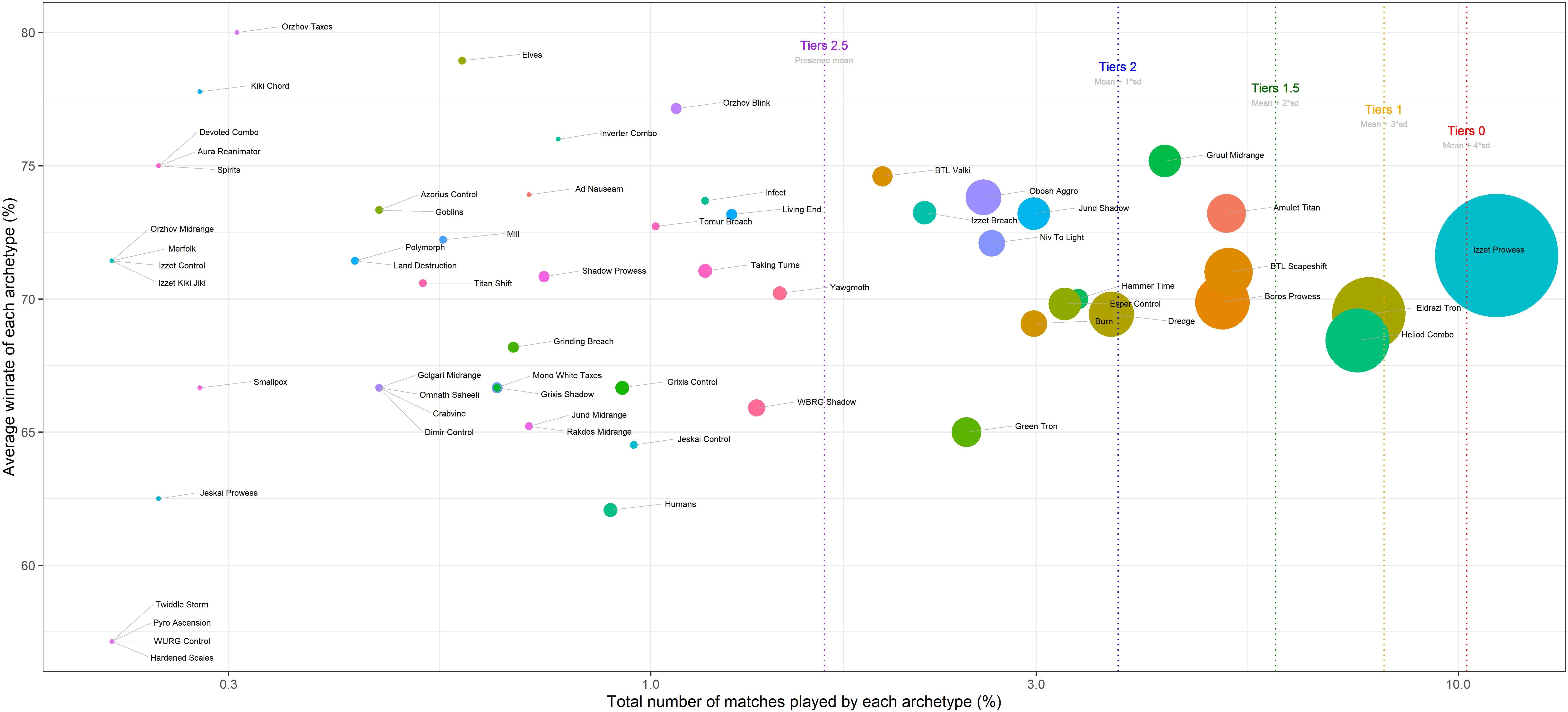
Heliod, the previous deck to beat, finally became enough of a target to fall back, in presence but also in performance. It now exhibits almost the worst win rate among all the decks above a 2% presence (the minimum for inclusion in the pie graph). Only those poor Green Tron players were doing worse, presumably because the good matchup for Green Tron that was Heliod fell a bit, whereas matchups that require spot removal as early as turn one or two (prowess) rose. Thus the Eldrazi variant replaced it as the go-to Tron deck of the format. Even when we only take the lowest bound of the confidence interval into account, an interval that is smaller for Heliod than for most archetypes because of its large presence, more than half of the decks have a better pessimistic estimation of the win rate than Heliod.
Meanwhile, red midrange decks (Obosh and Ponza) exhibited very good win rates, even though they were not highly represented in the results—hence a large confidence interval on their win rate. I also mentioned earlier that Izzet Breach seemed to encounter relatively few predators in the format at the moment, and it shows. Still, it has the largest confidence interval in our data set, so we will have to wait and see how things evolve to check whether it was a fluke or not. As for Izzet Prowess, the most represented deck in the results, it also has a win rate above average, leading to the highest pessimistic estimate of the win rate, along with Gruul Midrange, which showed the highest win rate in the data.
If we display both the win rate and the presence for all the decks in the data, we see the following:
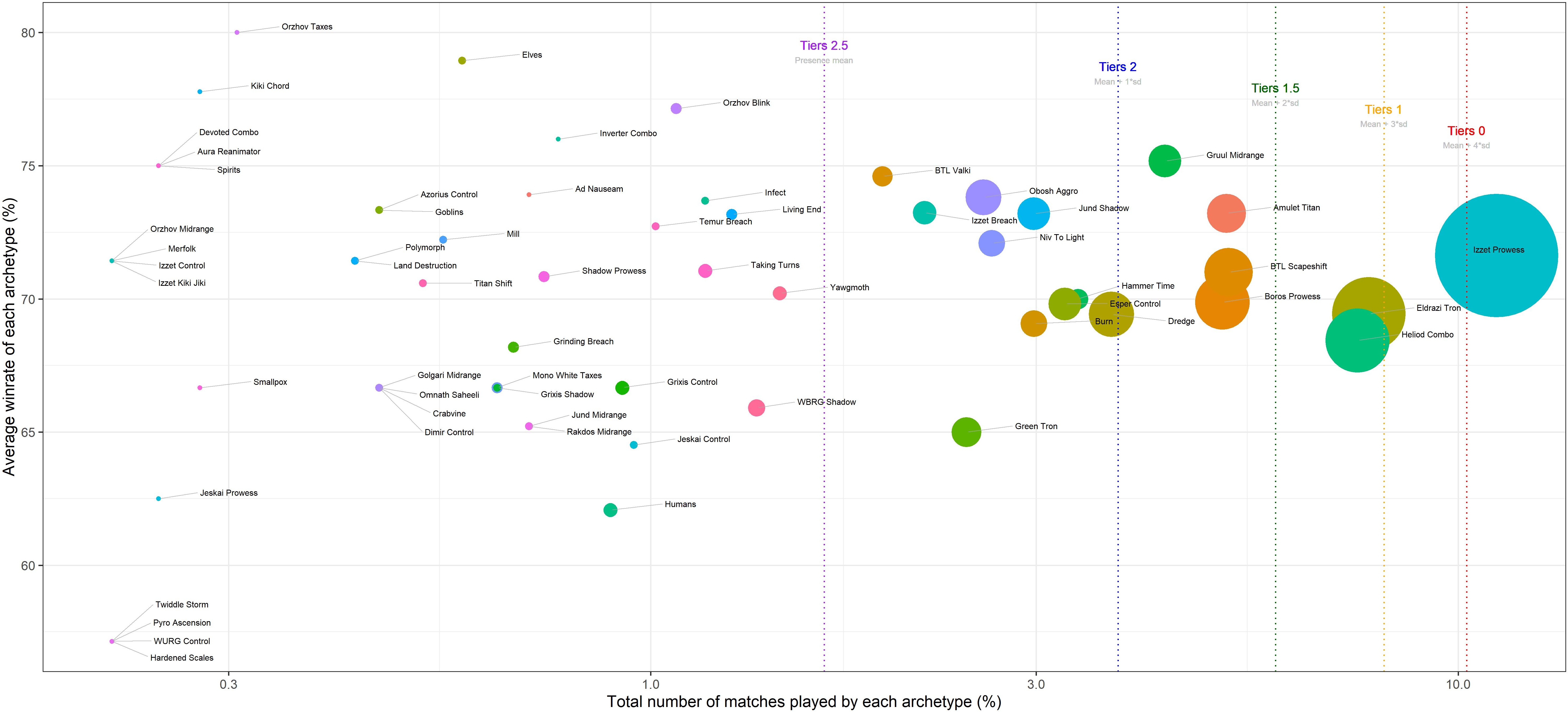
Some decks did particularly well in terms of win rate but did not appear all that much. Let us showcase a few, in no particular order:
-
Kiki Chord, a four-color toolbox and combo deck, full of tutors, silver bullets and value, with one Challenge Top 4 at the hand of its most famous pilot Kurusu
-
Elves, a tribal aggro deck, championing no Strixhaven cards, but
and from Kaldheim, with two Challenge Top 8s -
Inverter Combo, which the Pioneer players among you immediately recognize, with three Top 32s up to a Challenge final, always by the same player: musasabi, who already had success previously with off-meta decks such as Mardu Stoneblade. His take on Inverter includes some very uncommon cards such as
but also a new Strixhaven toy in . Here is his latest decklist.
| Inverter Combo by musasabi, 2nd at Champ Qualifier on May 14 | ||
|---|---|---|
| Main Deck | Sideboard | |
|
|
|
-
Orzhov Taxes/Blink, one archetype theoretically divided by the presence of
in one of the lists. With five Challenge Top 32s including three Top 8s, the archetype made good use of new Strixhaven cards: the World Champion, , and in the sideboard. Here is an example deck list.
| Orzhov Blink by MiguelCaster, 7th at Super Qualifier on May 16 | ||
|---|---|---|
| Main Deck | Sideboard | |
|
|
|
Let's move on to the tier list now. As mentioned before, we only keep the most represented decks. With this "zoom", we get:
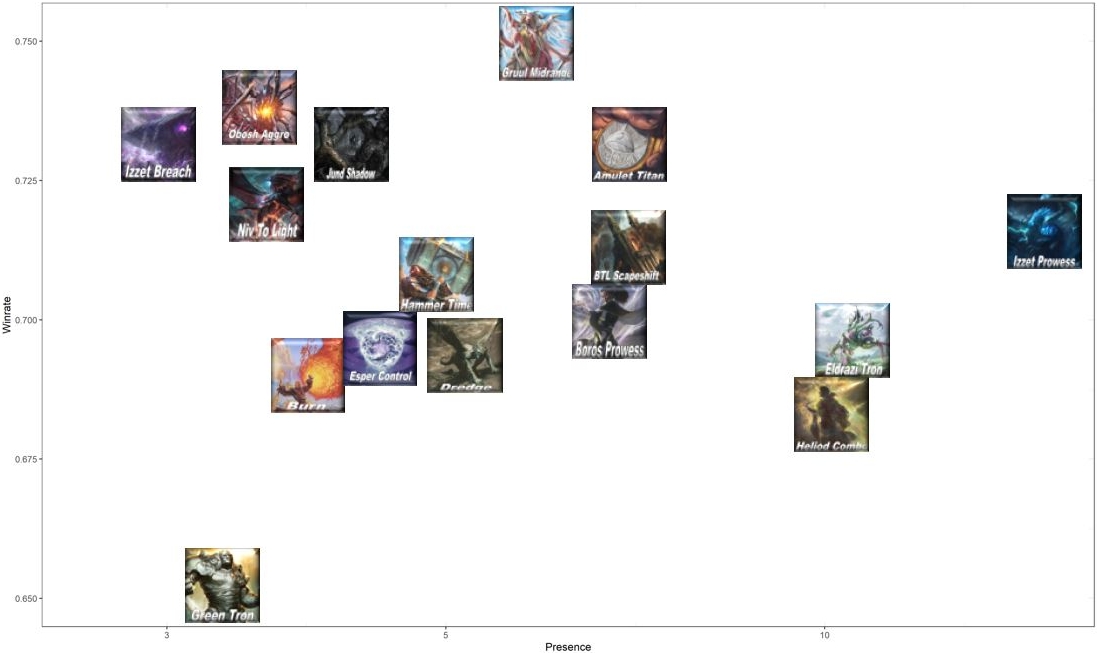
We now compute a normalized combination of the presence and the win rate—as detailed in a previous article—and get the following values for each deck.
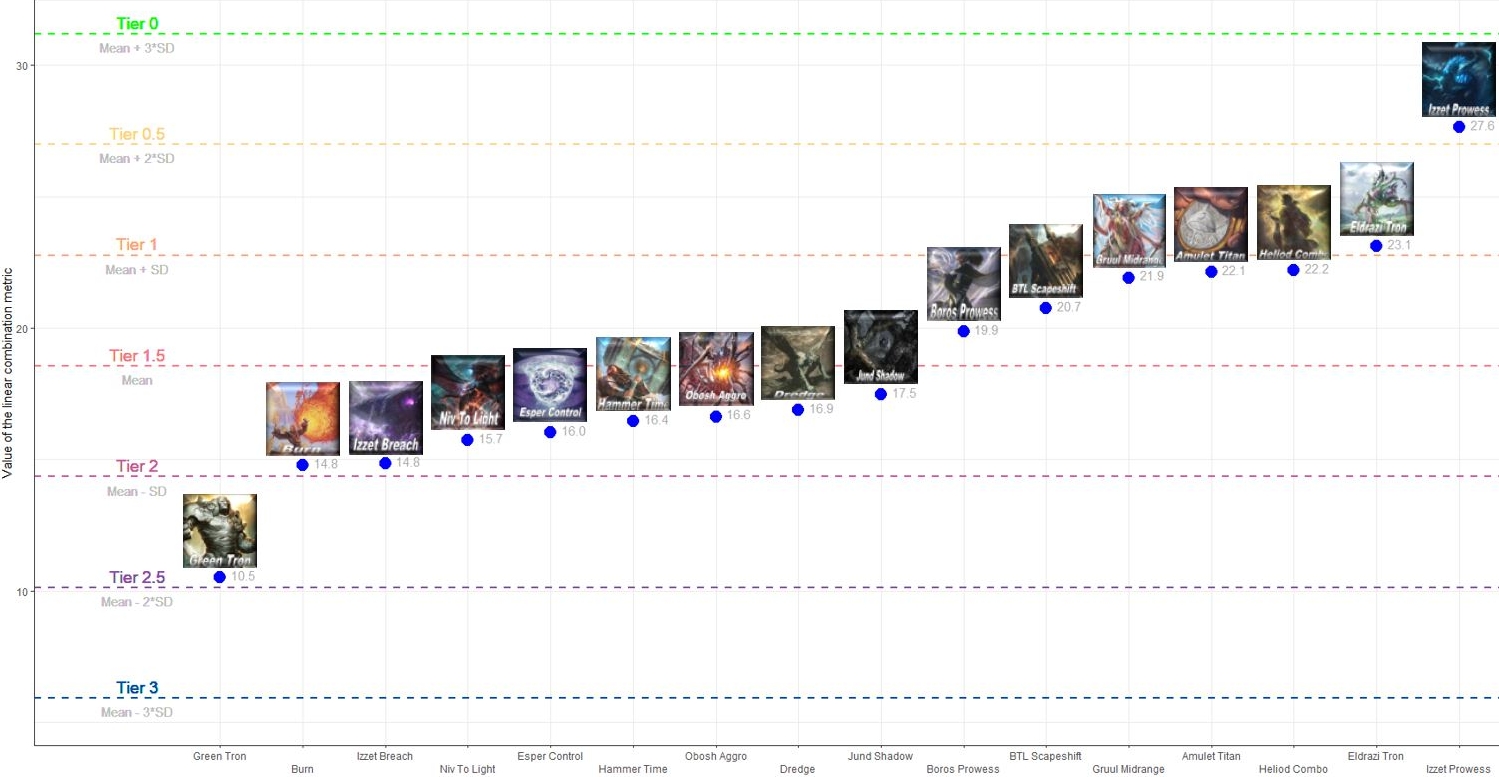
Previously, we would divide in the middle based on the average of those values, to which we add or remove a standard deviation of the value, so that we can split the decks in categories and get our tier list. This time, it is a bit more accurate, with additional divides to showcase decks that did really well or really poorly, through adding or removing even more standard deviations. Here is what the tier list looks like with those additional divides:
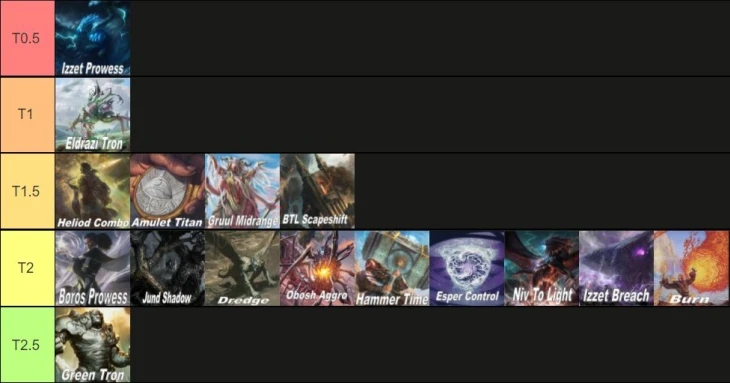
Note that with the previous system, the single change would be that Izzet Prowess would be considered tier one alongside Eldrazi Tron.
Bonus: All Strixhaven Entries, Including Preliminaries
Admit it: you mainly want to know which Strixhaven made an impact in the format, right? After checking, it turns out that the Preliminary results only bring two more cards into the picture, appearing in a single list each: a copy of
| Main Deck Additions | ||
|---|---|---|
| Card | Copies per Deck | Which Decks? |
| | 1 | 1 Mill |
| | 4 | 21 Boros Prowess 1 Jeskai Prowess |
| | 2 | 1 Smallpox |
| | 3.8 | 4 Orzhov Blink 1 Orzhov Taxes |
| | 3 | 1 Titan Shift |
| | 3.6 | 2 Grixis Shadow 40 Izzet Prowess |
| | 3.5 | 4 Amulet Titan |
| | 2.4 | 10 Boros Prowess 1 Jeskai Prowess |
| | 1 | 1 Temur Breach |
| | 2.7 | 7 Izzet Breach 4 Jeskai Control 8 Niv to Light 1 Omnath Saheeli 2 Polymorph 1 Pyro Ascension 4 Taking Turns 4 Temur Breach |
| | 2 | 1 Humans |
| | 4 | 14 Dredge |
| | 1.4 | 1 Esper Control 5 Niv to Light 2 BRGW Shadow |
| | 2 | 5 Taking Turns |
| | 3 | 1 Green Tron |
| Sideboard Additions | ||
|---|---|---|
| Card | Copies per Deck | Archetypes |
| | 1 | 1 Mill |
| | 1 | 4 Amulet Titan |
| | 1 | 4 Amulet Titan |
| | 2 | 1 Heliod Combo 1 Orzhov Taxes |
| | 1 | 1 Amulet Titan |
| | 2 | 1 Hammer Time |
| | 1 | 2 Amulet Titan |
| | 1 | 3 Amulet Titan |
| | 2 | 1 Amulet Titan |
| | 1 | 3 Amulet Titan |
| | 1.5 | 2 Izzet Prowess |
| | 2.3 | 8 Boros Prowess 3 BTL Scapeshift 2 Grinding Breach 1 Land Destruction |
| | 2.5 | 1 Esper Control 3 Inverter Combo |
| | 1.4 | 8 Jund Shadow 2 BRGW Shadow |
| | 2.1 | 2 BTL Scapeshift 1 Esper Control 1 Land Destruction 4 Orzhov Blink 1 Orzhov Midrange 2 Shadow Prowess 1 Smallpox 6 BRGW Shadow |
If you want to get the entire data for these cards and find the links to the decks in which they were played, you can check the initial files online: main deck and sideboard.
Let us talk about a few of these cards that we did not mention previously. Do you feel that you were missing on removal?
Speaking of big creatures again, but this time at a sizable mana cost,
| Taking Turns – Velomachus by Manacymbal, 19th at Super Qualifier on May 16 | ||
|---|---|---|
| Main Deck | Sideboard | |
|
|
|
Last, this review of Strixhaven cards in Modern would not be complete without the deck that incorporated the highest number of them: Learnmulet!
Four copies of
| Amulet Titan – Learnmulet by Biednarccio, 8th at Modern Challenge on May 2 | ||
|---|---|---|
| Main Deck | Sideboard | |
|
|
|
Graduating from the Strixhaven Academy
After all this, we have to conclude our excursion on Strixhaven for today. If I counted correctly, that makes 28 cards from the set that appeared in Modern results so far. The estimate of 30 at the end of my previous article was quite good! Even though, to be fair, to get an A+ I should have highlighted
Soon, we will get even more cards to enter the format: Modern Horizons 2 is poised to release online in about a month, and the month after we shall have a Dungeons & Dragons-themed set. Are you hyped for
Opinions expressed in this article are those of the author and not necessarily Cardmarket.