
It's always sad when friends move on and leave you behind. Worse when they move up and leave you "beneath." Worst of all, imagine a former love of your life living it up with a much wealthier partner. Imagine them jetsetting, hobnobbing, superyachting, slurping oysters, collecting real estate,
Many people feel a kind of love for Magic: The Gathering. But Magic has only ever been after their money. It doesn't love you back. If it can find a richer target audience elsewhere, it strays.
"You never would've come this far if it hadn't been for me! You wouldn't be where you are today without me!" you might yell at Magic in righteous fury. Then you look at all your fellow fans, who feel as betrayed as you do, and add, "Without me as part of a larger group, I mean," which no longer packs as much of a punch and really just sounds depressing.
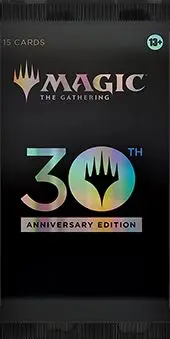
To which Magic replies: "Celebrate 30 years of Magic: The Gathering! 30th Anniversary Edition will be on sale for the holidays, available November 28 for $999."
Ten Things to Hate About #MTG30thEdition

1. The Price
Wizards have been telling us for a couple of years now that not every Magic product is for every Magic player anymore. A lot of players admittedly didn't get the message. Then again, Wizards have been sending mixed signals. Less charitably put, they haven't put their money where their mouth is as much as they've put your money where their mouth is. They forced Legacy players to buy Commander product and to worry about Secret Lairs. They're currently introducing stickers, sectors, and an Attraction extra deck into the format. They forced Standard players to keep up with always more rares and mythics. High-priced premium sets effectively turned Modern from a nonrotating into a rotating format. They forced Alchemy upon anyone interested in top-level Magic.
At least this message is clear: You can buy a box of 30th Anniversary Edition if you have $999 to spare. It really says: You probably cannot. Not realistically anyway. Because you probably have conflicting commitments, like food, shelter, and electricity bills. The message is: This product is not for you.
2. The Price per Pack
So what do you get when you spend $999? For this kind of money you'd expect to get a full playset of everything, basically a big Secret Lair. But no. Nine hundred and ninety-nine dollars merely get you a booster box. How many boosters are in this box? 36 like in a draft booster box? 30 like in a set booster box? Maybe twelve like in a collector booster box? Nope. The number is four.
Yes, you get four booster packs, each containing fifteen cards and a token. Each pack costs $249.75, presumably plus taxes, shipping, and import fees on top.
3. The Commander Conundrum
None of these cards are legal for tournament play. They look normal up front but don't have the regular Magic back side. That's never stopped
So can you use these cards, for example, for Commander play? The Wizards-endorsed ban list states: "The Commander cardpool consists of all regulation-sized Magic cards publicly released by Wizards of the Coast other than those with silver borders, gold borders or acorn-shaped security stamps."
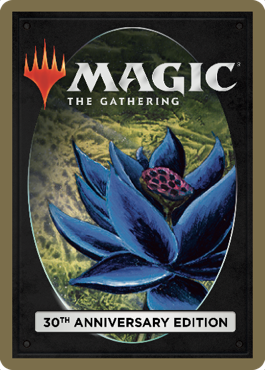
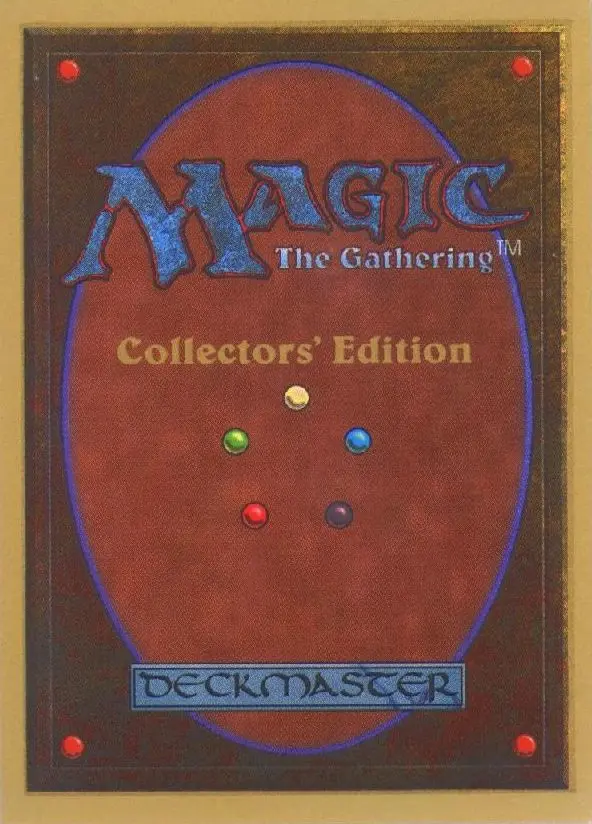
Apparently this bans 30th Anniversary Edition cards on the grounds of their gold-bordered back side. 1993's Collectors' Edition serves as precedent for this reading of the rules. However, the Rules Committee just reminded us that they don't care what Commander players do behind closed doors.
So it's best to take this document under advisement, and disregard as necessary. After all, it goes on to say that "Cards are legal to play with as of their sets' prerelease." Bad news for the Warhammer 40,000 Commander Decks, I suppose. No prerelease events preceded their release, so now those cards aren't technically legal in Commander either. Sorry!
4. The List Loophole
30th Anniversary Edition is, back sides aside, a reprint of Limited Edition Beta. So let's look up Wizards' infamous Official Reprint Policy, also known as "the Reserved List" in common parlance. There we find: "All policies described in this document apply only to tournament-legal Magic cards."
That was the last and final word the company ever gave on the issue. But people at the company still discussed the topic. Fortunately for us, just last year Mark Rosewater addressed the possibility of reserved cards reprinted in gold border. Unfortunately he dismissed the idea: "There were a bunch of loopholes in the original version of the Reserved List that we later closed. It covers all normal-sized versions of the card."
Plainly evident, the public document left and still leaves a loophole for gold-bordered reprints. Whatever Rosewater referenced that closed this loophole must have been a different document.
Even without this reference, it was clear in all communication in ages that this was indeed a loophole. To go back there was supposed to be some kind of violation, if not in court, then leastways in spirit. No one had reason to suspect Wizards would abuse that hole so suddenly and so vigorously. It's not necessarily a bad thing by itself, but, seriously man, it takes time to learn how to enjoy the ride!
5. The Problematic Proximity
There are players out there who promote the use of "alternative" cards not sanctioned by Wizards. Their number is growing, and that is partly Wizards' fault. They've made it so it's impossible for many to keep up financially with Magic's grueling release schedule. They simultaneously cultivate a "fear of missing out" that's supposed to drive sales but risks to drive customers elsewhere. All the while they give players less and less incentive to care about the tournament legality of their cards.
What form suggested alternatives take varies wildly. At one end of the spectrum, copyrightwrongers create counterfeit cards and attempt to sell them. Whether they pass them off as genuine or not, this is legally problematic. Lawyers of the Coast may try their best to put such businesses out of business and into debt. Cardmarket wants no counterfeit traffic either and has ways to deal with the rare fake. On the other end of the rainbow, more moderate minds merely suggest you grab a marker and turn your
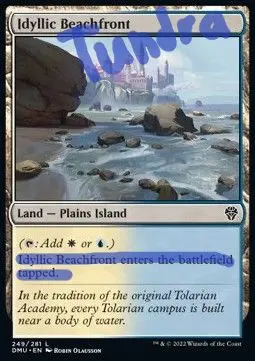
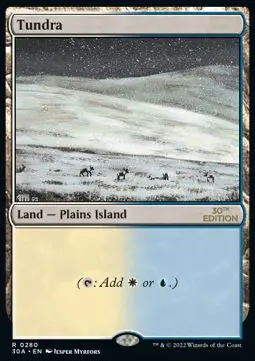
Please, do think about the difference between these two cards for real. When it comes to utility as a game piece, theirs is almost the same. Neither the Beachfront nor the 30th Anniversary Edition Tundra works as a Tundra in tournaments. Neither works as a Tundra in Commander if you play by strict rules, but either works if you don't. Still their gameplay utility is not the same. Do you know why?
Because you can damn well have the first card in your Commander deck whether you stick to the official rules or not. You can even have it in your deck at an honest, sanctioned Legacy tournament! You just have to note it down as an Idyllic Beachfront on your decklist, play it tapped, and ignore the marker. Meanwhile, you need to remove the second card wherever a golden border isn't allowed. If the hawks at your EDH table make you take it out, you may not even have a complete deck anymore. Though, in that case you should plead with them to make an exception and allow you to play the Tundra, if not as a stand-in for a proper Tundra, then maybe as replacement for Idyllic Beachfront.
So much for format legality. Real-world legality isn't an issue either. You are free to use a card you own to write down whatever, for instance your shopping list. You can even buy
The second big difference, and the main reason why someone might choose the more expensive option anyway, is up next. But first, look back on the previous five paragraphs, or the previous twenty, and consider how much 30th Anniversary Edition has already done to promote the acceptance of unsanctioned cards. Wizards even sell their own again. Only these now offer less utility as play material than some others and cost far more than any other in the history of honesty. This could well backfire for Magic, Wizards, Hasbro, and also Cardmarket. Which is a tad unfair, because what did we do?
Cardmarket is happy if you purchase a pricy gold-border-backed Tundra. (Available here, by the way, at just €229.99 while supply lasts!) But Cardmarket is happier when you buy a bunch of cheap cards. We know that you keep coming back, long term, because we offer the best prices to help keep your hobby affordable. While we rarely manage to write compelling articles about
6. The Resale Realization
The advantage of owning a 30th Anniversary Edition
Yes, a thing can be valuable merely because few of its kind are available. A thing can also be valuable because it is expensive. It will be valuable too, as long as people still want to have it hard enough. It's the inverse of primary school economics. Instead of a company creating value by selling more goods, it's a company creating value by selling fewer goods. If that sounds absurd to you, welcome to Magic! You must be new here. Maybe you should check out this article.
A company holding the power to withhold can conjure value, of the magical, fun, bubbly kind, out of thin air. The value for the private collector only remains real till the spell wears off, the market crashes. But at that point the company has long taken the money and run. If that sounds familiar to you, you may have encountered NFTs before. To read more on the eerie similarities between Magic and NFTs, check out this article.
7. The Speculation Trepidation
What do bubbles do? They float. Often they rise, especially when filled with nothing more than hot air. Eventually they all burst. They are kind of famous for it.
30th Anniversary Edition is poised to create a speculation bubble unprecedented in Magic history. There's no telling when it'll burst or what will happen when it does.
To be fair, none of us may live to see the day. Investing in rare Magic cards has been a winning strategy overall year over year possibly since the Renaissance. When Fallen Empires fell, it almost killed the entire game, but that was in part because it left so many of the then crucial retailers floundering. We live in different times now, of direct-to-customer sales via 30thEdition.wizards.com.
There also is no reason why a crash of 30th Anniversary Edition's secondary market should affect any other area of Magic. Alas, these things don't always play out rationally. There's danger of a pileup, where one crash causes the next and all together erode collector confidence to the point where no one wants to spend serious money on Magic ever again.
8. The Annuity Annulment
Did you know how Wizards paid Magic's original artists before the game's release, when the company was a still struggling startup? In an interview last year Melissa A. Benson lamented that she chose to contribute just seven pieces to the initial set. "Wizards was only paying $50, and $50 worth of stock, per illustration. I had to look for jobs that paid better. Sigh …"
Needless to say what was a $50 share of the company then soon became worth far more than $50. There's another story that you hear suspiciously less often. You can barely hear it when you watch this interview from a noisy event. But in it Mark Poole also mentions royalties, meaning a cut of a set's proceeds going to the set's illustrators. "And on the royalty checks you were just, like, going, wooow! You know. The percentage was really small, but of course, when you print millions and millions and millions, it adds up."
So Wizards clearly had usage rights, but up to The Dark all cards credited the artist with the copyright for the illustration. According to Poole, "When they hired a board and got bigger shareholders in, the first thing they took out was the royalties. But it was fun while it lasted."
One should assume they came to an agreement with all of the artists over royalties and rights regarding all of the art they re-used later. But maybe not with all of the artists and not for all of the art in 30th Anniversary Edition. One piece in question is Quinton Hoover's
Another of Magic's early artists, Pete Venters, chimed in with helpful advice: "there was a waiver of copyright that was offered to the artists. Some took it, some didn't. It did relinquish copyright to WotC but didn't give away the artist's rights to royalties. It's that document you need to nail down."
The Hoover estate hoovering up some of the profits from Magic's most profitable booster release reads almost like poetry.
9. The Outrage Outro
There is so much more to dislike about 30th Anniversary Edition than could ever fit in ten bullet points. For example, why do even the basic lands have to have the back that makes them ineligible for sanctioned tournaments/Commander? Why are there three of them per pack then?
The old-frame cards are the rarest things in the set. They're bound to be the most valuable. But of all the rares they are the ones without a holofoil security stamp. Even the famous "green dot test" doesn't work because of the different back.
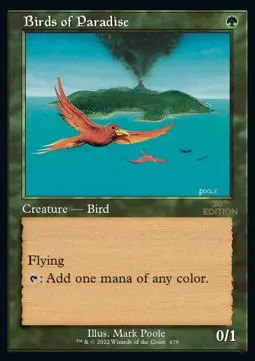
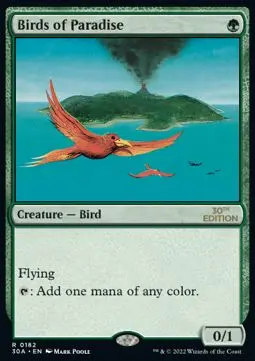
I know (from the Mark Poole interview) why the old art cannot properly fit the modern card frame (namely because it was painted to the exact dimensions of the old frame). But wasn't there some way of "featuring the original art that inspired a generation of Magic fans" other than cutting off artists' signatures?
A full set of Beta cards with gold-bordered backs, called Collectors' Edition, retailed for $49.95 in 1993. When they decided to adjust for inflation by adding 50,000%, did they look at that number and go, yup, this feels right? And when you, dear reader, saw that number, did you think I was making a joke? Did anyone at least register with the IWC?
10. But Worst of All …
What I hate most is that, in spite of all of the above, I actually hope this product will prove a success. Part of that is pure pragmatism. Once the cat is out of Pandora's can of worms, you simply have to hope it won't catch fire and burn down the house.
But it's not just that. This could be a good thing for Magic, at least on its current trajectory. No kidding here, it could be good for many of the same factors outlined above.
The $999 price tag makes it abundantly clear this is not aimed at the 99.9%. It's not barely out of reach for a normal player. It's so comically far out of reach that it will not, cannot tempt any player to buy in. For once the tag line of "This product is not for you" makes sense too. They should adopt it as an actual slogan for future entries in this line.
That is both because and why the cards have negligible play value. Past premium products like Secret Lairs maybe didn't offer additional play value. You can just as well use a
But this is the first large-scale experiment conducted to investigate questions central to Magic's future: Is it possible to uncouple collectible value from play value? How far can you take that? Does there always have to remain some connection?
These questions already arise with or without Wizards' participation. When was the last time a
The community needs to know how sustainable this development is. Money may be the main motivator for Wizards to enter this market. But it is great they run this experiment regardless. Important too, the experiment literally requires a price point inappropriate to the product's play value.
Likewise reasonable is it for them to run the experiment on their own (dime) with minimal involvement of local game stores. Some resent the lack of opportunity. But should the product fail and sit unsold on shelves, those shelves are better located in a Wizards warehouse than behind the counter of a store that still has to pay the bill for all the 30th Anniversary Edition it preordered.
If the uncoupling of collectible from play value succeeds, on the other hand, this could benefit all: those interested in playing the game as well as those interested in collecting/investing/speculating. Wizards too, who may not feel as much pressure then to put out as many products that attempt to appeal to both sides. They could run one line that's lucrative by aiming wide and another that's lucrative by aiming high, and serve both audiences better.
People in either lane may need to take little note of what's going on in the other. In fact, that may already be true for 30th Anniversary Edition. The average player may rarely even get to see one of these cards. Maybe literally never. After all, collectibles, in general and in Magic in particular, have long proven to be most valuable when they remain in their original packaging.
Gut Versus Good
A player's natural gut reaction when seeing the announcement of 30th Anniversary Edition is disgust. One might think this looks like "an even bigger cash grab from Hasbro," like "they are milking the cow for all it's worth planning to sell the dried-out husk for someone else to try to resuscitate." If you think I started making up stuff now, check out the top replies on this Hasbro tweet from earlier this week announcing plans to grow profits by 50% over three years. Okay, this time I am actually joking, kind of, because you can't, not anymore, because Hasbro deleted that tweet.
My first reaction sounded similar. But on second thoughts I must admit my gut may have been wrong. Rather than skinning the proverbial sheep you can shear every year, this may be reskinning the sheep, albeit in wolf's clothing. Meaning, it looks bad, and really, it does. But this one is not as bad as it looks. Far from it, it may prove to be the most strategically sound, internally consistent, future-oriented step Magic has taken in a while.
Admitting a mistake?
Thanks, I hate it.
Opinions expressed in this article are those of the author. Cardmarket doesn't know yet how to feel about any of this.