
When Wizards announced an expansion about a school of magic, many people got excited. As a blue mage at heart, I could barely wait for the preview season to start. Now that we know which mechanics the set will include I am even more pumped than I was—they all relate so well to the theme. Let me list all of the abilities and talk through what they mean in practice and what kind of gameplay they might promote.
Learn
The first mechanic I want to cover is learn. The name seems very apt for a fantasy college setting. What this keyword stands for is: "You may reveal a Lesson card you own from outside the game and put it into your hand, or discard a card to draw a card." In practice you've got three choices: do nothing, place a Lesson card into your hand, or "rummage" (meaning to discard and draw, a reference to
-
What does "outside of the game" mean as far as tournament rules are concerned? As in most cases with such wording, it refers to your sideboard. If you want to take advantage of your learn cards, you need to construct your sideboard accordingly.
-
What is a Lesson? It's a subtype of instants and sorceries. So far, it seems like a good chunk of them might be colorless so that any deck can use them. See for example
or .


I truly like the second part of the effect as it means that learn still does something even if you don't have any Lessons (left). The problem is that going up a card (Lesson) is much better in absolute terms than rummaging for card parity. Then again, many of the Lessons aren't actually worth a full card. For instance
However, in most tournament play, which is best of three, I am skeptical of the mechanic's utility. Devoting a sideboard slot is a cost, let alone two or three, which you'd need if you want to learn several times or if you want to have a variety of Lessons to choose from. Both the Lesson subtype as well as the learn ability would have to appear on some decently powerful cards to warrant inclusion in best-of-three decks. Among the first batch of previews,


Magecraft
The second ability we'll take a look at is magecraft. It states that whenever you cast or copy an instant or sorcery spell, you get some effect. While the condition is the same across all the cards, the benefit varies.


Talking nonrotating formats, each of them has some kind of Storm deck. So an ability that cares about casting spells or copying them could easily turn out busted if the design team went a bit over the top. We have not seen a card that's likely to break a format yet, but such a mechanic begs to do so. In fact, the very first magecraft card previewed,


Sure enough,
| Chain-Smogging Apprentice by Tobi Henke | ||
|---|---|---|
|
|
|
Ward
Ward is a triggered ability that says: whenever this permanent becomes the target of a spell or ability an opponent controls, counter that spell or ability unless that opponent pays some cost. That cost can be mana, life, or whatever else is written on the card following the word ward.
Wizards have confirmed that ward is a new evergreen keyword, which I am super happy about. Throughout the past we've seen abilities like protection (super rules convoluted), hexproof (lacking any counterplay but still allowing the controller to play Auras, Equipment, or pump spells on their own creature), and shroud (which allowed nobody to interact for better or worse). Between all of them ward looks the cleanest and most fun. It addresses the issue that people won't play creatures without an immediate impact if removal is too strong. In that case, you are forced to play creatures with enter-the-battlefield effects. Ward is a way to fix this weird dynamic. What it does great is that it does not invalidate interaction and counterplay—it just puts a bit of a restriction on it. On top of that, it's warded (see what I did there?) in a neat and easy to understand way.
However, there is a slight critique that people have been voicing as far as ward is concerned. It is a trigger and not a static cost modifier. In practice, it means you can use your removal anyway and the controller has to tell you to meet the ward condition, as opposed to effects such as protection where you wouldn't be able to target in the first place. This could potentially create some feel bad moments, especially among newer players. Making it a static modifier akin to what you see on some older cards—compare the new


Modal Double-Faced Cards
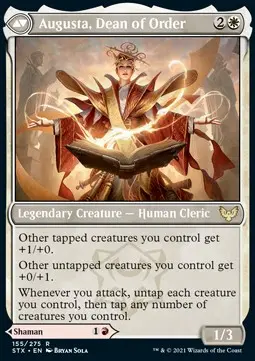
They're back! And that's great. I think that MDFC are a great addition to the game. I particularly enjoyed the cycle with a land on the back side as, like most Magic players, I hate being screwed or flooded on mana. As we're told, each Strixhaven college will have its own modal double-faced card featuring its two deans such as

That's all from me today. Strixhaven looks super exciting lore-wise but even more so mechanics-wise. I can't wait to explore it further as more previews flow in. Thanks for reading, and as always, remember to hold my hand and pass the turn together. Cheers!
Opinions expressed in this article are those of the author and not necessarily Cardmarket.