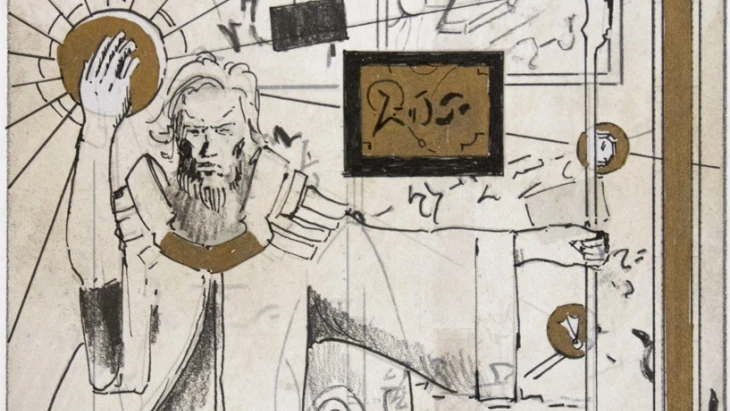
Because it explores unique design space, many people initially struggled to evaluate Urza's Saga correctly, possibly including the designers themselves. However, now the picture is getting clearer. The card already proved powerful to a worrisome degree and finds its way into more and more decks.
Modern Horizons 2 caught us off guard with many designs outside of established boxes. Clearly, the team responsible for the set had a ton of liberty in what they were doing and how. We revisited a ton of mechanics and got introduced to some new peculiarities. Among others, never before have we seen a land that's a Saga. And such a powerful one at that. In today's article, I want to break down and explore the shells it's played in.
What We Thought It Did
When first previewed, we didn't really know what to make of this card. What we did know is how previous Sagas worked, meaning: they all gave us one effect per chapter, once. Applying this preconception to Urza's Saga—thinking we'd get one mana, one Construct, one tutor—turned out to be a big mistake. The community also focused heavily on the last ability. Twitter hive minds mobilized and tried to come up with the most comprehensive list of all tutor targets to see where the card might see play.
First of all, we found out that we cannot search for cards without a cost. Saga explicitly states that the card's cost has to be either 0 or 1. This rules out , , or , and also , much to the dismay of combo players. To add insult to injury, you can't fetch out cards with X in the cost either. So long or . Finally, colored costs are out of the question as well—if you were brave enough to play , you can't get it for free via Saga either.
At that point, we were confused enough to wait and see what would happen. And see we did.
What It Actually Does
There is so much going on, but I will try to be brief.
It's an enchantment. This matters mainly if you play against Saga, because you can interact with it as you would with an enchantment. A spell like can be particularly devastating. A one-mana ! If you can do it in response to the first chapter ability, you don't even allow the opponent to get mana from their land drop. can bounce it in a pinch too.
It's a land. You can recur it with or . Playing it does cost us our land drop for the turn though, which we need to account for in sequencing, especially considering the Saga's eventual sacrifice.
It's complicated. Due to the very simple and always easy to understand Magic rules, playing a card like , , or on (a board with) will kill it on the spot. (You have to sacrifice a Saga when it has a number of lore counters equal to or higher than its number of chapter abilities; the aforementioned cards remove its printed abilities but neither its enchantment subtype nor counters.) It's a strong way to keep the card in check. Make sure you don't get caught off guard!
It tutors—the thing we focused on most during preview season. There are so many possible tutor targets that I cannot possibly list them all. However, the most notable include , , , , , , , , , and . In addition, fetching out allows you to create a nice value chain by finding more Sagas. As you can see, you can search for interaction, hate pieces, card advantage, and various other tools.
It creates tokens. Now this is what we all missed—the strength of this ability. If you play the Saga as your third land, you have the option to create a token twice (after the resolution of its second chapter ability and again before the resolution of its third). Surely, you wouldn't want to spend your entire turn three and turn four to put some vanilla tokens onto the battlefield, would you? Apparently, you would. Arguably, that's the reason the card sees so much play right now. It's a land that generates threats and then finds another artifact, which further buffs those threats. A one-card Swiss army knife. In heavy-artifact decks such a token can get as big as 7/7 by turn three. It makes your mulliganing better as well, since you've got threats in land slots and therefore the whole deck's failure rate drops.
It combos. Whether it's through land recursion as mentioned above or bouncing it, there are several ways to reap the benefits of all three chapters multiple times over. (Note that you have to bounce it at instant speed in response to the third chapter ability if you want the tutor effect and get it back into hand. Ordinarily, wouldn't be able to do that—that's one reason why is becoming more popular among Amulet Titan players right now.) Another cool trick is to copy the Saga with , let it gain the Construct creation ability, and then copy a different land. The Stage is no longer a Saga, so you won't ever have to sacrifice it, but it retains the ability to create Constructs forever.
Speaking of combos, my colleague Marin already covered the one with in his article on last week. You should also check out his article from this week on for another archetype that features great synergy with Urza's Saga. But of course, there's more …
Where? Everywhere!
Besides Food and Scales, what other decks can utilize the card? How big of a deck building cost is it to run this card? After all, it self-destroys so you are left with one fewer land on the battlefield. The short answer is: a lot of decks.
Affinity. Yes, actual factual Affinity with actual factual affinity cards. While Modern Horizons 2 has given the archetype some new cards such as and , the two big ones are Urza's Saga and . The latter is a on a stick or, if you're greedy enough, Thoughtcast number five to eight. It's a prerequisite to have a refill mechanic in a deck that dumps its entire hand within the first few turns, and this one carries Equipment like there's no tomorrow. The same applies to the Saga: because the deck has a lot of air and individually weak cards, having a ton of power within one card is very strong. While the tutor effect isn't at its best here, Saga does create absolutely huge Constructs.
Affinity
Main Deck
Sideboard
4
2
1
4
4
4
4
4
2
4
3
2
4
4
3
4
4
4
2
3
3
2
2
1
2
Amulet Titan. This has been one of the most powerful decks in the format for a long time, though it has its ups and downs. Its most explosive draws involve , but it can easily play a long game too. Urza's Saga is another tool to grind out the long game, especially combined with the abundance of bounce lands. However, this is also one of the few decks where it can be worth it to play the Saga on turn one, to ensure the Amulet's presence on turn three. (Especially nifty when followed up with on turn two to bounce the Saga in response to chapter III.) The following list also runs one copy of to add some diversity in tutor targets—and it should perhaps find room for one too.
Amulet Titan
Main Deck
Sideboard
1
1
1
3
1
1
3
1
1
1
1
3
4
1
1
2
2
1
1
4
2
4
4
4
3
4
4
1
2
2
1
1
1
1
1
2
2
2
Hammertime. Here's another strategy looking for one key one-mana artifact, and it's another example of a deck that can reasonably drop the Saga on turn one.
Hammertime
Main Deck
Sideboard
4
10
4
4
4
1
4
1
4
4
4
4
4
4
4
2
1
2
1
3
2
3
1
Lantern Control. The deck had been dead ever since the ban, but the Saga might revive it yet. The game plan heavily revolves around its engine contained in one-mana artifacts. Understandably, Saga is going to be great here. It literally searches out seventeen cards from the deck including the always needed and later so-called mill rocks or , with the rest some versatile interaction pieces.
Lantern Control
Main Deck
Sideboard
1
4
2
2
1
4
2
1
4
2
4
2
3
2
2
1
4
1
4
1
4
2
1
2
1
2
1
1
1
3
1
4
1
1
1
1
1
Dice Factory. One of the nicest aspects of the Saga is how it breathes new life into some of Modern's quirkier archetypes. This one relies on the interaction between / and / for at times extreme mana acceleration. Once again, the Saga creates huge Constructs here and tutors for a key artifact, either relevant to the deck's own strategy or to combat whatever the opponent is doing. Interested in charge counters, this may actually be another candidate for to keep the Saga around indefinitely, creating tokens and tutoring again and again.
Dice Factory
Main Deck
Sideboard
1
3
11
4
4
4
4
4
4
1
2
4
4
4
1
4
1
1
1
1
1
1
3
3
1
1
1
1
White-Blue Control. I wouldn't be IslandsInFront if I didn't mention White-Blue Control. Yes, White-Blue Control in a Saga article. People's ingenuity never ceases to amaze me and this case is no different. The following is a clean regular build with all the usual suspects, only with four Saga, two , and four on top. I truly don't know what to think. Early, the Saga is quite bad because you stunt your own mana development. In addition, the tokens are very small here as you only have six artifacts, and all of them are meant to be sacrificed. Its value certainly shows postboard when you can tutor out a hate piece every single game for free. I am very much curious whether this deck did well thanks to or despite the Saga. (It went 5-0 in a League, and an earlier version also was the most successful White-Blue Control specimen in the second post-MH2 Challenge, losing to the eventual champion in the quarterfinals.) Anyhow, it's an interesting approach. Violating some established heuristics might actually be the way to get ahead in Modern.
White-Blue Control
Main Deck
Sideboard
4
2
3
4
1
1
4
1
1
4
2
2
3
3
2
4
2
3
4
4
2
4
1
2
3
1
1
1
2
2
1
1
Clearly, is super versatile and slots into many, completely different archetypes. On the one hand, it seems to increase diversity. On the other, things won't end well if it turns out you have to play the card simply not to be behind from the very start against other Saga decks. I hope it ends up proving powerful but not bannable once the hype clears. As always, hold my hand and let's pass the turn together. Cheers!
Opinions expressed in this article are those of the author and not necessarily Cardmarket.